


📌 NOTE FOR NEW READERS: The 50501 Movement organizes peaceful action across all 50 states to defend democracy. This publication is nearly 100k readers strong and growing. If this resonates with you, hit subscribe.
SUMMARY
The Supreme Court ruled 6-3 that IEEPA tariffs are unlawful. Within hours, the administration imposed a new 15% global tariff under a different, never-before-used statute that expires in 150 days. Up to $175 billion in refunds are now in play. Section 301 and 232 investigations are being lined up to rebuild the tariff wall.
On Friday, February 20, the Supreme Court enforced a constitutional boundary.
In a 6-3 decision, the Court held that the International Emergency Economic Powers Act does not give the President the authority to impose tariffs.
Chief Justice Roberts wrote the lead opinion. Gorsuch and Barrett joined it in full. Sotomayor, Kagan, and Jackson joined the Court’s core statutory holding, and Kagan wrote separately to explain that ordinary statutory interpretation was enough to resolve the case without reaching the broader constitutional questions. Roberts wrote that two words buried in a 1977 emergency law “regulate” and “importation” can’t be stretched to hand one person the unilateral power to tax every import entering the country.
The Constitution assigns that power to Congress. It always has.
And IEEPA, Roberts wrote, contains no mention of tariffs or duties at all.
Within hours, the President issued a proclamation under Section 122 of the Trade Act of 1974 imposing a temporary import surcharge of 10% on virtually all imports, effective February 24.
By Saturday, he announced the rate would be lifted to 15%, the statutory maximum.
He called the justices who ruled against him “fools and lapdogs” and said foreign interests had undue influence over the Court. He praised the three dissenters by name.
And then Treasury Secretary Scott Bessent went on television and said the goal is to get back to the same tariff posture through different legal channels, and tariff revenue in 2026 would be “virtually unchanged.”
The IEEPA tariffs began in February and March 2025, targeting China, Canada, and Mexico under a drug-trafficking emergency, then expanded in April 2025 into a “reciprocal” regime affecting most trading partners.
Two lower courts struck them down last May.
The Supreme Court took the case on an expedited timeline, heard oral arguments in November, and ruled Friday.
Roberts grounded part of the opinion in what legal scholars call the “major questions doctrine” the principle that if Congress wants to hand the executive branch a power of vast economic and political significance, it has to say so clearly.
It can’t be implied through vague statutory language.
Kagan, joined by Sotomayor and Jackson, agreed on the outcome but said ordinary statutory interpretation alone resolves the case, you don’t need the major questions doctrine to see that “regulate importation” doesn’t mean “impose tariffs.”
This is the same doctrine the majority section invoked when striking down Biden’s student loan forgiveness program in 2023.
Roberts even quoted the administration’s own brief, which argued that whether America is a “rich nation” or a “poor” one hung in the balance.
Those stakes, Roberts wrote, dwarf previous cases, which is exactly why Congress needed to speak clearly, and it didn’t.
The opinion also pushed back on the administration’s argument that emergency powers and foreign affairs should exempt IEEPA from this kind of scrutiny.
In fact, Roberts wrote, courts should be more skeptical when alleged emergencies are used to claim powers that belong to Congress.
That’s constitutionally significant.
It reasserts a principle that has been under pressure for years: the executive branch cannot accumulate legislative powers by creatively reading emergency statutes.
The Section 122 Pivot
Section 122 of the Trade Act of 1974 has never been used.
It was designed for a different era for fixed exchange rates, gold-standard hangovers, genuine balance-of-payments crises where the U.S. dollar was at risk of rapid depreciation.
The White House justifies its invocation by declaring “fundamental international payments problems” and a “large and serious” balance-of-payments deficit.
But critics including economists at the Cato Institute, BCA Research, and the National Taxpayers Union argue Section 122 was written for a fixed exchange rate system the U.S. abandoned decades ago, and that a trade deficit is not the same thing as the kind of payments crisis the statute contemplates.
Section 122’s legal foundation may prove as shaky as IEEPA’s was.
But it doesn’t require an investigation.
It doesn’t require congressional approval for 150 days.
And it lets the President act immediately while longer-term tariff tools, Section 301 investigations, into unfair trade practices, additional Section 232 national security tariffs work their way through the pipeline.
Bessent himself said on Sunday that the Section 122 tariffs could disappear after five months as the 232 and 301 tariffs ramp up to replace them.
What about refunds?
A lot of what’s circulating online right now is misleading.
Penn Wharton projects up to $175 billion in potential refunds if the IEEPA tariffs fully unwind.
The Tax Foundation estimates the tariffs raised more than $160 billion through the ruling date.
CBP reporting has put collected IEEPA duties around $133.5 billion as of late 2025.
Different figures reflect different definitions and time windows but any way you count, the stakes are enormous.
And tariffs are paid by importers of record… businesses, not households directly.
Any refund process will run through U.S. Customs and Border Protection, the Court of International Trade, and likely years of administrative proceedings.
Nearly 2,000 importers had already filed cases before the ruling came down.
The Court’s decision didn’t order refunds.
It struck down the tariffs and remanded the case.
The process of who gets money back, how much, and when are going to be fought over in lower courts for a long time.
Small businesses that paid these tariffs and passed the costs along to customers are already calling for a fast, automatic refund process, as they should, but “refund checks to every American” is not what’s being considered.
The global picture
The rest of the world is watching the United States switch legal scaffolding.
European officials are reconsidering the timing of a U.S. trade deal vote scheduled for this week.
The EU’s trade committee is facing pressure to delay because legal ground shifted overnight.
European Central Bank president Lagarde warned the latest tariff moves create uncertainty for the EU economy and put negotiated terms at risk.
France’s trade minister called for a “united approach” to the new levies.
Countries that negotiated bilateral deals under the old IEEPA framework are being told by Trade Representative Greer that their agreements still hold, even where the negotiated rates exceed the new 15% baseline.
That’s an extraordinary position that the legal authority under which those deals were struck has been ruled unlawful, but the deals themselves are apparently binding.
China’s commerce ministry is conducting what it calls a “full assessment” of the ruling, while calling on the U.S. to remove unilateral tariffs.
The trade truce negotiated after the Xi-Trump summit remains in place, but the overall rate structure has shifted significantly, and Beijing is watching to see which tariff tools come next.
The through-line across all of these responses is uncertainty.
Markets price in predictability and what Friday demonstrated is that the U.S. government’s trade policy can be constitutionally struck down and functionally reconstituted before the stock market opens on Monday.
What does this mean for our households?
The Yale Budget Lab estimates that with the new 15% Section 122 tariffs in place, the effective U.S. tariff rate sits at roughly 13.7% the highest since 1941.
If those tariffs expire in 150 days as the statute requires, the rate drops back to about 9.1%, which is still the highest since 1947.
Either way, the remaining Section 232 tariffs on steel, aluminum, autos, and other goods aren’t going anywhere.
In practical terms, the Budget Lab estimates the current tariff regime costs the average American household between $600 and $800 while the Section 122 tariffs are in effect.
If they’re extended or replaced, that figure rises to between $1,000 and $1,300.
The unemployment rate is projected to be about 0.3 percentage points higher by the end of 2026 due to remaining tariffs alone.
The Supreme Court said the President can’t use an emergency sanctions law to impose sweeping tariffs without clear congressional authorization.
That is a meaningful check and it invoked separation of powers, the major questions doctrine, and the Constitution’s assignment of taxing authority to Congress.
Six justices agreed, including three appointed by Republican presidents.
The administration’s response was to attack the justices who stood up for the constitution… Then it raised the rate to the maximum the new statute allows… Then it announced a pipeline of additional investigations designed to rebuild the same tariff wall using different legal bricks.
What You Can Do This Week To Fight Back
1. Call your members of Congress. (Yes, keep calling!) Both the House and the Senate have a role here. Section 122 expires in 150 days unless Congress extends it. Section 301 and 232 investigations have procedural requirements that Congress can oversee. Your representatives need to hear, this week, that constituents are watching the tariff situation and expect congressional authority over taxation to be defended, not surrendered.
The Capitol switchboard number is (202) 224-3121.
2. Know your numbers. When someone in your life says “tariffs are good for America,” you have data. The effective tariff rate is the highest since 1941. The average household cost is $600–$800 right now, potentially rising to $1,300. The overall U.S. trade deficit still totaled $901 billion in 2025 despite a year of aggressive tariffs. These are from the Yale Budget Lab, the Tax Foundation, and the Penn Wharton Budget Model. Factual, credible, sources.
3. Support the businesses fighting back. Small businesses brought these cases to the Supreme Court. Wine importers, toy companies, educational supply companies, they put their names on lawsuits against the federal government and won. Organizations like “We Pay the Tariffs” are pushing for fast, automatic refund processes. Follow them and help amplify them. They did what a lot of larger corporations wouldn’t.
4. Watch the calendar. Mark July 24, 2026. That’s when the Section 122 tariffs are set to expire. Between now and then, watch for Section 301 investigation announcements, new Section 232 actions, and any attempt to re-invoke Section 122 after expiration to create a rolling permanent tariff.
5. Share this analysis. The more people we can inform and help understand what’s going on, the better chance we have at fighting back.
SAVE THE DATE: MARCH 28 2026
If you missed the announcement: ANNOUNCEMENT: The Next NO KINGS Mobilization. If you’re organizing locally: How to Organize a Protest.
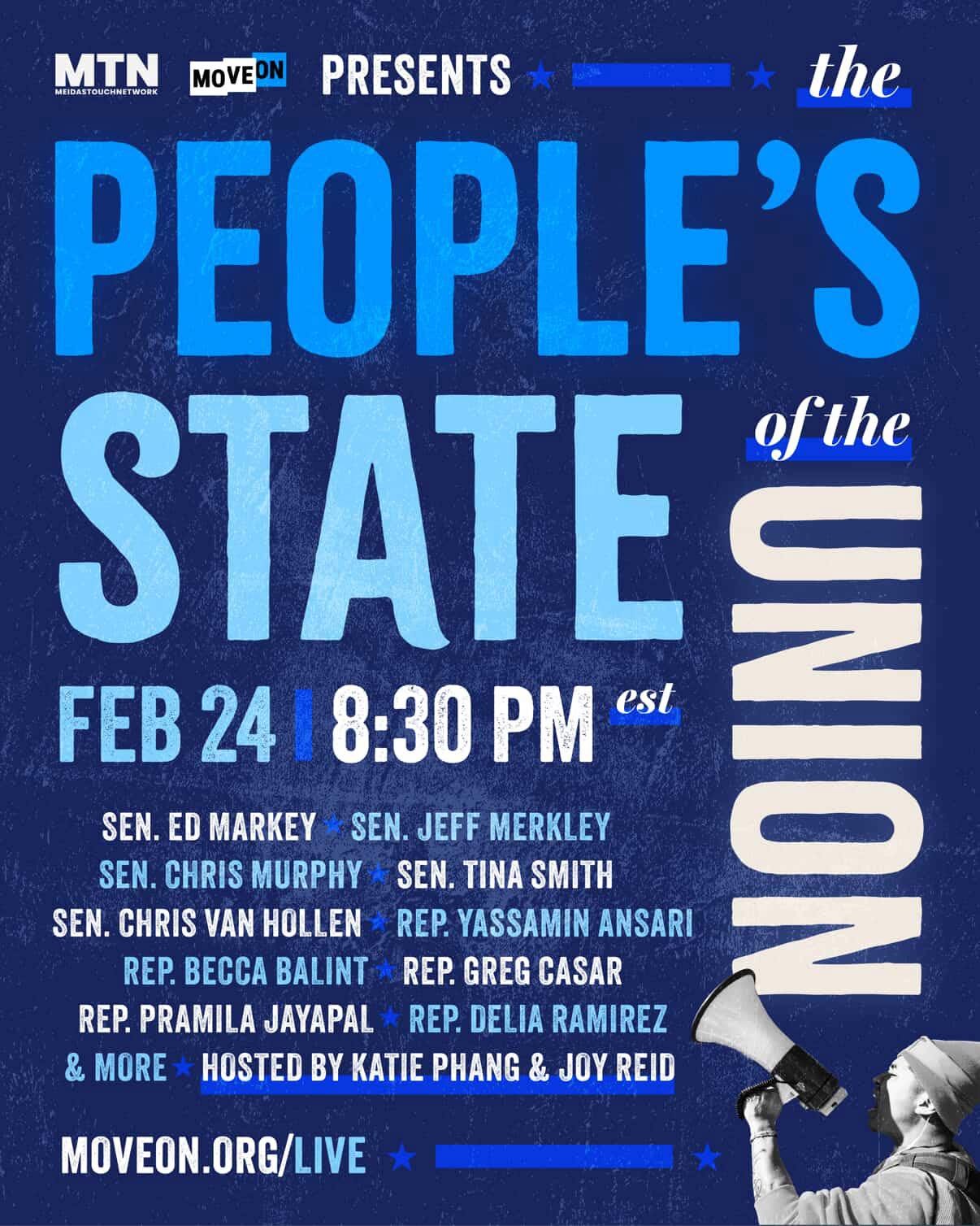
MeidasTouch Network and MoveOn are putting on the People’s State of the Union on the National Mall | February 24th at 8:30PM EST
Hosted by Katie Phang and Joy Reid, the event will spotlight lawmakers, federal workers, immigrants, and everyday Americans affected by Trump’s policies.
Stream it live on the MeidasTouch YouTube channel.

To ALL of us who don’t support the way things are going: STOP buying anything but essentials. SAVE your money and hurt the rich guys. They can’t stand to lose one penny! When money stream is slowed because we aren’t buying, then the rich guys who own the politicians and scotus will tell them to change direction. Lord help🙏
6 of 9 SCOTUS justices granted him complete, blanket immunity from prosecution for any crimes he commits while in office. So OF COURSE he is defying them with another tariff. If you think there are any real checks on his power, you're sadly mistaken.