


📌 NOTE FOR NEW READERS:
The 50501 Movement organizes peaceful action across all 50 states to defend democracy. Our publication is thousands of subscribers strong and growing. If this resonates with you, hit subscribe!
TL;DR
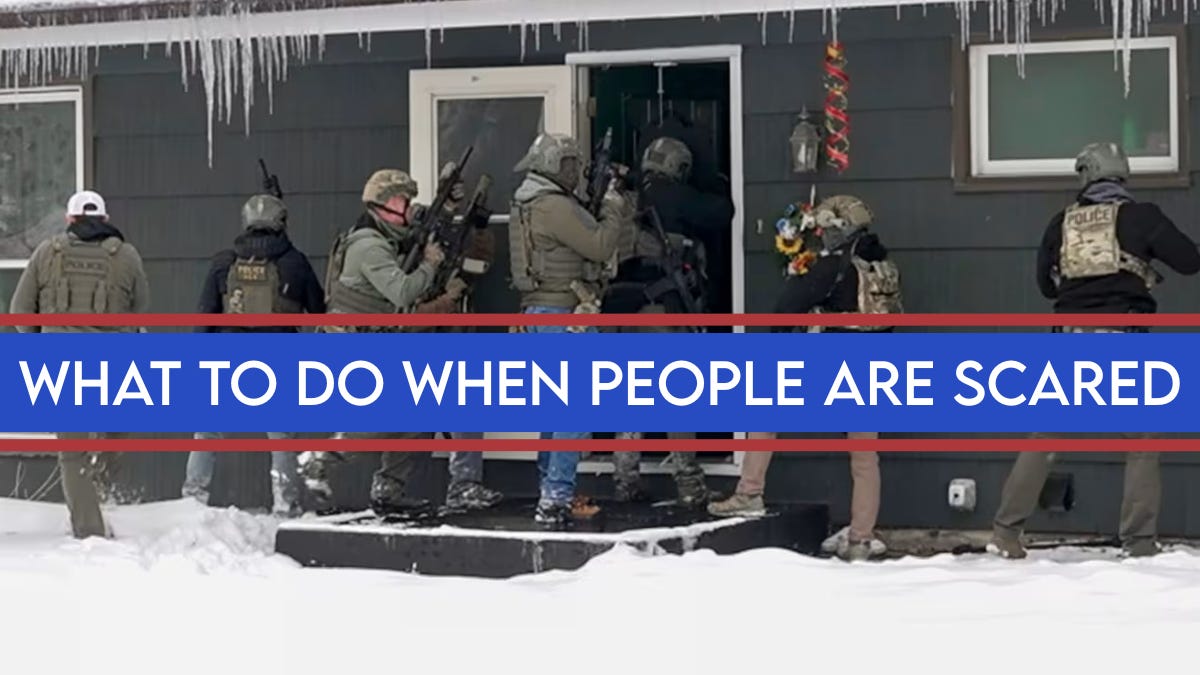
Fear is spreading because uncertainty has been made normal. Enforcement feels more visible, rumors and AI generated images are now spreading quickly, and many US households are financially fragile. When people ask us, “What can we do?”, one of the most useful answers is to build local capacity.
Local capacity helps us build protection. It lets our communities have reliable pathways for verification, legal support, documentation, and mutual aid so immigrant neighbors are not left isolated when pressure spikes and ICE shows up.
People are scared or worried
(ICE is shooting people, FFS)
When people tell us they don’t know what they can do, they are telling us they don’t have community connection they can lean into. Yes, national actions get us media but real change starts at local levels and when we get involved and protect our community members in our own towns and cities.
Right now, the absence of community is what will destroy us. Fear fills the space where structure should be, Artificial Intelligence, fake news, and rumors fills the space where verification should be, and isolation fills the space where community support should be.
We are also living under overlapping stressors.
Enforcement pressure is one. Even when a specific story turns out to be incomplete, the feeling of heightened activity can change behavior in whole neighborhoods, parents keeping kids home, people skipping work, households going quiet.
Economic pressure is another. Many families cannot absorb shocks because essentials already cost too much, and healthcare affordability remains a widely reported burden. (If you need a clean, scenario-based framework for what to do during an encounter, start with the ACLU’s immigrants’ rights guide and the National Immigrant Justice Center’s “If You Encounter ICE” page.) and check out yesterdays post on: what you need to know about ICE.
The third pressure is civic pressure. People stop trusting that the law will be applied consistently. When trust is gone, fear becomes their substitute for information.
The response that works is to organize with your local community.
Local Capacity
Local capacity is a community that can answer urgent questions quickly and confidently:
If enforcement shows up, who do we call in our community?
How do we verify what’s accurate before we post about it?
Where does qualified legal help come from, fast?
If a family is destabilized, who helps with rides, childcare, food, rent triage, and school planning?
Local capacity lets communities act without escalating danger by prioritizing safety. It’s also what keeps us from accidentally harming our most vulnerable community members.
This is where local “ICE watch” and rapid response networks come in. At their best, these networks have two purposes that they fill extremely well: they reduce fake news by verifying information, and they route people toward legal and material support.
A lot of people assume “ICE watch” means “post sightings.” That’s the least effective version. The effective version is a disciplined local system that treats accuracy, privacy, and de-escalation as the basic standard for protecting our communities.
Step 1: Find what already exists near you
Before building anything new, look for what already exists. Many communities already have rapid response networks, sometimes under different names.
Search your city/county/state with terms like “rapid response network,” “immigrant defense,” “deportation defense hotline,” or “know your rights training.” If you find a group, join, support it, and get involved.
Ask what they need most right now in terms of support. Often the needs are practical and unglamorous like intake coverage, translation, rides, childcare backups, printing, food coordination, fundraising, or court accommodations.
One reason established networks tend to feel “strict” is that they are trying to prevent harm. False sightings can cause panic and force families into difficult situations.
Step 2: If you can’t find one, build one
If your search turns up nothing, it can be worth starting something local.
Capacity is building a small system that can function when people are tired, scared, and overloaded.
A workable group needs a few things, and each one is worth explaining:
Verification
Verification is how we prevent ICE rumor cycles from harming immigrant families. It doesn’t mean we will always know everything but it means we label what we know, what we don’t, and what we are still verifying. Credibility is a safety practice.
A legal pathway
We don’t turn community groups into DIY legal clinics. We route people toward qualified guidance. The NIJC’s ICE encounter page is one of the clearest “real-world scenario” resources because it explains what to do at the door, in public, and after detention, without hand-waving. The ACLU’s immigrants’ rights guide is also designed for sharing.
Mutual aid readiness
When enforcement destabilizes a household, that household will now need help with things like rides, childcare, food, help contacting legal support, temporary housing coordination, and workplace coverage. A network with mutual aid capacity can keep a family from collapsing under pressure.
Documentation standards
Documentation is important when it’s done responsibly. This means documenting from lawful public spaces, not interfering, protecting privacy, and thinking ahead about whether what’s shared could put an impacted person at greater risk. Many civil liberties groups emphasize calm, non-escalation, and scenario-based decision-making rather than “do the boldest thing possible.”

Step 3: Legal observers
Legal Observers, often trained through the National Lawyers Guild, function as the eyes and ears of legal support documenting events in a structured way that can later be used in defense cases or public accountability efforts. Here’s the NLG’s overview of the program: National Lawyers Guild: Legal Observer Program.
If your local 50501 group is planning an action or if your community is building a rapid response capacity around encounters it’s worth checking whether there’s an NLG chapter nearby and what the process is for requesting observer support. The NLG keeps a chapter directory here: NLG Chapters.
A trained observer reduces the risk of violence, keeps interactions calmer, and preserves evidence quality.
Step 4: “Know your rights” has to be specific enough to use under stress
One of the most important and most misunderstood points is the difference between a judge-signed warrant and the administrative paperwork immigration agents often carry. If you want an extremely straightforward resource to share, the NIJC explains this clearly, including why many ICE “warrants” are not signed by judges and do not authorize entry without consent: NIJC: If You Encounter ICE.
The ACLU’s immigrants’ rights guide also gives shareable, scenario-focused guidance: ACLU: Immigrants’ Rights.
If your local group is trying to be useful quickly, one of the highest-impact actions is simply making sure these vetted resources are pinned, re-shared, and translated where possible.
Whistle kits: why they’re spreading in communities, and how to make them safer
Some communities are getting creative by putting together “whistle kits” and handing them out, usually a whistle paired with printed know-your-rights materials and a short instruction card.
The instinct makes sense. A whistle is cheap, easy to carry, and it still works when a phone is dead or someone is alone.
However please be aware that although whistles are useful as an alert, they can also create confusion once an encounter is active. They can drown out speech when someone is recording and raise the emotional temperature in ICE agents.
So if your community is doing whistle kits, the most responsible version includes a simple guideline: use the whistle to alert neighbors, then shift immediately to calm coordination, verified reporting, contacting the legal pathway, and documenting responsibly from lawful public space.

Where you live, what already exists? Rapid response, immigrant support, mutual aid and what is the one missing piece we should help each other build?
Our strength is in our local communities
We are strongest when we operate like a network.
Our national infrastructure exists to help people find each other and act together, but the real protective power is local: groups that know their neighbors, know the resources, and can move fast without losing discipline.
If you’re looking for our organizing tools, they’re here: 50501 Organizer Resources. And if you’re new and want the movement basics and standards (including our commitment to peaceful action), start here: 50501 Guide.
Local capacity is how we support immigrant communities without turning them into targets and it’s how we replace panic with confidence in our communities.
A hopeful truth
When communities have verification pathways, legal observer connections, mutual aid readiness, and clear safety protocols, we the people, take back some power. We breathe again, stop freezing and start helping because our local communities help us feel less alone.
Other poll option? Share it in the comments to let us know:
Sources and shareable resources
National Immigrant Justice Center | Know Your Rights: If You Encounter ICE
AP | what to know about the warrants most immigration agents use
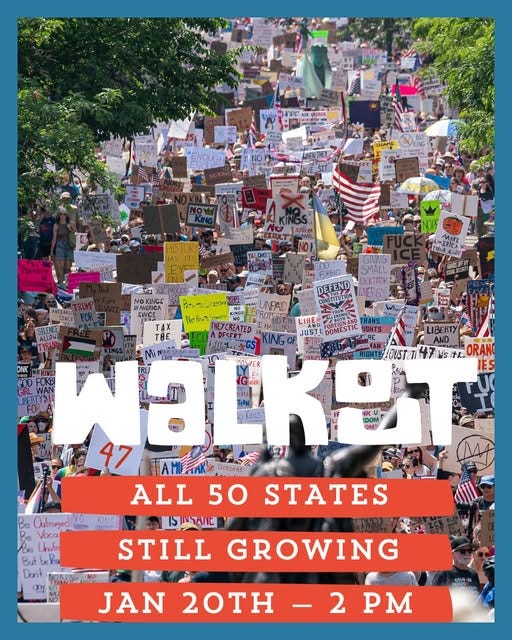
Join Us For Our Next Nationwide Action: January 20th | The Free America Walk Out
On January 20, 2026 at 2 PM local time, we walk out of work, school, and commerce as a visible refusal to normalize the construction of a coercive state.
Read more about how walkouts are different from a protest and how they can help make a bigger impact here: What Walkouts Do, Why They Work, and How to Join Safely
Do this today (2 minutes):
Commit here: FreeAmeri.ca
Calendar it: Jan 20, 2026, 2 PM local
Text two people: “Jan 20, 2 PM local. Free America Walk Out. I’m going. Will you?”
Please share this to help us get the word out:
How do we counter bullying tactics? I know my kids going to school were supposedly taught what to do when bullying happens but it doesn't seem to be working. I was touched by a story of a child started in there school, no one sits alone which turned into a national movement. How did this man get elected not once but twice when these are the tactics he uses?
I live in southern California and I have been trying to build a local capacity , we already have a neighborhood watch group but my neighbors think that is enough and they don’t want to do more , I will post this in our neighborhood watch group so they can follow this advice, thank you for the enormous help, I thank you with all my heart.