


📌 NOTE FOR NEW READERS: This is an independent publication covering 50501, No Kings, and the broader pro-democracy and civic-action ecosystem. We cover the forces shaping this moment, the communities pushing back, and the peaceful actions taking shape across the country. Read by thousands, subscribe to join our community.
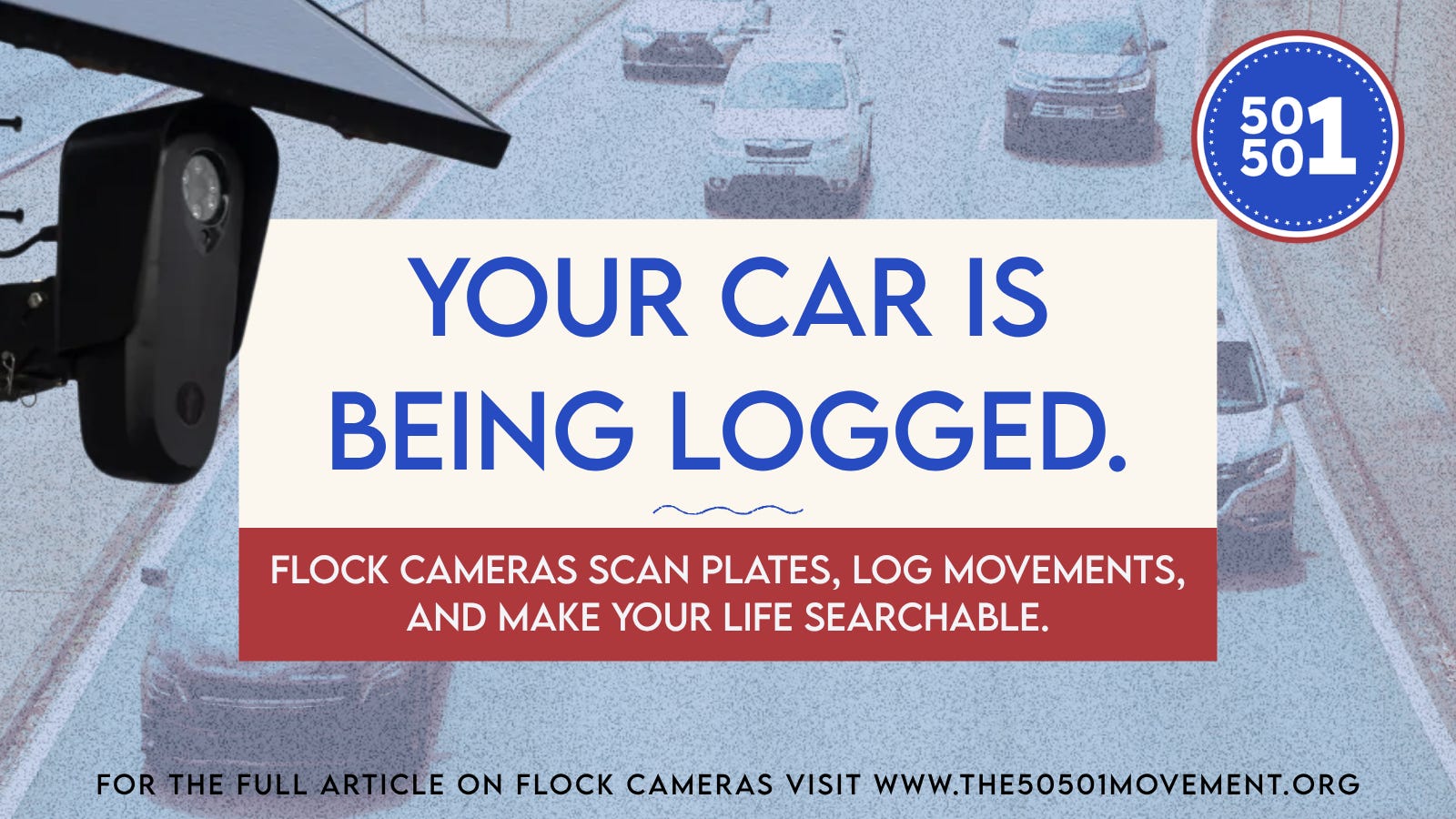
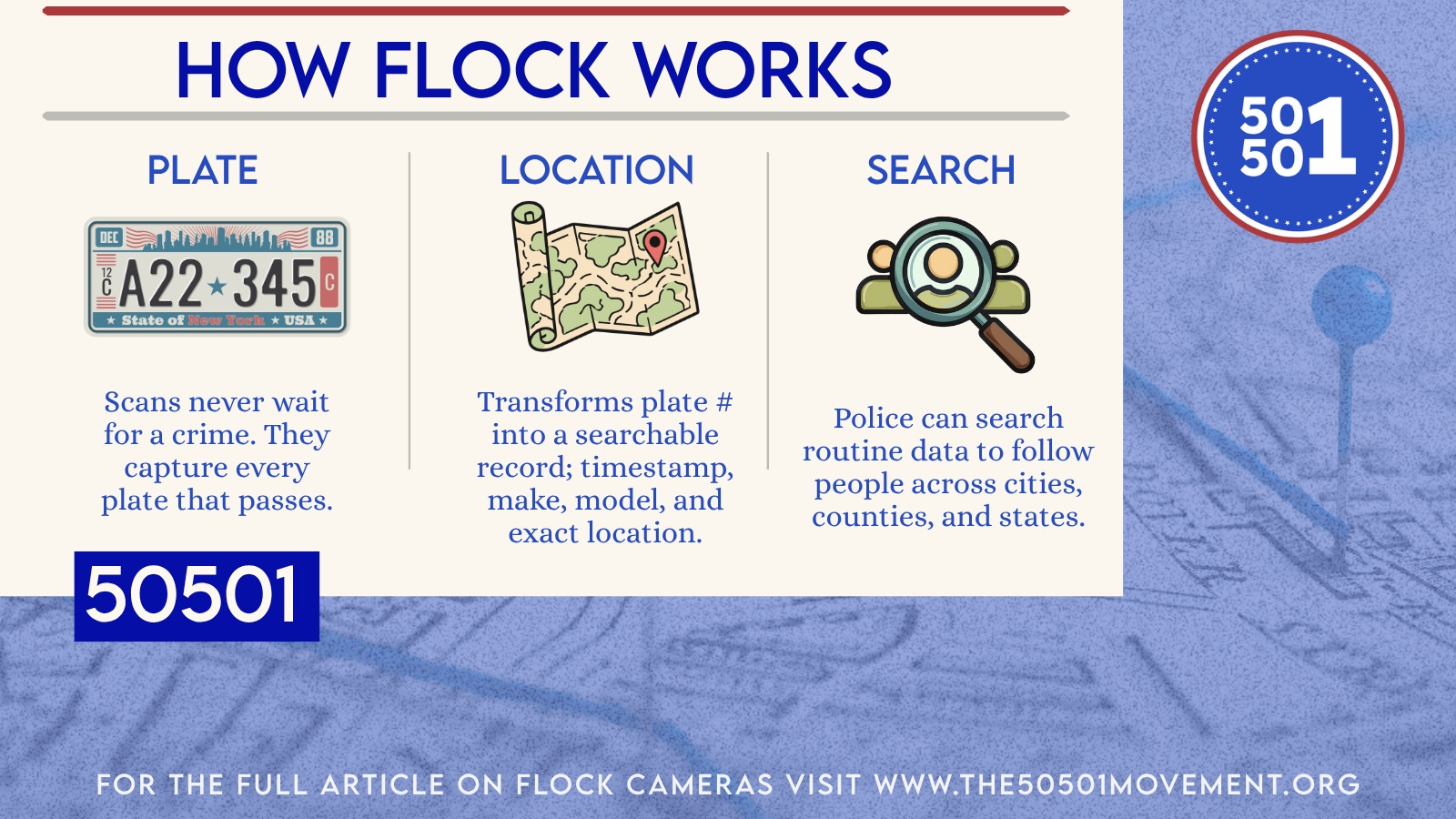
Right now, in thousands of American cities and towns, a camera is reading your license plate. It’s noting your vehicle’s make, model, and color while providing a time-stamp with your location. It’s storing that information in a searchable database connected to a network of more than 5,000 law enforcement agencies.
In many places, residents only learn the full scope of these systems after the cameras are installed or after audits reveal how widely the data can travel.
This is what a Flock camera is and how it operates. Flock safety is a priority for minority groups in 2026. Learn about them and share this with your community members to help keep them safe.
What Flock Is
Flock sells automated license plate readers such as cameras that capture every vehicle that passes, not just vehicles connected to a crime. The company now works with more than 5,000 law enforcement agencies and 6,000 communities, and its network processes billions of plate reads every month. The standard data retention window is 30 days, though agencies can request extensions.
A single scan may seem like nothing but thousands of scans across weeks and months can reveal where a person sleeps, work, which church they attend, whether they visited a clinic, a courthouse, a food bank, an immigration office or a rally, or whether they were in the same neighborhood as someone a federal agency is looking for.
Civil liberties groups have warned for years that automated license plate readers are surveillance systems built to log and track everyone.
What Flock Says
The company says ICE does not currently have direct access to its platform by default. It says data sharing with federal agencies is turned off unless a local agency deliberately enables it. It says its cameras don’t use facial recognition and that customer data isn’t being sold, and that customers own what is collected. Flock has also said that security vulnerabilities flagged by researchers resulted from misconfiguration and were subsequently addressed.
Those assurances don’t solve the problem:
This system doesn’t need to hand a database to a federal agency in order to enable federal surveillance. How are local agencies using them, and what happens when the federal government becomes far more aggressive about using every available tool.
Public records, audits, and reporting show that immigration authorities have accessed Flock data through local-agency sharing, side-door searches, or broader network permissions. That’s the documented reality, and it sits underneath every company assurance about default settings.
Immigrant Communities Are at Risk Right Now
A University of Washington Center for Human Rights report found that at least eight local law enforcement agencies in Washington state had enabled direct data sharing with U.S. Border Patrol during 2025. Later reporting found immigration agencies had access to data from at least 18 of 31 Washington agencies examined. That evidence was serious enough to drive new state legislation. Washington’s new law, signed by Governor Bob Ferguson on March 30, 2026, now bars use of plate-reader data for immigration enforcement and protected activities, restricts cameras near sensitive locations including health care facilities, immigration offices, schools, courts, food banks, and places of worship, and requires data deletion within 21 days in most cases.
The reach of Flock-connected data extends well beyond immigration enforcement, and communities should understand the fully what’s going on.
EFF analyzed more than 12 million Flock searches logged by more than 3,900 agencies between December 2024 and October 2025. Within that dataset, it found protest-related searches tied to the February 2025 50501 protests, the April 2025 Hands Off protests, and the June and October 2025 No Kings protests. In Texas, EFF obtained documents showing that law enforcement searched data from 83,345 cameras across 6,809 networks as part of an abortion investigation with the search reason logged plainly as “had an abortion, search for female.” In California, cities including Mountain View and Santa Cruz discovered broader out-of-state and federal access than local officials believed they had authorized, and canceled or pulled back from their Flock contracts as a result.
Here’s how this works: the system is installed for one purpose. Then another agency requests access. Then federal authorities arrive with a compelling reason. Then a search expands. The original promise that the data will only be used to find stolen cars or solve local crimes doesn’t fulfil contact with the full weight of what the system can do.
There’s also a dimension of inaccuracy. License plate readers misread plates and can generate false alerts. When police act on a false alert with full force, innocent people are stopped, questioned, and sometimes hurt or killed.
Business Insider reviewed police records, lawsuits, and local coverage and found that in at least a dozen documented cases, Flock misreads contributed to people being stopped at gunpoint, sent to jail, or attacked by police dogs. In Toledo, Ohio, a camera misread a “7” as a “2” and a man was mauled by a police dog and taken to jail before the error was discovered. A federal judge later summarized the incident: “Flock flocked up.” A surveillance system marketed as objective is only as safe as the accuracy of its data and the judgment of the humans acting on it.
Communities Are Pushing Back and Saying No
At least 53 cities across 20 states have rejected, deactivated, or canceled Flock contracts with 38 of those decisions coming in just the past six months. Some cited privacy concerns and some cited evidence of federal access. Flagstaff, Eugene, Santa Cruz, and Cambridge are among the communities that ended contracts after sustained community pressure. San Jose kept its cameras but was required to add tighter retention policies and ban cameras near sensitive locations including houses of worship and reproductive health clinics.
None of those are perfect solutions but it’s evidence that public pressure continues to work.
How to Find Out If This Is Already in Your Neighborhood
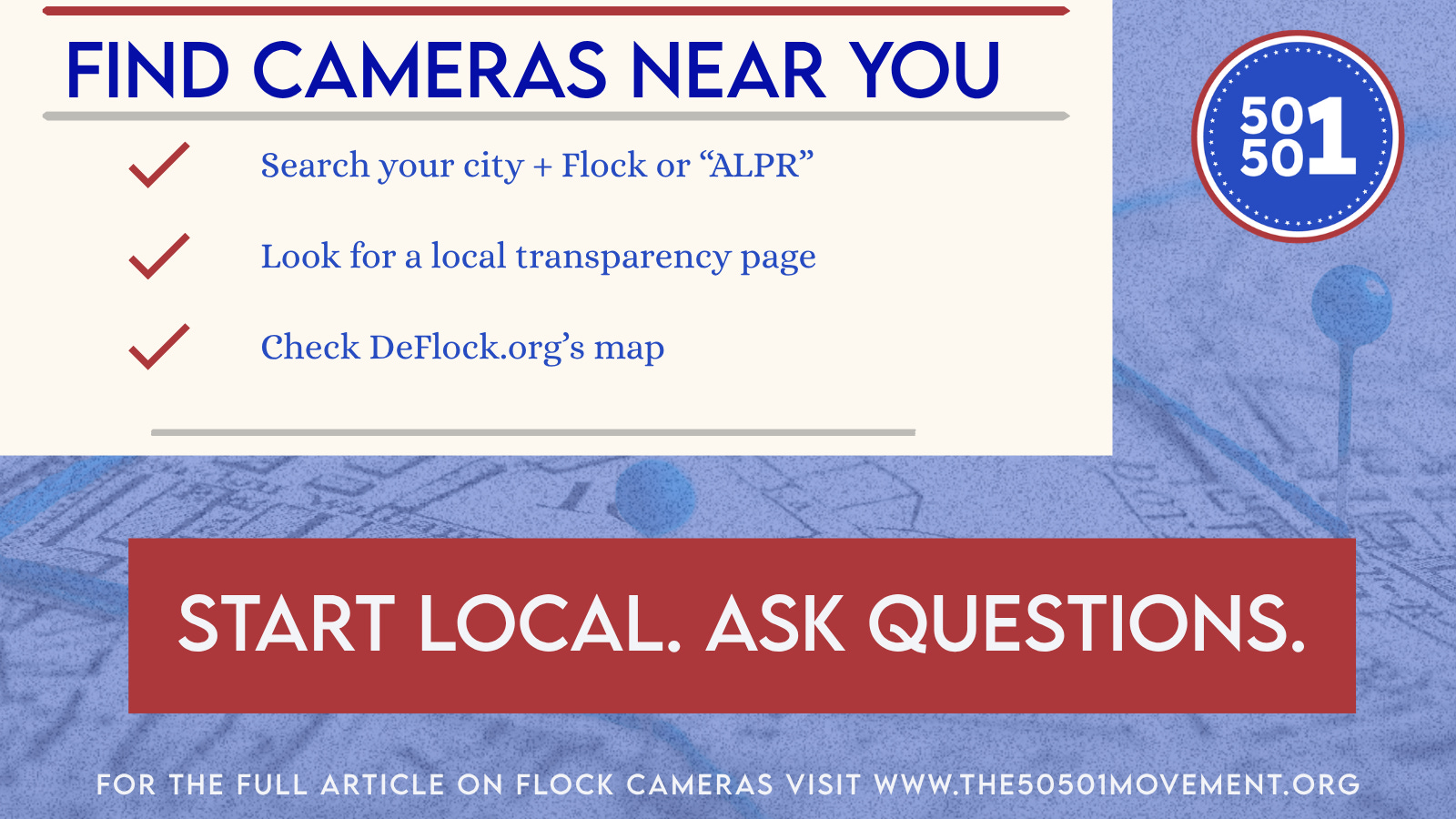
Start with your city or county government website.
Search for “Flock,” “automated license plate reader,” or “ALPR.” Check your local city council agenda archives for contract approvals or renewals.
Search your city’s name plus “Flock transparency portal” some cities have opted into public audit logs where residents can see how many searches have been run.
Then use DeFlock’s crowdsourced map, which currently shows more than 87,000 mapped license plate readers nationwide.
DeFlock is clear that its map is incomplete. If you don’t see a camera mapped near you, that doesn’t necessarily mean there isn’t one.
Contact your city council member and ask… Does the city have a contract with Flock or any ALPR vendor? Who is authorized to access the data? Is federal sharing enabled? What are the retention and audit policies? Those are reasonable questions and every resident deserves to know.
What We Need to Demand
Communities that already have these systems and those deciding whether to install them should be pushing for no data sharing for immigration enforcement, no tracking of First Amendment activity, no cameras near places of worship, food banks, courts, clinics, or immigration facilities, short deletion windows, public audit logs, and real penalties when agencies violate the rules.
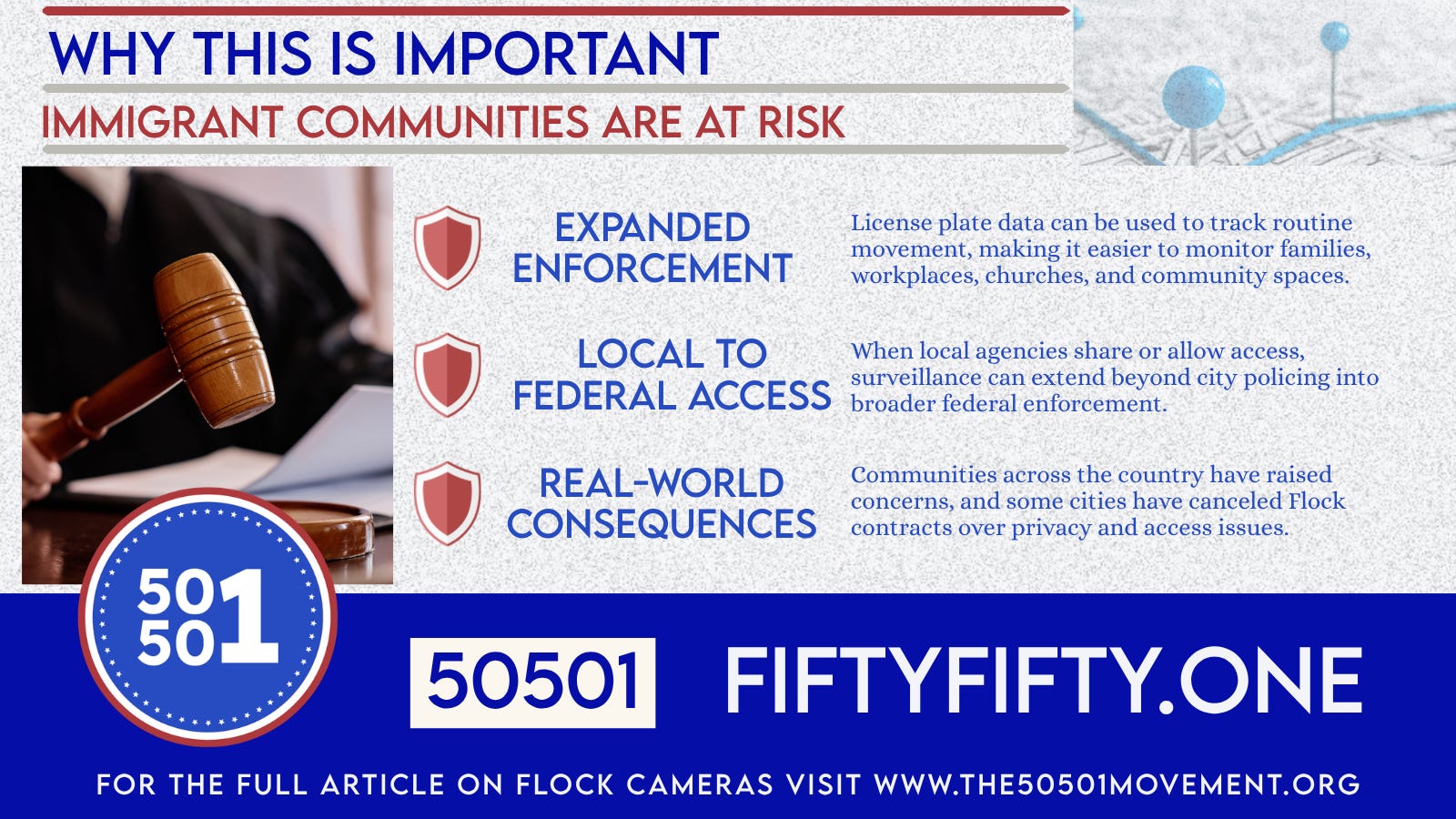
Surveillance systems built for safety do not stay neatly confined to their original purpose. They expand. And once they do, people who pay the highest price are always the ones with the least protection… immigrant families, mixed-status households, protesters, patients, and communities that have every reason to fear how the data will be used to control them.
We live in a country where U.S. citizens were shot dead by federal immigration officers this winter and where the government is blocking independent investigation of its own agents.
Search your city. Attend your council meetings. Ask who can access the cameras in your neighborhood. And if you do not like the answers, organize.


Sources
Flock Safety | Company Overview
EFF | How Cops Are Using Flock’s ALPR Network to Surveil Protesters and Activists
EFF | 2025 in Review: Flock Safety Surveillance Abuses
EFF | Texas Sheriff Claimed Abortion Search Was a Missing Person Case
University of Washington Center for Human Rights | “Leaving the Door Wide Open”
The Spokesman-Review | Border Patrol Tapped Into Washington Police Surveillance Systems
The Center Square | Washington House Passes ALPR Bill (SB 6002)
TechSpot | 53 Cities Across 20 States Pulling the Plug on Flock
NPR | Why Cities Are Canceling Flock License Plate Reader Contracts
Business Insider | AI Cameras Are Everywhere, and People Are Paying for Their Mistakes
PBS NewsHour | A Second U.S. Citizen Was Killed by Federal Forces in Minneapolis
ProPublica | Minnesota’s Fight to Hold Agents Who Shot Alex Pretti and Renée Good Accountable
PBS NewsHour | Minnesota Sues to Obtain Evidence in Shootings by Federal Officers
DeFlock | Crowdsourced ALPR Map
Such an important posting! The more you learn about ALPRs the scarier it is. The CT legislature is currently considering a bill to regulate them. It’s not just Dems in the legislature who favor strict regulation on these cameras; some libertarian leaning republicans are also on it.
Windsor, CT was the first town to turn off the cameras and develop a plan to assess all new AI tech used by the town to protect civil liberties. We just FOIAed west Hartford for Flock data, obtained copies of the Flock contracts, locations of fixed cameras and mapped them on deFlock. The town also has Flock cameras on the patrol cars!
I’m really surprised there’s no reference to Benn Jordan in this writeup…he’s the Youtuber / musician / technologist / documentarian who did a lot of the initial research & whistleblowing on Flock Safety, their egregious security flaws, and the (arguably) criminal business tactics of their company…leading several cities to end their relationships with Flock, getting the attention of legislators to open investigations, and forcing the company to address some of its most glaring vulnerabilities.
Benn is one of the biggest reasons Ring Camera ended their partnership with Flock… but his latest vid from approx 5 days ago really tears into Ring cameras and federal law enforcement abuse of the data they collect, too.
I’d HIGHLY encourage folks to watch Benn Jordan’s videos on this subject (all of his content is A+, IMHO.)
Breaking The Creepy AI in Police Cameras:
https://m.youtube.com/watch?v=Pp9MwZkHiMQ&pp=0gcJCdkKAYcqIYzv&ra=m
We Hacked Flock Safety Cameras in under 30 Seconds. 🫥:
https://m.youtube.com/watch?v=uB0gr7Fh6lY&ra=m
It's Time to Take Down your Smart Cameras 😬:
https://m.youtube.com/watch?v=UMIwNiwQewQ&ra=m