


📌 NOTE FOR NEW READERS: The 50501 Movement organizes peaceful action across all 50 states to defend democracy. This publication is nearly 100k readers strong and growing. If this resonates with you, hit subscribe.
SUMMARY:
Mainstream reporting confirms that the Department of Homeland Security and Immigration and Customs Enforcement are acquiring large industrial warehouse properties across multiple states to expand immigration detention and processing capacity. The expansion has been documented by the Associated Press and further examined by the Washington Post, which described internal planning tied to roughly two dozen warehouse-style sites nationwide.
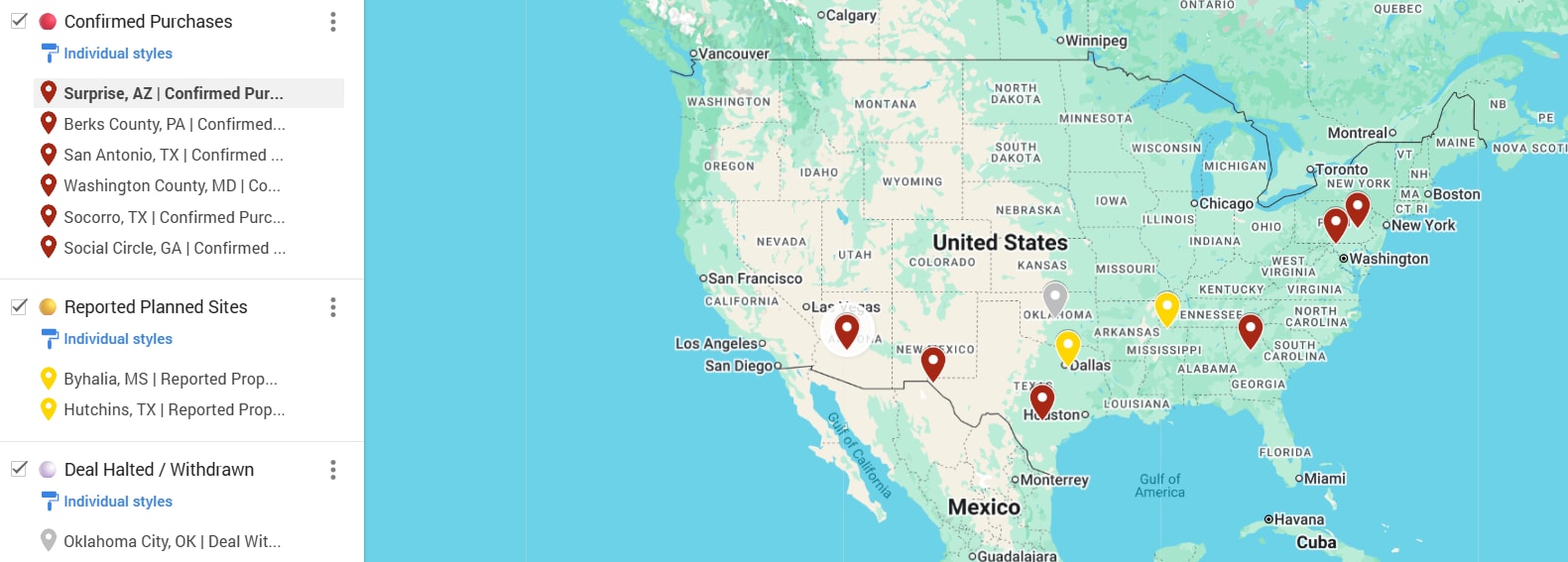
Confirmed Purchases
In Surprise, Arizona, near Phoenix, Axios reported that DHS purchased a 418,000-square-foot warehouse for approximately $70 million. The acquisition was also referenced in broader national coverage by the Associated Press.
In Upper Bern Township, Berks County, Pennsylvania, Spotlight PA reported that ICE purchased a roughly 520,000-square-foot warehouse for $87.4 million, citing deed records confirming the federal acquisition.
In San Antonio, Texas, the San Antonio Express-News reported that ICE confirmed purchase of a nearly 640,000-square-foot facility for $66.1 million, with local officials stating it is intended for detention or processing use.
In Washington County, Maryland, WYPR reported that DHS purchased an 825,000-plus-square-foot warehouse for $102.4 million, with deed documentation confirming the transaction.
In Socorro, Texas, near El Paso, KFOX reported that public records show DHS purchased a warehouse property for over $122 million, prompting transparency concerns from local officials.
In Social Circle, Georgia, FOX 5 Atlanta reported that city officials acknowledged the federal government purchased a large industrial warehouse for use as a new ICE detention facility.
These transactions are supported by public records and confirmed reporting.
Reported Plans and Proposals
National investigative reporting suggests a broader strategy.
The Washington Post reported that internal planning documents describe a strategy involving approximately 23 warehouse-style properties nationwide.
In Byhalia, Mississippi, Reuters reported on a proposal to convert a warehouse into an ICE detention facility that could hold more than 8,500 beds, drawing bipartisan opposition and public scrutiny.
Regional reporting in Texas has referenced ICE planning documents describing a proposed large detention site in Hutchins, though confirmed purchase documentation remains distinct from planning reports.
Separating confirmed purchases from reported plans protects credibility.
If you are aware of additional warehouse purchases, lease agreements, zoning filings, or public meetings related to federal detention or processing facilities in your area, please share in the comments below. Property records, council agendas, official statements, or credible sources are especially helpful.
Why Warehouses?
If deportations are already happening through existing enforcement channels, why is the federal government quietly acquiring enormous amounts of additional industrial space?
Reporting from the Associated Press offers an important clue. Many of these properties sit near major highways, freight corridors, and airports, locations selected for logistical efficiency. That detail deserves careful attention, because immigration enforcement at scale involves far more than arrest and removal. It requires intake, processing, classification, transportation coordination, court scheduling, medical screening, and short-term holding before transfer to longer-term facilities. Every one of those functions demands physical space, and specifically, flexible space.
Traditional detention facilities are purpose-built and expensive. They require years of planning, environmental review, and political negotiation at multiple levels of government.
Warehouses, by contrast, already exist.
They are large, open-span industrial structures that can be retrofitted far more quickly and cheaply than constructing new detention complexes.
Federal acquisition of properties already zoned for industrial use also reduces dependence on local approval processes, a meaningful advantage when speed is the priority.
A single warehouse ranging from 400,000 to 800,000 square feet enables centralized intake operations capable of processing large numbers of individuals simultaneously. Even if these facilities serve primarily as temporary processing and transfer points rather than sites of long-term confinement, that physical footprint dramatically expands the system’s throughput capacity which also becomes operationally possible.
Physical infrastructure signals institutional expectations. Governments do not invest hundreds of millions of dollars in industrial properties without anticipating sustained, high-volume use.
Whether these sites are characterized as detention facilities, processing centers, staging areas, or logistics hubs, the acquisition of millions of square feet across multiple states represents a deliberate expansion of enforcement capability.
Community Oversight
In Oklahoma City, KOSU reported that a warehouse owner ended negotiations with DHS after public opposition and scrutiny.
Documentation and local engagement can alter outcomes.
Physical infrastructure is durable
Once acquired, it does not disappear easily. Warehouse purchases across multiple states represent a structural expansion of detention and processing capacity supported by documented reporting from the Associated Press, Reuters, the Washington Post, and regional investigative outlets.
At what point does infrastructure expansion become a red flag for you? Is it the square footage? The number of states involved? The speed of acquisition? Or does none of this cross a line in your view? Explain where your threshold is and why.
Sources & Additional Reading/Reporting
Associated Press
“Federal immigration officials scout warehouses as they eye more detention space.”
https://apnews.com/article/52244cad6413704d4bacfcb0cb06b6bb
Washington Post
“ICE plans warehouse detention expansion across the U.S.”
https://www.washingtonpost.com/investigations/2026/01/30/ice-warehouse-detention-dhs-immigration/
Axios Phoenix
“DHS buys Surprise warehouse for immigration detention use.”
https://www.axios.com/local/phoenix/2026/02/04/dhs-surprise-warehouse-immigration-detention
Spotlight PA
“ICE purchases Berks County warehouse for detention expansion.”
https://www.spotlightpa.org/berks/2026/02/ice-warehouse-berks-county-purchase-federal-government/
San Antonio Express-News
“ICE confirms purchase of East Side warehouse for detention facility.”
https://www.expressnews.com/news/article/ice-confirms-buying-san-antonio-site-detention-21334133.php
WYPR (Maryland)
“DHS buys Washington County warehouse to possibly hold detained immigrants.”
https://www.wypr.org/wypr-news/2026-01-27/dhs-buys-warehouse-in-maryland-to-possibly-hold-detained-immigrants
KFOX (El Paso, Texas)
“DHS purchase of Socorro property raises transparency concerns.”
https://kfoxtv.com/news/local/dhs-purchase-of-socorro-property-for-detention-center-raises-transparency-concerns-mayor-rudy-cruz-jr-lack-of-transparency-answers-ice-department-of-homeland-security-el-paso-county-officials-immigration-migrant
FOX 5 Atlanta
“Federal government buys Social Circle warehouse for ICE detention facility.”
https://www.fox5atlanta.com/news/feds-buy-social-circle-facility-new-ice-detention-center-officials-say
Reuters
“Republican senator opposes planned ICE detention center in Mississippi.”
https://www.reuters.com/world/us/republican-senator-opposes-planned-ice-detention-center-mississippi-2026-02-04/
KOSU (Oklahoma)
“OKC warehouse no longer being considered for ICE detention center.”
https://www.kosu.org/local-news/2026-01-29/okc-warehouse-no-longer-being-considered-for-ice-detention-center
COMING UP:
February 17: National Day of Lobbying.
Show up in your representatives’ district offices and demand impeachment, conviction, and removal. In-district pressure matters more than phone calls to D.C. offices. Visit here for more: citizensimpeachment.com/feb17

March 28: The next NO KINGS mass mobilization.
If you missed the announcement, read it here: ANNOUNCEMENT: The Next NO KINGS Mobilization. If you’re a beginner organizing locally, use this guide: How to Organize a Protest.

Well if Americans didn't think he was serious about imprisoning the population that disagrees with him, think again. They will take documented as well as undocumented. Wether you have a criminal conviction or not. When they've got that supply sent of of the country then that leaves the white dissidents next. Yell at an ICE agent and you're next. He will deport white, born in the USA people who don't agree with his government and ship them out too. It's all to install fear. Like Hitler and Stalin and the modern day Putin he want's what he wants and to hell with your democratic rights. You have none. Within a year YOU WILL BE NEXT! FIGHT!
What it represents and everything about it is alarming! Americans want immigration reform, not concentration camps! What we know already about many of the existing “facilities” is hideous. I heard from a former detainee, now deported, about her year in the South Louisiana (Basile) Core Civic camp 😩 Dilly now has a measles outbreak, people are mistreated, denied medical care and other human rights abuses. We, the People have to STOP THIS!