


📌 NOTE FOR NEW READERS:
If you’re new here: 50501 coordinates peaceful action nationwide: 50 states, one movement. No kings, no exceptions. Join thousands of readers who subscribe to our publication and for resources and updates on our next mobilization update.
TL;DR
Overnight Friday into Saturday, the United States launched a major operation in Venezuela and captured Nicolás Maduro and his wife, flying them to the U.S. to face criminal charges. The administration is describing it like “law enforcement,” while also openly talking about running Venezuela and its resources.
What Happened
The U.S. carried out a large-scale operation in and around Caracas and seized Nicolás Maduro and his wife during the mission.
They were transported to the United States to face charges tied to narco-terrorism/drug trafficking allegations.
The President publicly celebrated the operation and spoke in terms that sound like temporary U.S. control of Venezuela.
The international reaction has been immediate and alarmed, multiple governments have condemned the action as a violation of international law, and the U.N. Security Council is meeting Monday.
Maduro is still a dictator and this is still illegal.
That’s the point of the rule of law.
If Venezuela becomes “normal,” it becomes “repeatable.”
The line has to be drawn now.
“Rules” are the thing keeping the world from sliding
After World War II, the world built an agreement:
big countries don’t get to invade small countries because they want something such as oil, leverage, or revenge
It’s imperfect and it’s been violated before. But it’s also one of the main reasons your grandparents weren’t drafted into World War III.
When the United States, the country that has historically presented itself as the anchor of that system, starts acting like the rules are optional, two things happen:
Allies lose confidence in the idea that the U.S. is predictable.
Authoritarians gain a gift: “See? There are no rules. Only power.”
This is how the world becomes more dangerous.
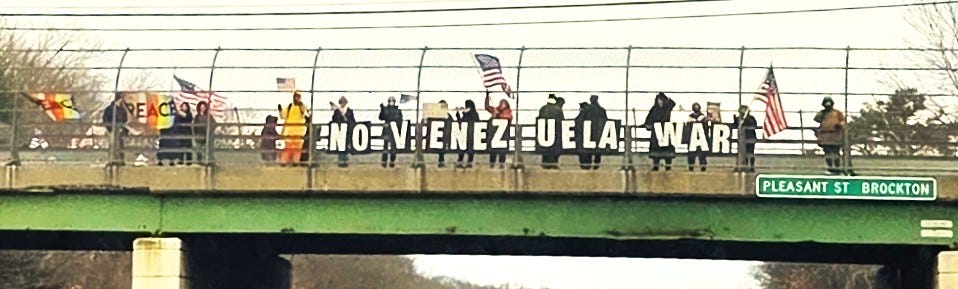
To everyone who mobilized within hours, thank you. While the story was unfolding, people were already in the streets demanding constitutional limits, congressional oversight, and an end to escalation. From rallies in New York, Chicago, Philadelphia, Seattle, San Francisco and beyond, these rapid-response pop-up protests continue to show us we’re insisting on statutory process… transparent legal authority, defined objectives, and enforceable limits before force is expanded or normalized.
A constitutional problem
There’s a reason the Constitution gives Congress the power to declare war.
The founders understood this:
When a single person can launch military action unilaterally, especially when domestic pressure is high, war becomes a tool of politics.
Under U.S. law, presidents have reporting and consultation requirements when introducing U.S. forces into hostilities. The administration is already facing scrutiny for how Congress was (or wasn’t) informed.
Here’s the principle everyone should read, and read again:
If this can be done to Venezuela without Congress, it can be done again, anywhere, by any future president.
And the next time, you might not like the target, reason, or outcome.
*Using military force to seize resources is illegal and violates international law. Congress never authorized this.
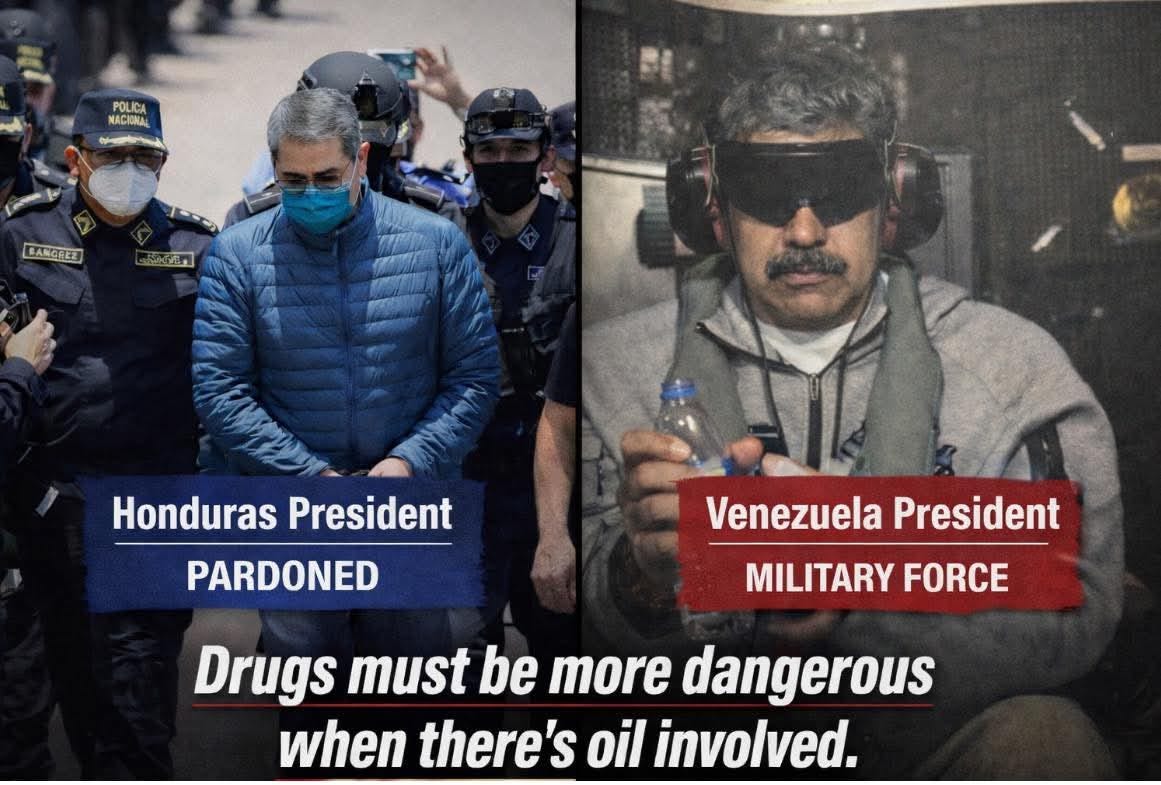
“But Maduro is a bad guy.” Yes. And that’s exactly why this is a trap.
Authoritarianism sells itself as an exception:
“This is urgent.”
“This is about safety.”
“This person is evil.”
“Trust us. We have to break the rules just this once.”
But if a government breaks the rules to remove a dictator… what you end up destroying isn’t only the dictator.
You destroy:
constitutional limits,
international credibility,
and the idea that law applies when it’s inconvenient.
That is the road to “might makes right.” and the road away from democracy.
If Congress and the public treat Venezuela as a one-off, it becomes a precedent. In practice, that means the executive branch learns it can initiate major military action, define the legal theory after the fact, and face minimal institutional resistance. This will become a separation-of-powers problem. The Constitution assigns Congress the war power to prevent “emergency” logic from becoming a standing authorization for force. No Kings in this context is simple: no unilateral war-making, no open-ended executive authority, and no normalization of claims like “we’ll run” another country without clear statutory authorization, transparent objectives, and enforceable limits.
What to pay attention to right now
Congress: Do our leaders demand a vote, hearings, and a clear legal rationale or become compliant?
The U.N.: Monday’s Security Council meeting will tell you how isolated the U.S. is becoming.
Allies’ language: Watch whether allied governments emphasize “international law” and “UN Charter.”
The precedent effect: Russia and China will absolutely study this because it helps them argue rules don’t matter in Ukraine, Taiwan, and beyond.
The “what now” inside Venezuela: Capturing one leader does not equal stability. Power vacuums create humanitarian crises quickly.
What you can do today
1) Keep Calling Congress
U.S. Capitol Switchboard: (202) 224-3121
Ask to be connected to your Representative and both Senators.
Quick Script (30 seconds):
“Hi, I’m a constituent in ZIP _____. I’m calling about U.S. military action in Venezuela.
I want Congress to assert its constitutional authority immediately.
Will the Senator/Representative support hearings, a public legal justification, and a War Powers vote before any further escalation?
And will they oppose any long-term U.S. control of Venezuela?”
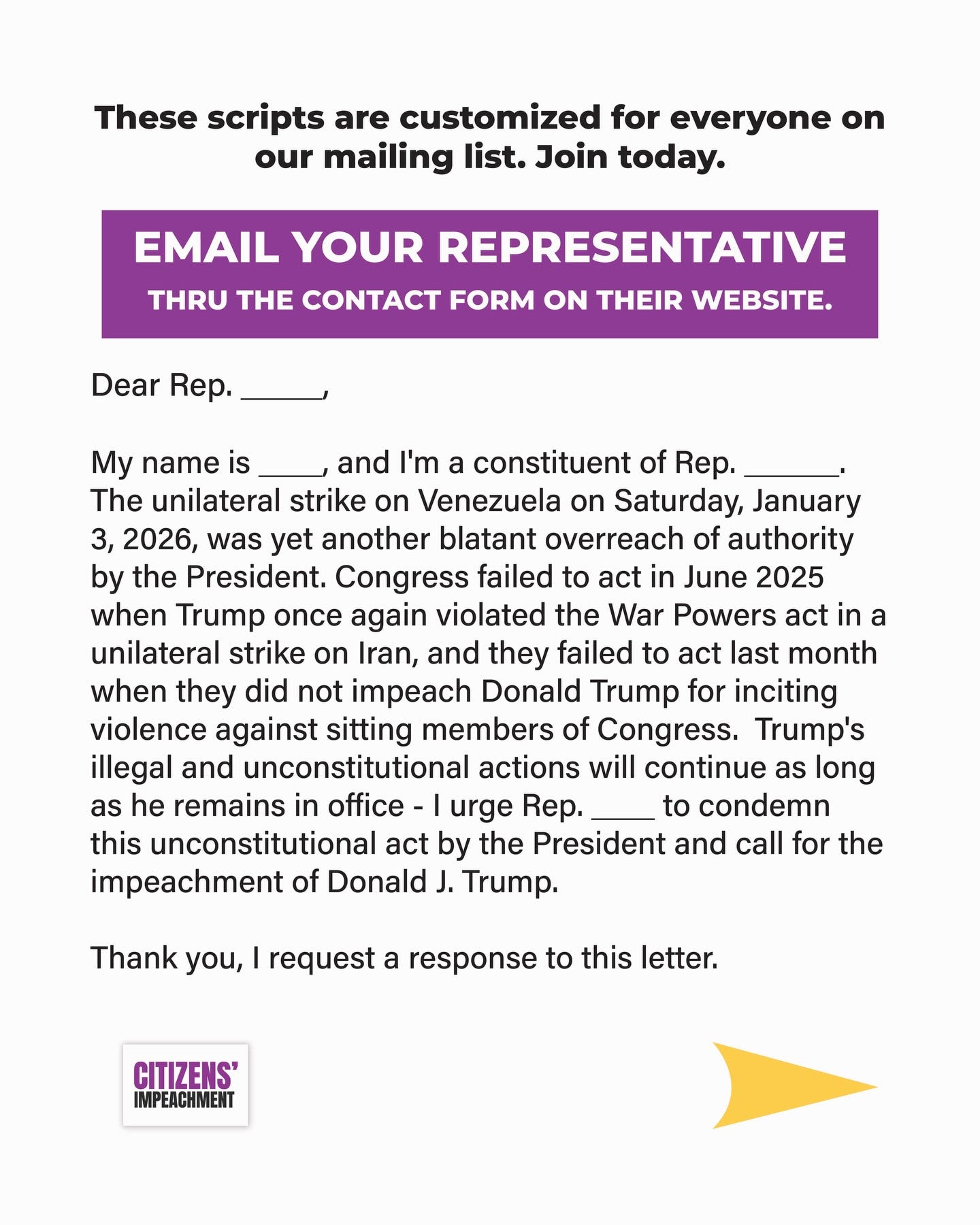
Or use this email/voicemail script created by our friends at Citizens' Impeachment here:

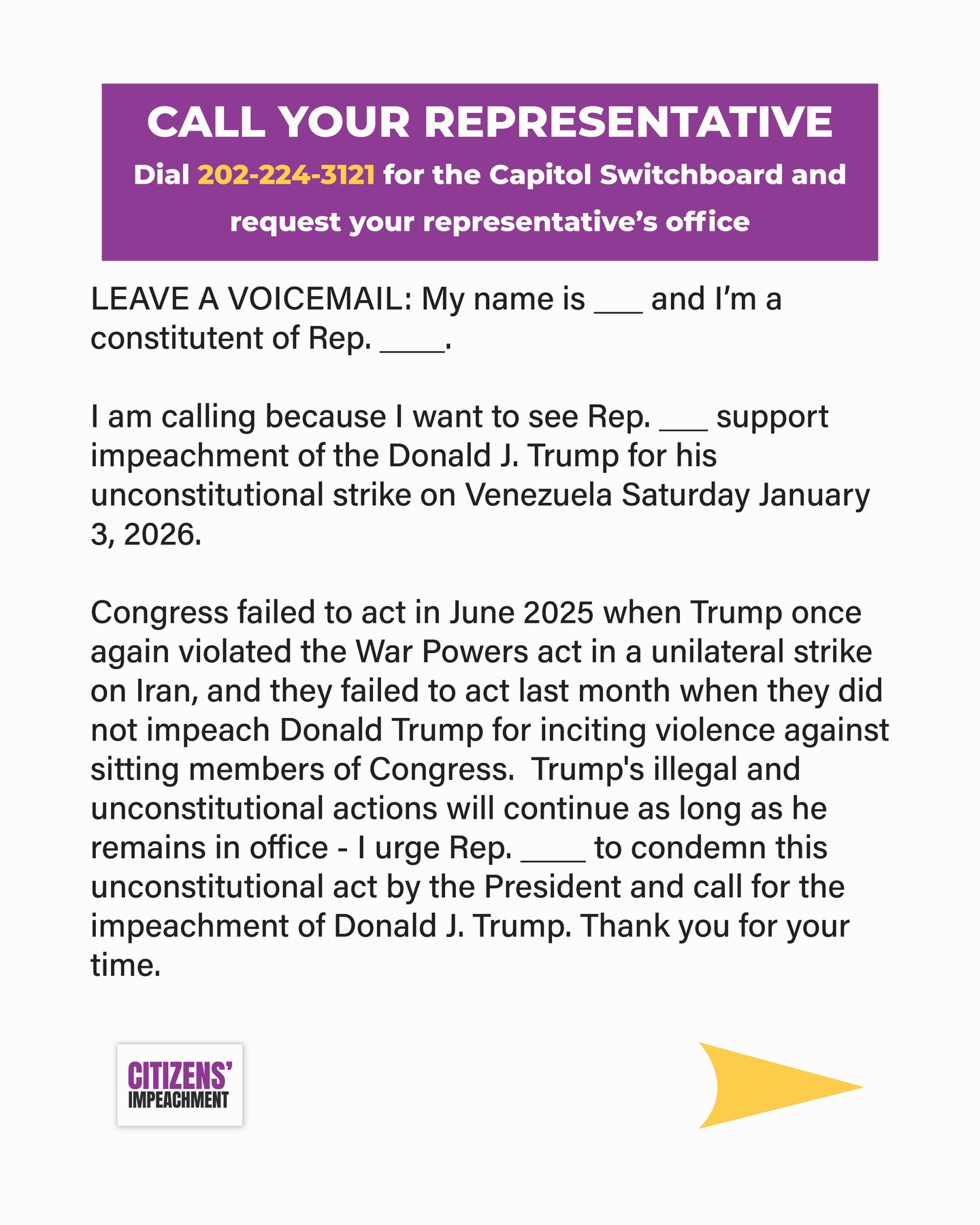
2) Make this about the Constitution, and the legal process.
When you talk about it online, focus on process and principle:
“Congress has to vote.”
“International law matters.”
“No president gets unilateral war power.”
“Maduro being bad doesn’t make anything automatically legal.”
3) Find a protest near you
Check Mobilize (search “Venezuela,” “anti-war,” or “War Powers” + your city) or use the Answer Coalition’s listings: https://www.answercoalition.org/Venezuela
If nothing is posted near you yet, reach out to your local 50501 community groups, many have rapid-response threads with meetup points, carpools, sign-making, and support roles you can join quickly.
4) Share clarity
If you found this article valuable, share it with one person, or even better… share it into a community group so we can reach more people faster.
Two questions for you to let us know in the comments:
Do you believe Congress will act like a co-equal branch here or will it become complicit?
What worries you most: the international precedent, the constitutional precedent, or the risk of escalation?
Have more to share about your poll answer? Share it with us in the comments:
A lot of people are going to say, “This is complicated,” because Maduro is exactly the kind of strongman the world calls a king.
But that’s the test: do we oppose kings only when they’re foreign or do we refuse to create one here?
If presidents can launch major military actions without Congress and claim the right to “run” another country, then the guardrails are gone.
When guardrails disappear, we won’t look away, we will push back to restore them.
Sources
AP | What we know about the U.S. strike that captured Maduro
Reuters | Was the U.S. capture of Venezuela’s president legal?
Congressional Research Service | War Powers Resolution: expedited procedures + consultation requirements (R47603)
Long ago I was a lowly intern for US Senator William Proxmire. My job was to keep count of phone calls and mail from constituents by issue. The data was used to guide his positions and votes. Calls matter!
I'm mostly concerned that congress will continue to sit by and let Trump get away with stepping on our sacred constitution. Which will.pave the way for other authoritarians to do the same. It needs to stop now with the full force of a unified congress and senate.