


📌 NOTE FOR NEW READERS: The 50501 Movement organizes peaceful action across all 50 states to defend democracy. This publication is nearly 100k readers strong and growing. If this resonates with you, hit subscribe.
Summary
On April 30, 1977, fourteen women gathered in the Plaza de Mayo in Buenos Aires, directly in front of Argentina’s presidential palace. Their children had been disappeared by the military dictatorship. The government denied responsibility and refused to tell families where their children were. The women sat on benches and waited. When police told them to move, they walked in pairs around the plaza. They came back the following Thursday, and the next. The regime called them “las locas”, the crazy ones. The regime killed three of their founders and infiltrated their meetings but they kept coming back. Within a year, there were hundreds. They wore white headscarves embroidered with their children’s names. They carried photographs. They drew international attention that helped erode the junta’s legitimacy and add to the domestic and international pressure that contributed to its fall. They are still marching today, every Thursday, in the same plaza, nearly five decades later. We are telling this story four days before March 28 because the reasons people are showing up on Saturday are exactly the reasons those mothers gave for walking into a plaza in 1977.
This Saturday, March 28, over 3,000 No Kings events are planned in all 50 states.
This is gearing up to be the largest single-day protests in U.S. history. Help us by sharing or restacking!
Argentina in 1976 was a country that had learned to be afraid of it’s government.
A military junta seized power in March of that year and immediately began a campaign that it called the “National Reorganization Process.”
This was a special task force created to kidnap, interrogate, torture, and kill anyone the regime considered a political threat such as trade union organizers, students, journalists, professors, lawyers, people who knew those people and people who were reported by neighbors.
The regime called them subversives while everyone else called them los desaparecidos, the disappeared.
An estimated 30,000 people were disappeared during what became known as the Dirty War. They were taken from their homes, workplaces, taken from the street. Their families went to the police and to government offices. They were told their children didn’t exist.
The regime denied responsibility and obscured the fate of the desaparecidos by disappearing people and disposing of their bodies in mass graves, or thrown from airplanes into the sea on what survivors later described as “death flights”, the regime could pretend the people it murdered had never been there at all.
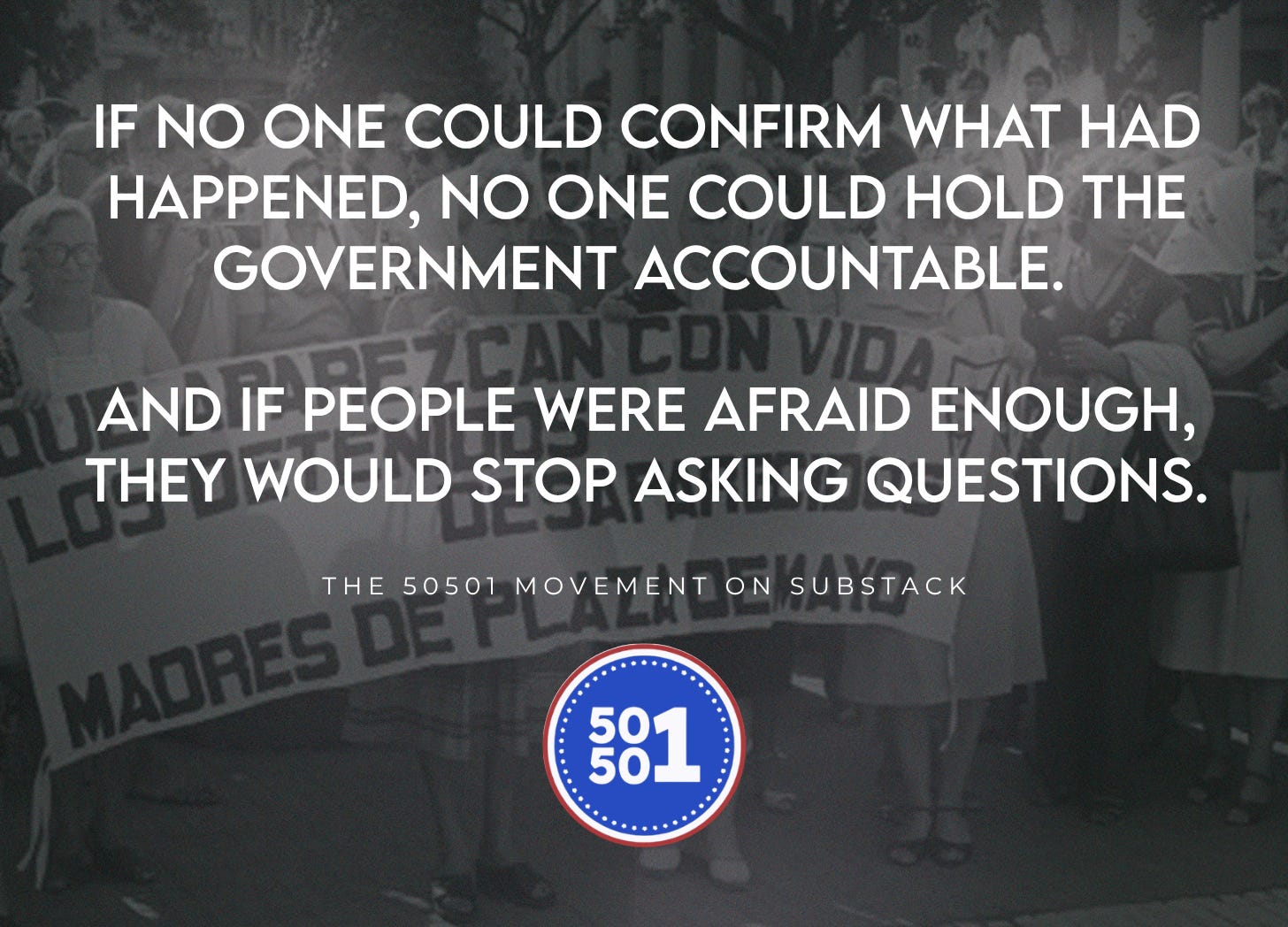
If no one could confirm what had happened, no one could hold the government accountable. And if people were afraid enough, they would stop asking questions.
On April 30, 1977, fourteen women walked into the Plaza de Mayo.
The Plaza sits in the center of Buenos Aires, directly in front of the Casa Rosada, the presidential palace.
It had been Argentina’s center of political power for centuries.
The fourteen mothers went there because they had exhausted every other option. They had searched government offices, filed paperwork, and begged for information.
One of them, Azucena Villaflor, had become convinced that the only way forward was to make their grief visible in the one place the government couldn’t pretend not to see.
So they sat on benches, and some brought knitting to look inconspicuous.
When police officers told them they were violating the law against public assembly and ordered them to move, the women stood up and began walking in pairs around the plaza’s central monument.
They weren’t even organized. They didn’t have a coalition or a communications strategy or a plan for what was to come.
They were mothers looking for their children.
That first day, the plaza was mostly empty. One of the founding members later recalled: “It was us and the pigeons.”
They came back the following Thursday, and the cycle continued.
As word spread, more mothers came.
Within months, the movement had grown sharply and by the following year, hundreds were participating. They began wearing white headscarves embroidered with the names and birthdates of their missing children, the fabric meant to symbolize their children’s diapers, a reminder that these were human beings who had once been infants held in their arms.
They carried photographs and they piled their children’s belongings in the plaza.
They published the names of the disappeared in a half-page newspaper advertisement on October 5, 1977, addressed to the president, the military commanders, and the Church: “The most cruel torture for a mother is uncertainty about the destiny of her children.”
The regime’s first response was to try to make them invisible. Officials dismissed them as “las locas”, the madwomen.
So the women kept walking.
And the regime’s second response was violence.
In December 1977, three of the founding mothers, Azucena Villaflor, Esther Ballestrino, and María Ponce de Bianco, were themselves kidnapped and murdered.
They were killed as death flights, thrown from aircraft into the sea.
French nuns who had supported the movement were killed the same way.
The regime infiltrated their meetings.
It tried to identify and eliminate their leadership.
But, the women kept walking.
In a recent 2025 interview, Mothers leader Taty Almeida said: “We were not heroines. We did what any mother would do for her child.” And said: “They called us crazy. And we were crazy. Crazy with pain, rage, and helplessness.”
This moment in history tells us that standing up to the regime can feel like a pain that has nowhere else to go. It feels like the alternative to stay home, remain quiet, and pretend it’s not happening is worse than whatever risk comes with being visible.
This relates to what people told us when we asked why they are showing up to No Kings this Saturday, on March 28:
A senior citizen said she’s coming even though her cardiologist has warned her not to be out in the heat.
A father said he’s going so his daughters and granddaughters know he stood up.
A woman said she’s going for her veteran husband she lost in 2024.
Another said she’s going to offer hope to people who can’t stand there themselves.
A grandmother wrote: “You just don’t piss off old grannies.”
These are recognizably reasons of grief, duty, love, refusal… similar moral terrain that brought fourteen women to a plaza in Buenos Aires in 1977. With refusal to stay home while something unacceptable is happening to the people and the country they love.
The Mothers of the Plaza de Mayo didn’t end the dictatorship alone.
Argentina’s military regime collapsed in 1983 under the combined weight of economic failure, the disastrous Falklands War, and sustained domestic and international pressure that the mothers had been instrumental in building.
Over time, the movement spread into linked chapters across Argentina.
The Carter administration became part of the growing international human-rights pressure on the junta.
The Inter-American Commission on Human Rights visited Argentina in 1979 and later issued a damning report.
Foreign journalists covering the 1978 World Cup in Argentina reported on the Thursday marches and broadcast the mothers’ faces to the world.
None of that international attention would have existed if the mothers had stayed home.
Showing up didn’t fix the problem on a Thursday afternoon but it created the visible, sustained, undeniable evidence of dissent that made it impossible for the regime to maintain the fiction that everything was normal.
It gave journalists something to report and gave foreign governments a reason to act. But most importantly, it gave other Argentine citizens permission to stop being afraid.
The white headscarves became one of the most recognized symbols of human rights resistance in the world.
The mothers won the Sakharov Prize for human rights from the European Parliament.
Their tactics inspired similar movements across Central America, in El Salvador, Guatemala, and Honduras.
Hundreds of military officials were eventually convicted for crimes committed during the Dirty War.
And the mothers are still there. Every Thursday, in the same plaza, walking the same route, nearly five decades later. Because the question of what happened to 30,000 people has still not been fully answered.
Here is what we need to carry into Saturday.
The Argentine regime called the mothers crazy because that’s what authoritarian systems do when confronted with people who refuse to comply.
They minimize and mock you, say you’re overreacting, and that you’re emotional, that you are wasting your time.
The mothers didn’t believe them when they used these tactics.
On March 28, over 3,000 events are planned in all 50 states.
In June, more than five million people showed up.
In October, over seven million.
This is the third national mobilization in less than a year, organized by a broad coalition including groups such as the ACLU, Indivisible, 50501, the AFL-CIO, MoveOn, SEIU, and Planned Parenthood Action Fund and many, many, more. The flagship event is in St. Paul, Minnesota, with speakers including Lt. Gov. Peggy Flanagan, Attorney General Keith Ellison, Joan Baez, and Jane Fonda.
Nobody’s asking you to walk into a plaza under a military dictatorship. What we’re asking is simpler and safer… show up at a public event in your community on a Saturday with your community.
Find your event at nokings.org.
Bring a person who has been thinking about going but hasn’t committed yet.
That’s how fourteen becomes hundreds and how hundreds becomes millions.
It’s how the people who want you silent discover that you are not.
They will call you crazy.
Let them.
Why are you showing up on March 28?
Sources
Global Nonviolent Action Database | Mothers of the Plaza de Mayo, 1977–1983
HISTORY | 30,000 People Were ‘Disappeared’ in Argentina’s Dirty War
International Center on Nonviolent Conflict | Mothers of the Disappeared: Challenging the Junta
European Parliament | Las Madres de Plaza de Mayo, 1992 Sakharov Prize
openDemocracy | The Mothers of Plaza de Mayo: “We were born on the march”
The Real News | Stories of Resistance: Mothers of Argentina’s 30,000 Disappeared
FOX 9 Minneapolis | No Kings Rallies Across Minnesota, March 28
Great piece! “Auntie Fas” draw strength from the brave women of the Plaza de Mayo!
The surest way to get Democrats elected in November?
Defer spending until after the election.
If the economy is suffering between now and November, Democrats will be ensured victory.
The real star of the American economy is consumer spending, which accounts for 68% of GDP
Stop spending now, except on essentials. Defer spending, as much as possible, especially on big ticket items, until after the election.
Shop, but don’t buy. Defer that gratification for a short while.
It’s important to stop spending now so there will be two quarters of bad economic news before the election.
“It’s the economy, stupid” as James Carville famously told Bill Clinton. It was then, and still is, in politics. The reelection of His Royal Heinous is largely attributed to the state of the economy, misrepresented as it was by HRH.
HRH will not destroy the economy on his own (TACO). He’s already retreating from his ill conceived war with Iran because of the damage it’s doing to the economy.
He will find a way to prop it up (like lower interest rates) because the economy is his key to keeping power.