


📌 NOTE FOR NEW READERS: The 50501 Movement organizes peaceful action across all 50 states to defend democracy. This publication is nearly 100,000 readers strong and growing. If this resonates with you, hit subscribe.
In late September 1943, Nazi authorities set in motion a plan to arrest and deport Denmark’s Jewish population. They expected compliance and instead found a country that had already moved. After a leaked warning reached community leaders, Danes organized a rescue operation through spare rooms, hospital wards, parish buildings, fishing boats, and community trust. In little more than three weeks, more than 7,000 Jews and close to 700 non-Jewish family members were ferried across the Oresund to neutral Sweden. More than 98 percent of Denmark’s Jewish population survived the Holocaust. This remains one of the clearest historical examples of what happens when people act before it is too late.
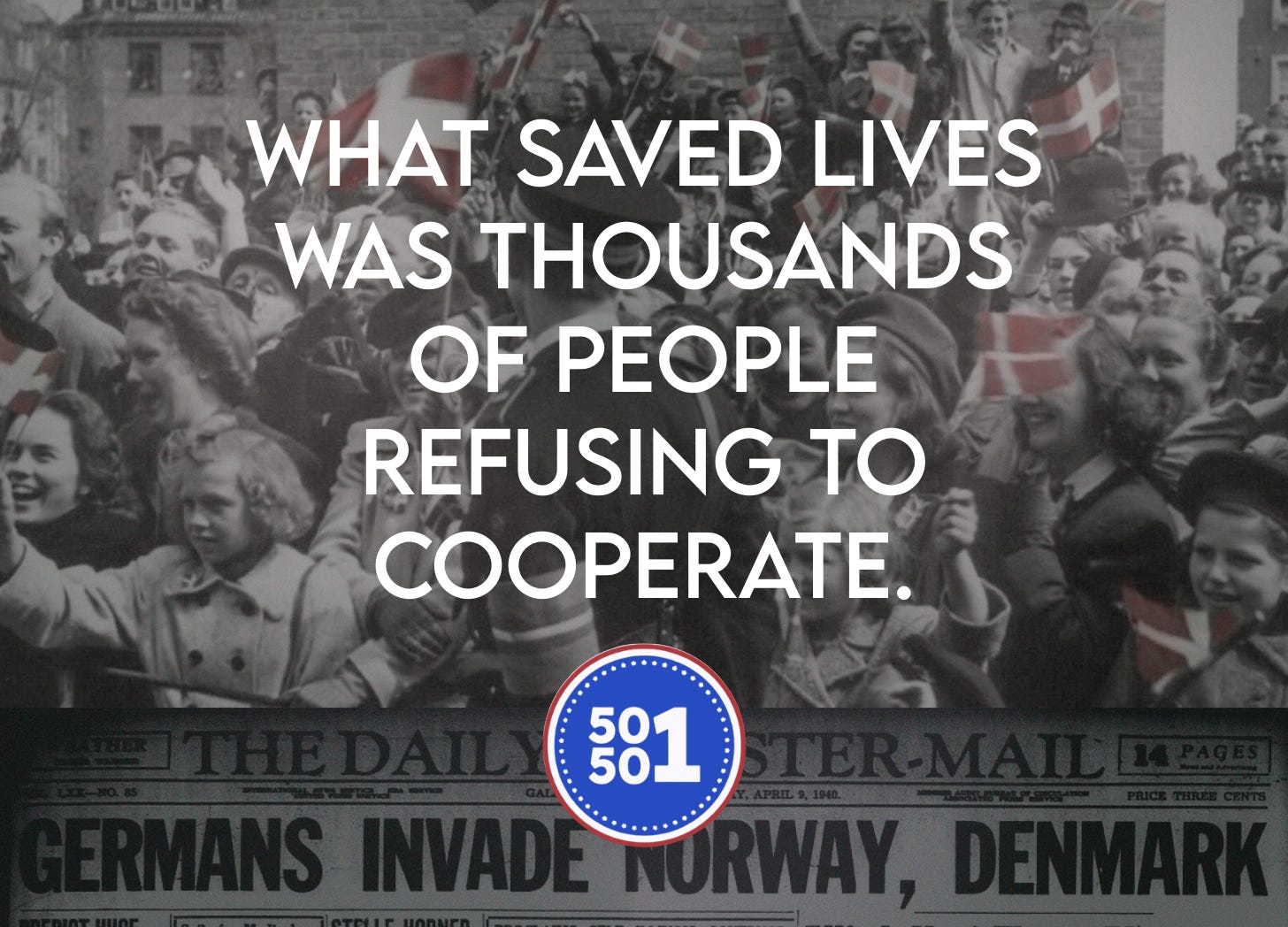
Germany occupied Denmark on April 9, 1940.
For the first few years of the occupation, Denmark’s government remained in place and Danish Jews were not subjected to the same anti-Jewish laws that had already been imposed in much of Nazi-occupied Europe. That didn’t mean they were safe, rather it meant the danger had been delayed.
That changed in late August 1943.
On August 29, the Danish government resigned rather than accept new demands from the German occupation authorities, and martial law was imposed. With that shift, the limited protection Danish Jews had experienced effectively ended. Werner Best, the top German official in Denmark, then pushed for their deportation.
The plan might have succeeded if the warning had not spread first.
On September 28, German diplomat Georg Ferdinand Duckwitz learned that arrests and deportations were about to begin and passed that information to Danish political contacts. From there, the warning reached leaders in the Jewish community, including Chief Rabbi Marcus Melchior. The next day, September 29, as Rosh Hashanah began, Melchior warned members of his congregation not to return home, but to go into hiding and alert others immediately.
That warning set off a rapid chain of action.
People shared information through personal networks, and within hours many Danish Jews began leaving their homes and seeking shelter.
When German officers began arrests on the night of October 1, many of the people they expected to find were no longer there.
What followed was not a single organized operation led from the top.
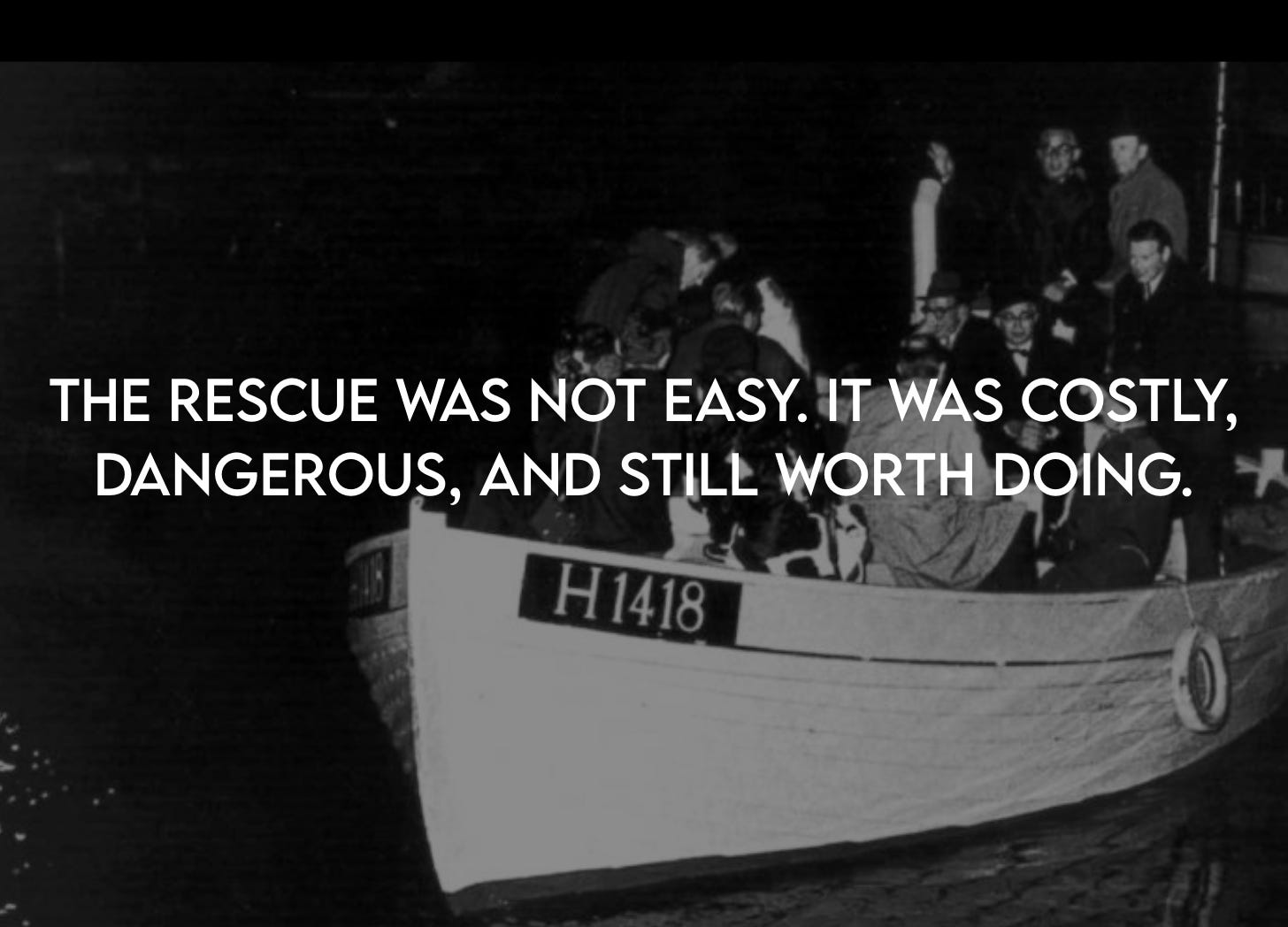
It was a decentralized rescue effort carried out by people across Denmark. Families hid neighbors in their homes. Hospitals and churches provided temporary shelter. Friends warned friends. Local helpers arranged transportation, food, and safe places to stay. Many Jews traveled north from Copenhagen by train, car, or on foot, trying to reach fishing towns along the coast.
From there, Danish fishermen and other local residents helped ferry people across the Oresund to neutral Sweden. Committees raised money to pay for transport, coordinated departures, and helped families move from one hiding place to another. The rescue succeeded because thousands of people chose to act quickly and help their neighbors.
One of the most important places in that story was Gilleleje,
which is a fishing town on the northern coast of Zealand. Roughly 20 percent of Denmark’s Jews escaped through that area. People arrived because Gilleleje was close to Sweden and connected by road and rail to Copenhagen. Locals organized food, shelter, and departures. Fishing boats and small craft ferried families across the strait.
The operation expanded because people improvised faster than the occupiers expected.
After the Gestapo returned to Gilleleje with reinforcements, about 80 Jews were arrested on the night of October 6 after a local informer led German forces to the church.
Across Denmark, almost 500 Jews were ultimately deported to Theresienstadt concentration camp. This wasn’t a safe, cost-free rescue. It included betrayal, fear, failed crossings, and people who were caught.
The result remains one of the most remarkable acts of collective resistance in Nazi-occupied Europe.
In just a little more than three weeks, Danes helped ferry more than 7,000 Jews and close to 700 non-Jewish family members to safety in Sweden. And even among those deported to Theresienstadt concentration camp, the vast majority survived because Danish officials kept pressing the Germans for information and access, eventually securing a visit by representatives of the Danish and International Red Cross, and later allowing food and medicine to be sent to the Danish deportees. More than 98 percent of Denmark’s Jewish population survived.
Have you ever been warned about something and acted on it before most people took it seriously? What made you act?
What This Has to Do With March 28
March 28 is not Denmark in 1943, and people should be careful about historical comparison. But authoritarian movements, then and now, depend on similar structural weaknesses in democratic societies such as fear, confusion, delay, isolation, and the assumption that someone else will handle it.
The Danish rescue is instructive because it shows the opposite of what the regime counted on. Resistance turned real when it moved through existing community connections, through the person who heard the warning and passed it on and through the friend with a spare room. The line between “just ONE person” and “person who changed history” is thinner than what we’ve been taught to believe because just ONE person can be enough to change the course of history.
That’s what March 28 is about, finding community and having a network of people to look out for one another.
There is so much that we can learn from history.
Learning that waiting for perfect conditions is just another form of surrender.
Learning that community is power.
Learning that warnings work when communities act on them.
Learning that movements are built by people who decide that this moment belongs to them, too.
If you have not already read our action guide, start here: March 28 Is Coming Up. Here Is Everything You Need to Do Before You Go.

Share this story. The more people who see it before March 28, the more people will understand what movements are and the more people may decide to become part of one.
Join the discussion, comment below!
Sources:
United States Holocaust Memorial Museum | Rescue in Denmark
Yad Vashem | The Rescue of Danish Jewry
National Museum of Denmark (PDF) | October 1943: The Rescue of the Danish Jews from Annihilation
Yad Vashem | Georg Ferdinand Duckwitz | Righteous Among the Nations
For another lesson on history and how small symbolic resistance can make a huge impact, click here!
I never knew this story. Yes I have acted to stand up to racist acts to a college professor when I was a freshman in a giant lecture hall. Not one other student supported me as I marched up to the stage to denounce the professor. I was poor, tiny , shy 18 year old girl. The older, very large professor screamed in my face, said he would fail me and threw me out of class. I went to the Dean who did nothing. I went to the local newspaper who told my story. The professor was forced to resign. I am white. The group he was maligning were Mexican women. I knew his words of hate were immoral. Although I was nervous, I spoke out.
Feeling goosebumps and inspiration reading this! A movement that’s decentralized, grassroots, quick-acting and, of course, focused on helping the most vulnerable, is exactly what we’re doing right now. And, I happen to have a Danish flag flying today 🇩🇰💪