


📌 NOTE FOR NEW READERS:
50501 organizes peaceful protests defending democracy across all 50 states. We now have over 80,000 subscribers to our Substack community. If you’re new here, welcome! If this resonates with you, hit the subscribe button to stay connected.
TL;DR:
“Don’t worry, that won’t affect you” is how white privilege props up authoritarianism. A baker in 1935 Berlin believed he was safe while his Jewish neighbors disappeared. That bystander comfort powered the Holocaust and the same pattern is alive in the U.S. today. This is about learning to hear those eight words as a siren and choosing solidarity over safety before it’s too late.
Berlin, 1935:
The Baker Who Thought He Was Safe
Every morning before dawn, Klaus Weber would step into his bakery on Rosenthaler Straße.
Flour dust in the air while the oven breathes heat. The street outside is still dark and quiet except for the rattle of the tram.
For twenty years, the Goldsteins have lived two doors down.
Their children would chase each other in laughter across the cobblestones.
Mrs. Goldstein and Klaus’s wife would trade recipes and gossip in the stairwell.
On Fridays, without fail, Mr. Goldstein would come in for the same rye loaf and an extra roll “for the walk home.”
This is what Klaus believes his life was made of:
routine, bread, neighbors, small kindnesses.
Then the Nuremberg Laws pass.
One evening, after the radio crackles out the news, his brother-in-law waves a hand and laughs:
“Don’t worry. None of that will affect you. You’re not Jewish.”
Klaus feels a knot in his stomach, but he lets the words settle over.
He believes him.
Why wouldn’t he? The ovens are still hot.
The children are still laughing.
The rye still sells out by noon.
By 1938, the Goldsteins are gone. No forwarding address. No goodbye. Just an empty apartment and a door that never opens.
By 1942, Klaus is baking bread for Wehrmacht soldiers, trying not to wonder where his neighbors disappeared to or why the city feels more cruel every month.
By 1945, his shop is rubble. His son is dead on the Eastern Front. The street is unrecognizable.
And for the rest of his life, Klaus would ask himself the same question
How did I not see it coming?
The Comfort of a Dangerous Lie
Oppression doesn’t always happen all at once or quickly.
One of the most dangerous parts of white privilege isn’t the material comfort.
It’s the illusion that you can watch someone else be crushed and somehow remain standing on solid ground.
That you can spectate while:
rights dissolve
families are separated
books burn
…and you’ll still be “fine.”
Authoritarianism lives on that illusion.
This Is Just Some of Who They’re Targeting Right Now
They’re coming for immigrants.
“Don’t worry, you’re not an immigrant.”
They’re coming for trans.
“Don’t worry, you’re not trans.”
They’re coming for teachers who teach real history.
“Don’t worry, you’re not a teacher.”
They’re coming for women’s autonomy.
“Don’t worry, you can travel.”
They’re coming for voting rights.
“Don’t worry, you vote Republican.”
What did you say back when someone said this to you?
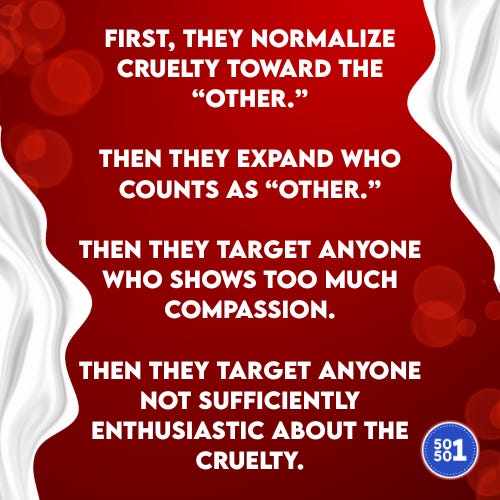
First, they normalize cruelty toward the “other.”
Then they expand who counts as “other.”
Then they target anyone who shows too much compassion.
Then they target anyone not sufficiently enthusiastic about the cruelty.
By the time Klaus realizes there is no such thing as safe in a system built on cruelty, there’s no one left to stand with him.
The Lie White Comfort Tells Us
If you’re white, that soft voice that whispers this won’t affect you is specifically designed for you.
In 1930s Germany, a lot of “good” Germans weren’t cartoon villains. They were comfortable. They had enough distance and privilege to believe the harm would never reach their street.
That comfort became an engine.
Not hatred. Indifference.
Not malice. Comfort.
Not evil. Silence.
Authoritarians don’t need everyone to be cruel.
They just need enough people to be comfortable.
How “Some People Matter Less” Comes for Everyone
Here’s what the architects of oppression understand:
If they can convince you that cruelty toward them won’t touch you, they can do anything.
Once you accept that some people are “others” who deserve less, you’ve handed over the strategy for your own oppression.
The thing about “some humans matter less”:
Eventually, you’re some human.
You’re too old, sick, poor, disabled, loud, queer…
Too compassionate.
Eventually, you’re the one who “matters less.”
And when they come for you, everyone else has already realized what this really means: “Don’t worry. None of that will affect me.”
If You Come for Them, You Come for Us
The alternative to becoming Klaus isn’t complicated, but it’s not easy either.
You have to refuse the comfort.
When they come for your neighbors, you refuse to take refuge in not-being-them.
You say:
“If you come for them, you come for all of us.”
And then you back it up with:
your body
your voice
your vote
your money
your time
Your privilege becomes a shield to protect and defend, not insulation.
When have you refused that comfort? When have you accepted it?
If you feel safe sharing, tell us below. Naming it is part of changing it.

Treat These Eight Words Like a Fire Alarm
1. Ask: Who is it affecting right now?
Follow the harm, not the reassurance.
If someone is telling you not to worry, someone else is worrying.
2. Refuse to repeat their line.
Instead of “that won’t affect me,” practice:
“If it harms them, it harms us all.”
3. Move one step closer, not one step away.
That might look like:
showing up to the school board meeting instead of just reading the recap
calling your representative when “it’s not your issue”
donating to legal defense or mutual aid even if your own rights feel secure
intervening when a friend, coworker, or relative repeats dehumanizing talking points
4. Treat your comfort as a resource, not a prize.
If you have safety, use it to make more people safe, not fewer.
The Cost and the Gift
This is not free.
Refusing comfort will cost you:
some ease
some relationships
the luxury of looking away
But it also builds something authoritarians can’t take away.
Solidarity. Community. And collective resistance that:
toppled monarchies
ended apartheid
won civil rights, voting rights, and labor rights
The kind of love that looks like justice.
That’s what terrifies authoritarians, not our individual safety, but our collective refusal to be divided into “safe” and “sacrificed.”
Klaus learned too late that there’s no personal safety in a society that permits cruelty.
We get to learn it in time.
Answering “Don’t Worry” With “Yes, It Will”
So when someone says:
“Don’t worry, none of that will affect you.”
Remember Klaus.
Remember that he wasn’t a monster. He was a man who believed he could stay safe while his neighbors suffered.
Make a different choice.
Choose solidarity over safety.
Choose community over comfort.
Choose resistance over indifference.
The most dangerous words in history:
“Don’t worry, none of that will affect you.”
The most powerful response:
“Yes, it will. And I refuse to let it happen.”
What will you do the next time you hear those eight words?
That was very powerful.
As for me, I studied ww2 decades ago, so i had no trouble believing this is all happening.
The frustrating part is getting others to see it.
I have found things I can do to fight back and I will not stop. This is not the world I want to leave for the kids
The only way I sleep at night is by doing what I can during the day to protect neighbors and democracy.