


📌 NOTE FOR NEW READERS: The 50501 Movement organizes peaceful action across all 50 states to defend democracy. 80,000+ subscribers strong and growing. If this resonates with you, hit subscribe and join us.
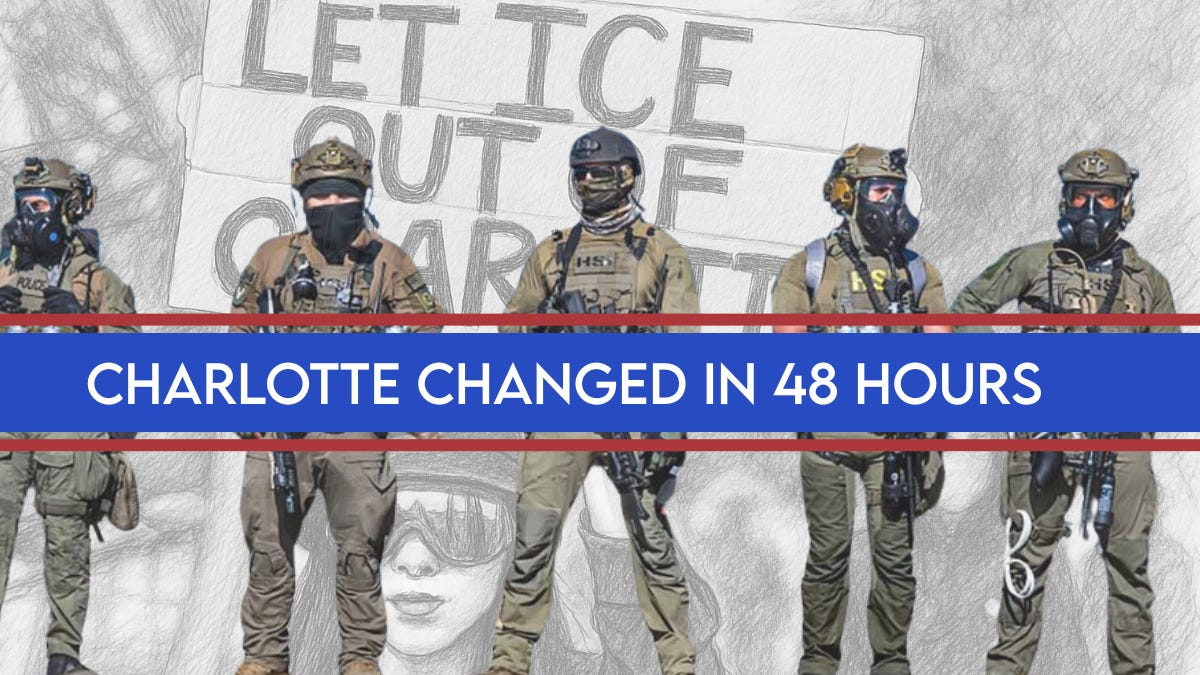
TL;DR: Federal agents launched “Operation Charlotte’s Web” in Charlotte, North Carolina this weekend, arresting 81 people in approximately five hours on Saturday. Businesses shuttered, families hid, and the city that once celebrated diversity through food trucks and cultural parades went silent. U.S. citizens were detained. Car windows were smashed. Agents were reported at churches and apartment complexes. This is what happened, what it means, and what you need to do before it happens in your city. New Orleans is listed as next. Asheville’s mayor says her city may be targeted.
Charlotte used to be a place of slow, easy mornings.
Alt National Parks:
Coffee cups clinking in cozy cafés, jazz drifting through open doors on Tryon Street, families stepping onto the light rail with strollers and soccer bags. A city defined by banking towers and craft breweries, where weekend accomplishments were measured by Panthers touchdowns, farmers’ markets, and late-night debates about who served the best barbecue in town.
By this weekend, that collapsed.
Before sunrise on Saturday, unmarked SUVs slid through quiet neighborhoods. Border Patrol agents moved in like a storm. Residents described officers sprinting through parking lots, jumping fences behind small bakeries and mercados, voices shaking as shouts ricocheted between brick storefronts.
Some said they watched people shoved to the ground and belongings scattered.
A café known for empanadas and music stayed shuttered, its metal grate pulled tight. A handwritten note hung on the door: “Closed for the safety of our community.” Just down the street, a weekend lunch spot told customers online: “Too dangerous today. Please stay home.” Parents kept children inside. Workers who normally clocked in before dawn called their bosses in fear.
The city that once celebrated diversity through food trucks, cultural parades, and church festivals found itself being invaded and intimidated by ICE. Although doors were locked, neighbors said it didn’t feel like protection. It felt like punishment. Not order, but intimidation.
Operations were no longer about safety.
This was fear that reached families, workers, business owners, and even those with the legal right to be here. And in the quiet between sirens, the city wondered what it was becoming.
Then Sunday morning came.
Gregory Bovino, the Border Patrol commander leading the operation, posted on social media: 81 people arrested. “Massive numbers in Charlotte,” he wrote. “Some good criminals also.”
81 people in approximately five hours.
Willy Aceituno knows what “massive numbers” feels like up close.
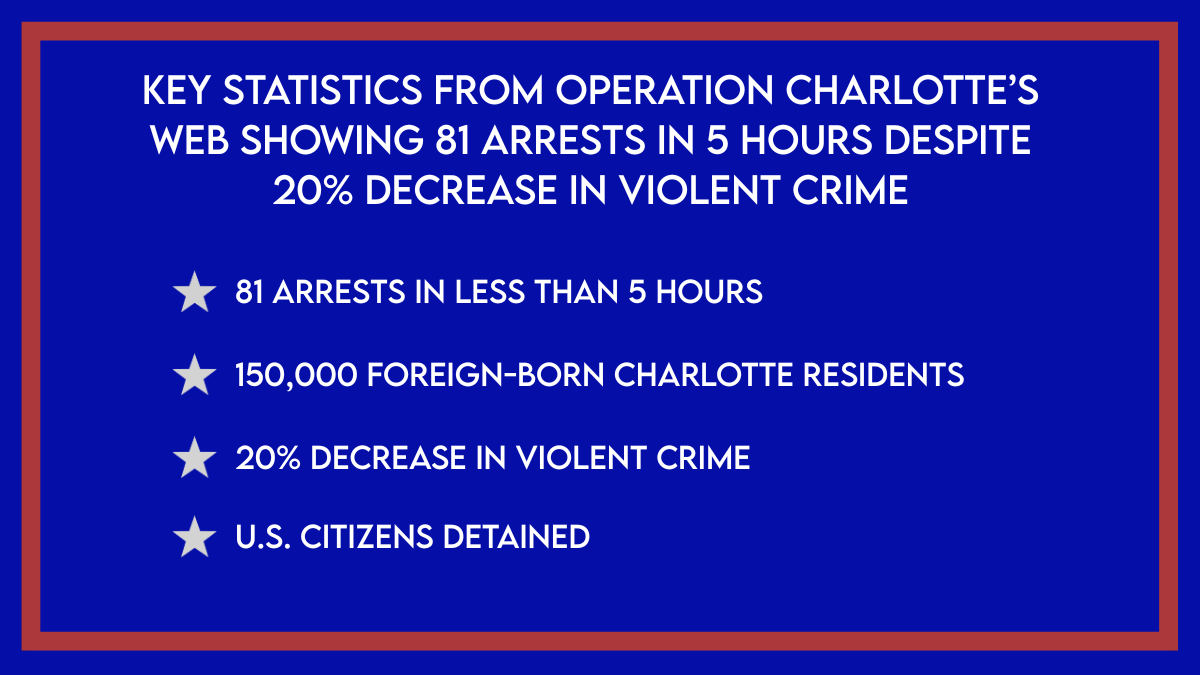
By Sunday morning, 81 people were gone.
What Happened This Weekend
Willy Aceituno is a 46-year-old U.S. citizen. Born in Honduras, naturalized years ago, working in Charlotte, living his life.
Saturday morning, he was on his way to work when he saw “a lot of Latinos running,” chased by “a lot of Border Patrol agents”.
He was stopped, twice.
During the second encounter, agents broke his car window, forced him from his vehicle, and threw him to the ground.
“I told them, ‘I’m an American citizen,’” he said.
They detained him anyway. Only after showing his citizenship documents was he released.
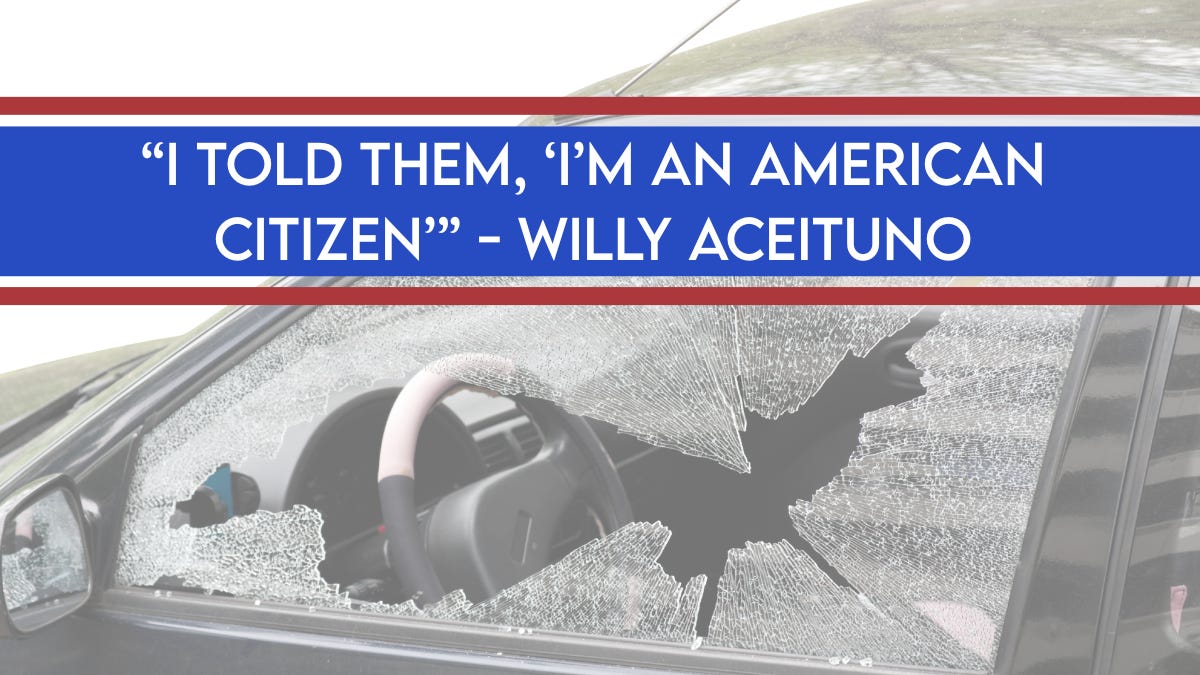
“They wanted to know where I was born, or they didn’t believe I was an American citizen.” - Willy
His car window was smashed. His morning was ruined. His faith that citizenship protects you was shattered along with his car window glass.
Willy wasn’t alone in how he was treated.
The Department of Homeland Security announced Saturday it was launching “Operation Charlotte’s Web” because local law enforcement refused to detain people for immigration violations without judicial warrants.
Assistant Secretary Tricia McLaughlin said the operation targeted “violent criminal illegal aliens.” DHS claimed nearly 1,400 immigration detainers across North Carolina had not been honored, putting the public at risk.
But here’s what really happened on the ground:
Workers putting up Christmas decorations in a homeowner’s front yard were approached by agents. The homeowner, Rheba Hamilton, watched two CBP agents walk into her yard Saturday morning. One tried to speak to her workers in Spanish. The workers didn’t respond. The agents left without making arrests, but it made them realize that nowhere is safe.
Businesses along Central Avenue and South Boulevard reported Border Patrol agents in unmarked cars making stops throughout Saturday morning. Latino business owners watched agents in green uniforms, masks, and sunglasses chase people through shopping centers.
A dental clinic run by Camino, a nonprofit serving Latino communities, had nine appointment cancellations on Friday alone. Spokesperson Paola Garcia said people were too afraid to leave their homes to attend school, medical appointments, or work.
By Sunday, reports of CBP activity were “overwhelming,” according to Greg Asciutto, executive director of CharlotteEast, a community development group. “The past two hours we’ve received countless reports of CBP activity at churches, apartment complexes, and a hardware store,” he said.
Churches, where people pray and apartment buildings, where children sleep.
On Saturday afternoon, hundreds of Charlotteans gathered in uptown to protest. They condemned the deployment of federal immigration agents, carried signs, and chanted.
North Carolina Governor Josh Stein, a Democrat, said Friday that “The vast majority of people they have detained have no criminal convictions, and some are American citizens.”
He urged people to record any “inappropriate behavior” they witness and notify local law enforcement.
The Charlotte-Mecklenburg Police Department emphasized it isn’t involved in federal immigration enforcement and had no authority to enforce federal immigration laws.
The Mecklenburg County Sheriff’s Office said two federal officials contacted Sheriff Garry McFadden on November 13, confirming Border Patrol agents would arrive November 15 or early the following week. They didn’t disclose details about the operation.
This Has Happened Before
If Charlotte feels like a preview of something terrible, that’s because it is.
We’ve seen this before:
May 12, 2008. Postville, Iowa.
A town of 2,200 people woke to the sound of helicopters circling overhead. Pedro Lopez, a seventh grader at the time, gathered with friends at the school window. They thought maybe the National Guard was recruiting high schoolers, giving them helicopter rides.
By that afternoon, 389 people had been arrested at the Agriprocessors meatpacking plant. Nearly 900 federal agents. Multiple helicopters. The largest single-site immigration raid in U.S. history at that time.
Within days, most workers were sentenced to five months in prison and deportation.
Schools nearly stopped because so many children lost parents. Storefronts went dark. Property values sank. Families who didn’t work at the plant fled anyway, terrified they’d be next.
One resident, Bob Schroeder, told reporters in 2025 that Postville has “never quite returned” even 17 years later. “The biggest thing was the kids. Kids lost their parents,” he said. The population dropped. Businesses closed permanently. The economic impact extended far beyond the 389 arrested.
Allamakee County, which houses Postville, lost more than 1,300 jobs from 2008 to 2009. Annual payroll decreased about 20 percent, nearly $28 million. Eight years after the raid, job numbers still hadn’t recovered.
The human cost was even worse.
University of Michigan researchers found that Latina mothers in Postville gave birth to lower-weight infants at significantly higher rates in the year following the raid. The trauma was measurable in newborn babies.
Children whose parents were deported dealt with persistent mental health issues years later. Families who got humanitarian release reported fewer mental health problems than those who weren’t released, but everyone suffered.
The raid cost taxpayers over $5,211,092 as of August 2008, not including costs from the U.S. Attorney’s Office, Department of Labor, or local Postville authorities. It devastated an entire community for years. The plant eventually reopened under new ownership, struggled to find workers, and had to recruit from homeless shelters and rehab centers before finally filling positions with Somali refugees.
And what did it achieve?
The owner who employed those workers, Sholom Rubashkin, went to prison for financial fraud. President Trump commuted his sentence in December 2017. The workers? Deported. Their families? Destroyed. Their community? Still recovering nearly two decades later.
Charlotte is following the same script. The same tactics and justifications that turned a small Iowa town into a case study of what happens when immigration enforcement becomes about punishment instead of safety.
Postville wasn’t the only one. Swift meatpacking plants across six states in 2006: approximately 1,300 arrested. New Bedford, Massachusetts textile plant in 2007: 361 arrested. Bean Station, Tennessee in 2018: operations were severely reduced after the raid.
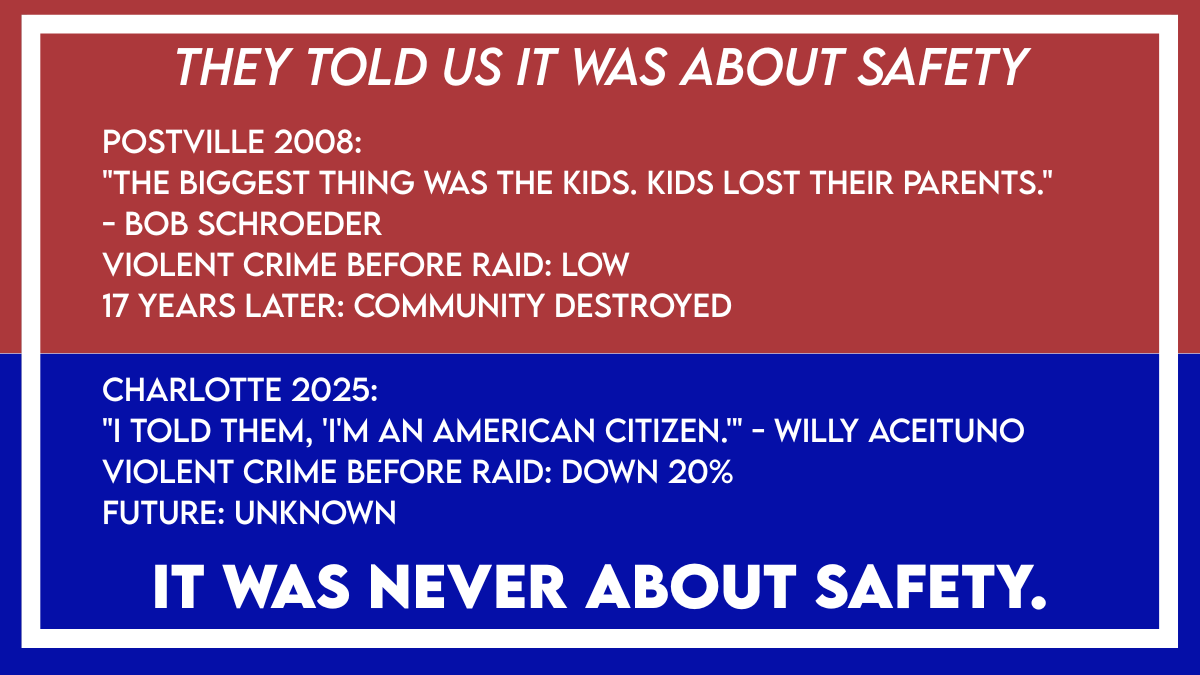
“The biggest thing was the kids. Kids lost their parents.” - Bob Schroeder, Postville resident
Have you heard about immigration enforcement activity in your area? Drop your city/state in the comments. Let’s track where this is happening.
New Orleans and Asheville are Most Likely Next
Gregory Bovino, the Border Patrol commander who led operations in Chicago (where more than 3,000 people were arrested from September through early November) and Los Angeles, is now running Charlotte.
After Charlotte? New Orleans.
Asheville, North Carolina Mayor Esther Manheimer said in a statement Saturday: “We have learned that Asheville may be a targeted city”.
She added: “We believe every person, regardless of immigration status, should feel safe in the community they call home”.
The operation has a name. A budget. A timeline. And a list.
Is your city on it?
Your Survival Toolkit:
What to Do When ICE Comes to Your Community
Charlotte taught us this weekend: you won’t get a warning.
Federal officials didn’t announce the operation. Local leaders found out when agents showed up. Families woke Saturday morning to helicopters and unmarked cars.
You need to prepare now. Not when you hear helicopters. Now.
How to Protect Your Community Starting Today
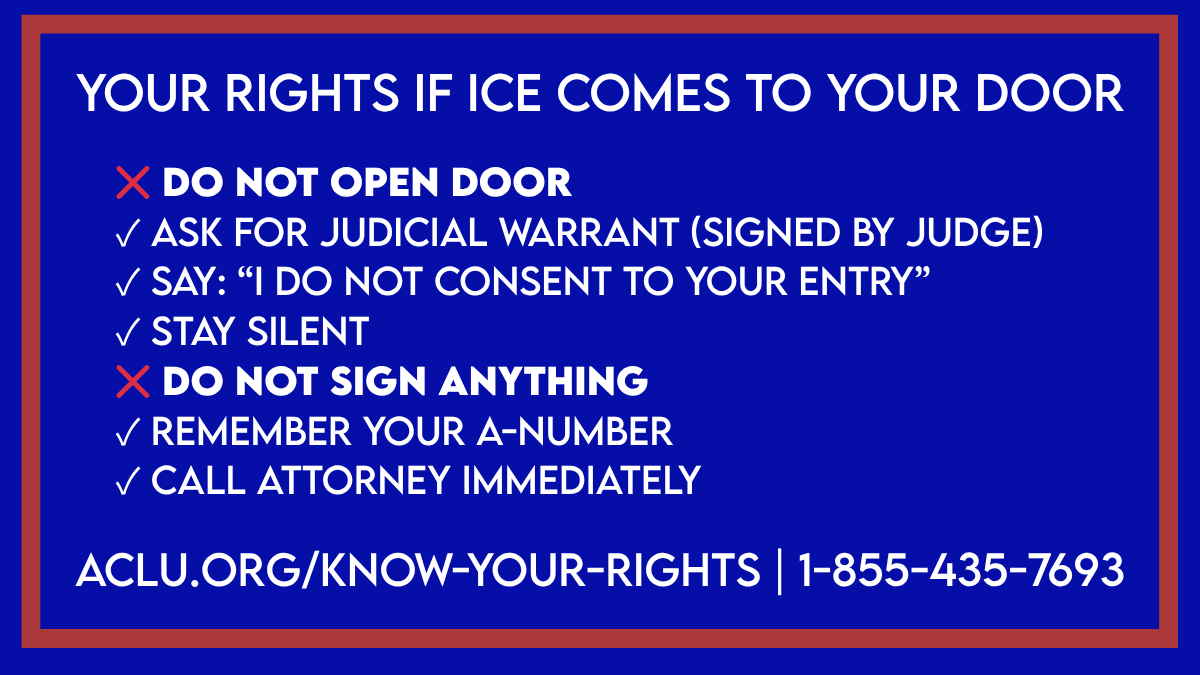
If ICE Shows up at Your Door
Do not open your door. ICE cannot enter your home without a judicial warrant signed by a judge.
If agents say they have a warrant, ask them to slip it under the door. Look at the top and signature line. If it’s signed by a DHS or ICE employee instead of a judge, they cannot legally enter without your consent.
State clearly through the door: “I do not consent to your entry”.
If agents force their way in anyway, do not resist physically. State clearly: “I do not consent to your entry or search of these premises.” Then remain silent.
Do not sign anything. If you sign a document without speaking to an attorney first, you may be waiving your opportunity to remain in the United States.
Remember your A-number (alien registration number, if you have one). Share it with your family. This will help them find you if you’re detained. Use ICE’s online detainee locator: locator.ice.gov.
If You Witness ICE Activity
Charlotte showed us that citizens documenting ICE activity is critical.
Protesters filmed everything. Residents recorded from windows. Bystanders took photos of badge numbers and license plates.
Here’s how to do it safely:
Film horizontally to capture as much of what’s happening as possible.
Focus on filming the actions of the agents rather than yourself or the people around you.
Immediately call your local rapid response hotline. These networks verify ICE activity, dispatch legal observers, and connect detained individuals with immigration attorneys.
A Few Critical Rapid Response Hotlines:
Illinois Coalition for Immigrant and Refugee Rights (ICIRR): 1-855-HELP-MY-FAMILY (1-855-435-7693) (can provide resources outside of Illinois)
Carolina Migrant Network (Charlotte area): Currently building network, check carolinamigrant.org
Legal Aid Justice Center PODER VA: Build local rapid response
Find your local rapid response network at cliniclegal.org or search for your city’s rapid response immigration hotline.
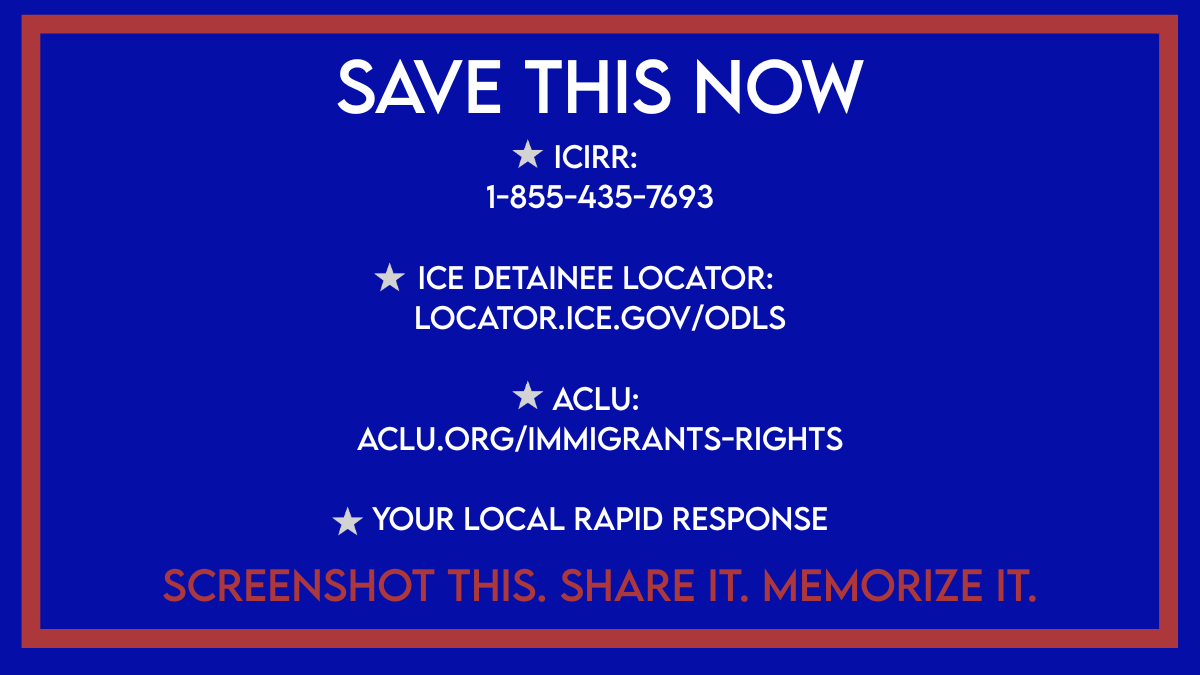
Critical Resources You Need Now
ACLU Know Your Rights guides (available in English, Spanish, and multiple languages):
What to do if ICE is at your door
What to do if stopped by ICE
What to do if ICE raids your workplace
Find them at: aclu.org/know-your-rights/immigrants-rights
Find an immigration attorney:
Immigration Advocates Network: immigrationadvocates.org
American Immigration Lawyers Association: aila.org
Catholic Legal Immigration Network: cliniclegal.org
ICE Detainee Locator: If someone you know was detained, use ICE’s online locator at locator.ice.gov/odls
Prepare NOW: Your Emergency Plan
Create an emergency plan today.
Your plan should include:
Emergency contacts: Memorize at least three phone numbers. Your attorney. A family member. A trusted friend. Write them down and give copies to people you trust.
Childcare authorization: Designate an adult to be a standby guardian for your children if you’re detained. Put this in writing. Give copies to your children’s school, your emergency contacts, and keep one at home labeled “privileged and confidential”.
Document copies: Make copies of birth certificates, passports, medical records, immigration documents. Give them to someone you trust outside your home. Never carry your passport with you daily since ICE can use it to speed up deportation.
Legal representation: Find an immigration attorney NOW, before you need one. Keep their name and number with you at all times.
Money: Save what you can. Immigration bond can cost thousands of dollars.
If You’re Arrested
Stay calm. Fear is their weapon. Don’t give them that power.
Say: “I want to speak to a lawyer and choose to remain silent.” Then stop talking.
Do not sign anything without your attorney present. ICE may ask you to sign forms agreeing to deportation without seeing a judge.
If you have a fear of returning to your home country, tell the agents immediately. This may affect your case.
Give your A-number (also called an Alien Registration Number) to your family so they can locate you through ICE’s detainee locator system.
You have the right to contact your country’s consulate. Ask agents to notify them of your arrest.
Who Authorized This
Gregory Bovino Border Patrol Commander leading Operation Charlotte’s Web. The same official who led major enforcement efforts in Chicago (3,000+ arrests) and was involved in Los Angeles crackdowns. He posts on social media bragging about arrest numbers.
Tricia McLaughlin Assistant Secretary for Public Affairs at the Department of Homeland Security. She announced the Charlotte operation and justified it by blaming “sanctuary politicians.”
Kristi Noem Secretary of Homeland Security. She oversees the entire operation.
Donald Trump He authorized the operation and has made immigration crackdowns a centerpiece of his administration.
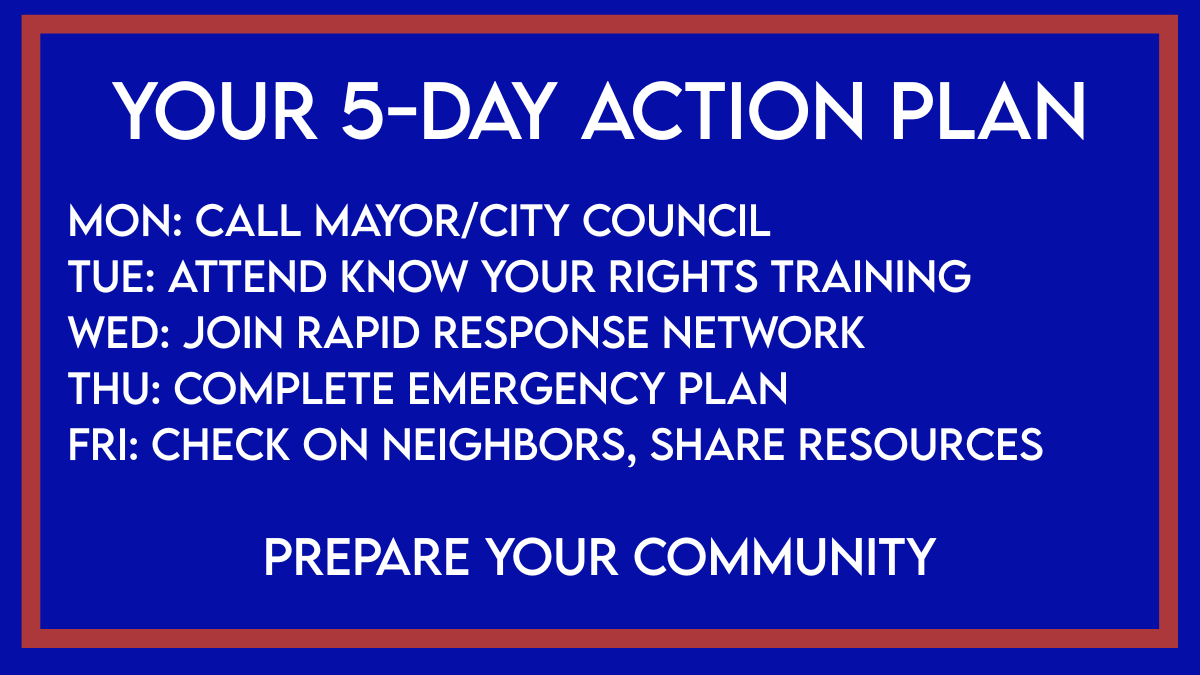
Monday: Call your mayor and city council. Demand they publicly declare your city will not cooperate with ICE without judicial warrants.
Tuesday: Find and attend a Know Your Rights training. If none exist in your area, organize one. Contact your local ACLU chapter for materials.
Friday: Check on your immigrant neighbors. Share these resources. Build community networks now, before the agents arrive.
The New Normal
Chicago: More than 3,000 arrests from September through November.
Los Angeles: Massive operations throughout the fall.
Charlotte: 81 arrests in approximately five hours.
New Orleans: Next on the list.
Asheville: Mayor says they may be targeted.
The Trump administration is deploying Border Patrol agents to Democratic-led cities under the justification of fighting crime and removing “violent criminal illegal aliens.”
But here are the facts Charlotte revealed:
NPR reports that Violent crime in Charlotte is down 20 percent compared to last year.
The vast majority of people detained in North Carolina have no criminal convictions, according to Governor Josh Stein.
U.S. citizens are being detained, like Willy Aceituno, who had his car window smashed and was thrown to the ground despite showing his citizenship documents.
Businesses are closing, dental appointments are being cancelled, children are being kept home from school, and entire communities are living in fear.
This isn’t about safety… It’s intimidation.
DHS claims Charlotte was targeted because of “sanctuary policies” the city’s refusal to detain people for ICE without judicial warrants. Mecklenburg County Sheriff Garry McFadden has sparred with ICE before, and several county jails in North Carolina do honor detainers.
The Charlotte-Mecklenburg Police Department doesn’t participate in immigration enforcement because they don’t have the authority to enforce federal immigration laws.
Charlotte Fought Back.
Your City Can Too.
After the arrests, hundreds of Charlotteans gathered Saturday afternoon in uptown to protest.
Local businesses closed in solidarity. Signs went up in Spanish: “Know Your Rights”. Restaurants that normally buzz with weekend crowds stayed dark, choosing safety over profit.
Citizens filmed federal agents. They wrote down badge numbers. They called rapid response hotlines.
City council members stood with immigrant communities. The mayor issued statements condemning the operation. Governor Stein urged residents to record inappropriate behavior and notify local law enforcement.
Charlotte showed up.
And that’s what terrifies them the most.
But Charlotte had warning. Chicago and Los Angeles came first. Organizers prepared. Communities trained. Networks formed.
When the agents arrived, Charlotte was ready.
Not ready to stop them, local police have no authority over federal agents. But ready to witness. Ready to document. and ready to support each other. Ready to fight back within the law.
That’s what your city needs to do now.
Before the helicopters circle and the unmarked SUVs arrive. Before your neighbors disappear.
Prepare your community. Build your networks. Know your rights. Share resources. Check on each other.
Because if you’re in a city with immigrant communities, if you’re in a Democratic-led area, if your local officials refuse to cooperate with ICE without judicial oversight, your city could be next.
Charlotte changed in 48 hours. How long will your community have?
We’re 80,000+ readers strong. If each of us shares this with three people, that’s 240,000 people who know what’s coming and how to prepare.
Forward this to someone who needs it. Download the ACLU guides. Memorize the hotline numbers. Create your emergency plan.
This is happening. Will your community be ready?
❤️ Like this post if you found it valuable.
Share with three people who need this information.
What resources exist in your city for rapid response? Share links, phone numbers, organizations. Let’s build a national directory together so we can create a toolkit to share.
Resources & Sources:
Rapid Response Hotlines:
ICIRR Family Support: 1-855-435-7693
Legal Aid Justice Center: justice4all.org/rapid-response-toolkit
Find local networks: cliniclegal.org/rapid-response
Know Your Rights:
ACLU Immigrants Rights: aclu.org/know-your-rights/immigrants-rights
ACLU North Carolina: acluofnorthcarolina.org/know-your-rights
Legal Resources:
Immigration attorney finder: immigrationadvocates.org
Catholic Legal Immigration Network: cliniclegal.org
National Immigrant Justice Center: immigrantjustice.org
Detainee Locator:
ICE Online Locator: locator.ice.gov/odls
Key News Sources:
Al Jazeera: “US immigration crackdown, arrests under way in Charlotte”
Associated Press: “Border Patrol official touts North Carolina arrests”
ABC News: “Federal agents deployed to Charlotte”
PBS NewsHour: “Trump’s next immigration crackdown”
Historical Research Sources:
Wikipedia: “Postville raid”
Urban Institute: “ICE worksite raids are back”
Iowa Capital Dispatch: “Postville raid brought devastation”
Axios Des Moines: “The raid that changed Postville”
Marketplace: “How an immigration raid threw a small Iowa town into economic crisis”
PMC (NIH): “Large-Scale Immigration Worksite Raids”
American Immigration Council: “Understanding ICE Raids”
Blue | The 50501 Movement | 80,000+ Subscribers Strong | fiftyfifty.one
For those in NC:
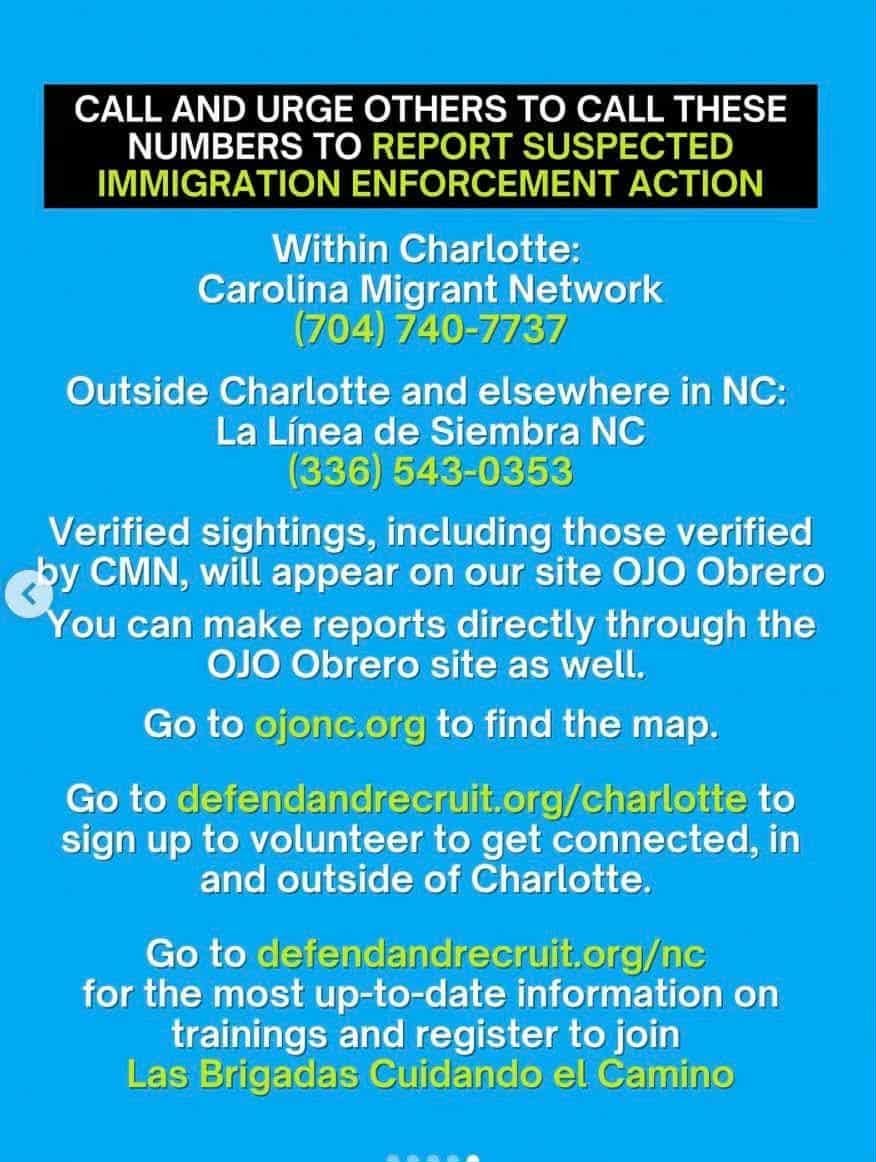

The evil hand of Bovino and Co. reaches down to sow fear and chaos. This isn’t government, it’s hell on earth!
I just finished reading this appalling article, here on the countryside of Uruguay. The contrast between there and here is even more frightening. Not even during military dictatorship, which lasted till 1984, such dreadful things happened, and atrocities were committed by either them and the tupamaros. My family arrived in 1979. We were issued a temporary CI (cédula de identidad), with our birthplace (Perú) included. Police stopped us, asked for them, let us go on. The USA ICE, with a democracy, are behaving worse. They are a small Geheime Staatspolizei with licence to kill. I shall download and archive this article to quietly peruse, when I am less shaken.