


📌 NOTE FOR NEW READERS: This is an independent publication covering 50501, No Kings, and the broader pro-democracy and civic-action ecosystem. Subscribe to join our community and to keep us posting.
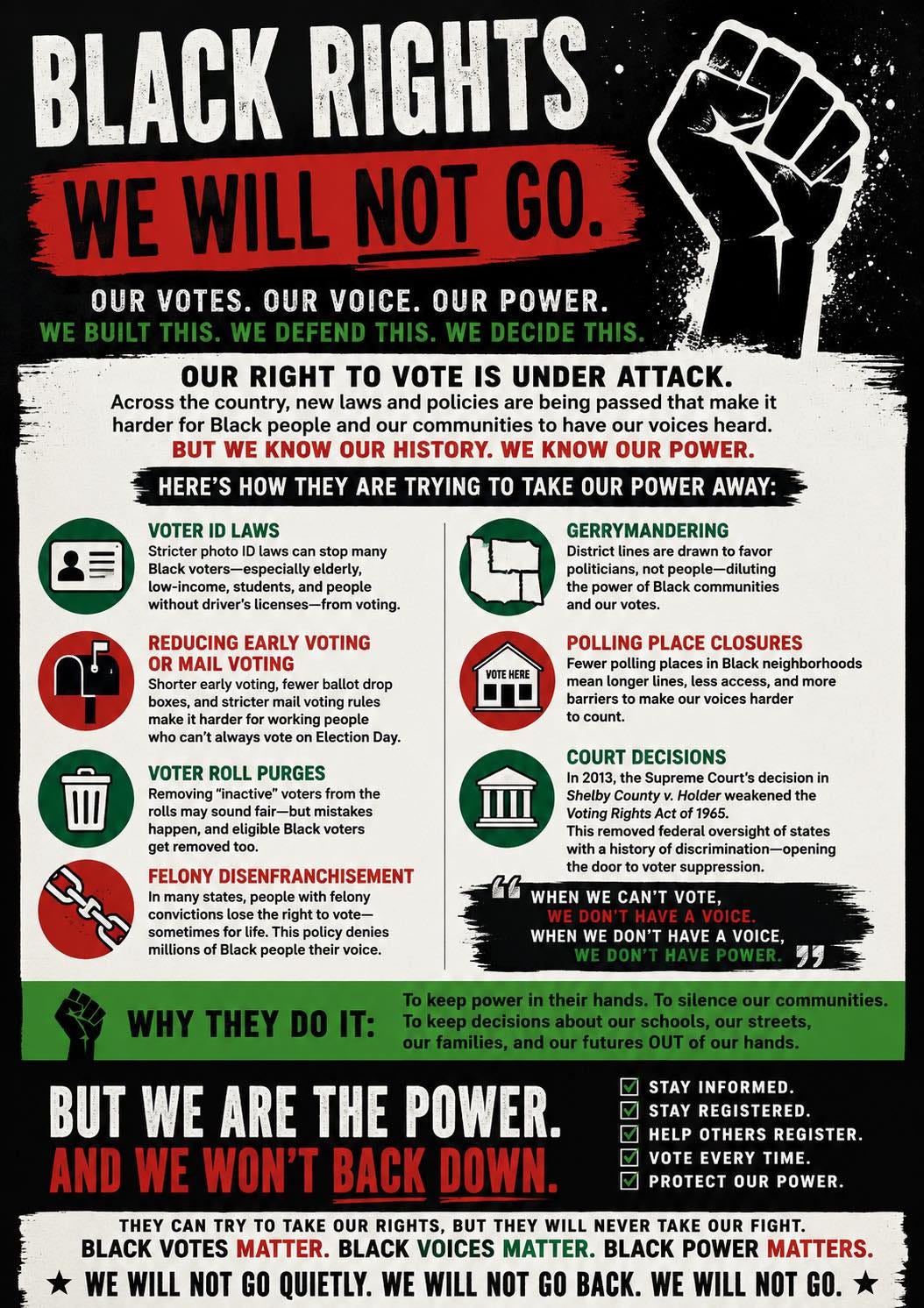
On May 7, Republican lawmakers approved a congressional map that breaks apart Memphis and Shelby County, dismantling Tennessee’s only majority-Black congressional district.
The new map splits Black voters in Memphis and Shelby County across three majority-white districts that stretch hundreds of miles into central Tennessee, according to the ACLU’s lawsuit. The result makes it likely that Republicans could hold all nine of Tennessee’s congressional seats after the midterms.
Yesterday, on May 12, Tennessee House Speaker Cameron Sexton stripped House Democrats of their standing committee and subcommittee assignments after protests during the special session.
In his letter to House Democratic Leader Karen Camper, Sexton accused Democratic lawmakers of disrupting the legislative process. He cited interlocking arms, blocking aisles, and the use of prohibited props or noisemakers.
Rep. Justin Pearson, a Democrat from Memphis, said the decision removed “me and every Democrat, and therefore every Black elected official in the state legislature from any committee we served on.” Rep. Justin Jones, Rep. Gabby Salinas, and Rep. Gloria Johnson also confirmed they were removed.
And it may not stop with the House.
Lt. Governor McNally’s spokesperson said McNally is “currently reviewing and considering several possible actions” against those who participated during the special session. Senate Democrats have not yet been affected, but the door is open.
Committees are where bills are shaped, debated, amended, delayed, killed, or moved forward. Removing elected representatives from those committees doesn’t only punish those representatives, it reduces the voice of every voter who sent them there. 24 House districts’ worth of Tennesseans now have less representation in the committee rooms where legislation is made.
What Tennessee Did
The new congressional map was unveiled only 24 hours before the special session vote.
To make it legally possible, lawmakers first had to repeal a 1972 Tennessee law that prohibited mid-decade redistricting. Gov. Bill Lee signed that repeal about an hour after it cleared the Republican supermajority.
The special session followed pressure from President Trump and came just days after the Supreme Court’s decision in Louisiana v. Callais weakened key Voting Rights Act protections for minority voters.
Republicans have defended the map as a partisan redistricting effort rather than a racial one. Republican leaders argued the map was drawn using partisan and population data, not race. Sen. John Stevens, the Senate sponsor of the new map, listed several Democratic-controlled states where district maps were designed for partisan advantage. However, civil-rights groups and Democratic lawmakers argue the practical effect is to split Black voters in Memphis across three majority-white, Republican-leaning districts, and that the stated neutrality does not change the outcome.
The redistricting package also weakened direct voter-notice requirements.
County election officials will no longer be required under state law to directly notify voters by mail when redistricting changes affect their polling-place assignments, though separate funding was included to reimburse counties that choose to send notices.. Making voter self-checking even more important.
Tennessee voters: verify your registration, district, and polling-place information now.
The Secretary of State’s office announced a special qualifying period for U.S. House candidates through noon on May 15, and local reporting says the new districts bring changes for some voters and candidates.
The Retaliation
Sexton’s stated justification was that Democratic lawmakers disrupted the House floor during the special session. His letter cited interlocking arms, blocking aisles, using noisemakers, and allegedly coordinating with protesters.
The context can’t be separated from the punishment.
Democratic lawmakers were protesting a map that civil rights advocates say dilutes Black voting power in Memphis.
Black lawmakers stood in the front of the chamber linking arms in prayer as protesters chanted against the maps.
Protest is being treated differently depending on who is protesting, what they’re protesting, and whose power is being challenged. The same legislature that moved rapidly to reshape representation is now punishing the lawmakers who resisted that reshaping.
Rep. Gabby Salinas of Memphis posted a single message after receiving her removal letter: “I would do it again.”
She also said “It’s interesting that disenfranchising an entire district here in Shelby County carries zero consequences, but speaking out, using your voice, and representing the interest of the people of Tennessee is something that they deemed punishable.”
The Legal Fight
The NAACP Tennessee State Conference filed an emergency petition on May 7 in Davidson County Chancery Court, arguing that lawmakers violated Tennessee law and the state constitution when they repealed the ban on mid-decade redistricting during a special session whose stated purpose did not include that repeal. The Tennessee Supreme Court has named a three-judge panel to hear the case.
A separate federal lawsuit filed by the Tennessee Democratic Party, Rep. Steve Cohen, several congressional candidates, and voters is also moving forward. The May 20 hearing is now the next major court date. A federal judge will consider whether to temporarily block Tennessee’s new congressional maps, but that hearing comes five days after the May 15 candidate qualifying deadline. That timing is part of the problem plaintiffs are raising: the map was passed deep into the election calendar, after candidates and voters had already begun operating under the previous districts.
On May 11, the ACLU and ACLU of Tennessee filed a third lawsuit in federal court on behalf of three Memphis voters and several community organizations including the Black Clergy Collaborative of Memphis. The ACLU’s complaint argues the map constitutes intentional racial discrimination and First Amendment retaliation against Black voters for their political expression. The ACLU’s filing also placed the redistricting within a broader pattern of state action targeting Memphis specifically: the 2017 removal of bicentennial funding after the city took down Confederate statues, the expulsion of two Black lawmakers in 2023, a 2026 law authorizing state takeover of Memphis-Shelby County Schools, and another 2026 law giving the state Attorney General power to seek replacement of Shelby County’s elected district attorney.
Public attention keeps pressure on the process and helps voters understand what is happening before the next election deadline.
Why This Goes Beyond Tennessee
Tennessee is among the first states to enact a new congressional map after the Callais decision, and reporting from AP and Reuters confirms that the ruling has intensified redistricting fights across several states. Alabama, Florida, Louisiana, Mississippi, Missouri, and South Carolina are all engaged in redistricting efforts that follow the same pattern.
At the federal level, the fight moves state by state. Maps get redrawn and communities get split. Courts get asked to intervene. And when lawmakers speak up, they risk being punished for it.
On May 12, the Memphis City Council voted 10-0 to oppose the redistricting plan, saying it dilutes the political voice of Memphis, particularly its Black community, for partisan gain.
What We Can Do
This is a moment for focused civic pressure. Here is what is actionable right now:
For Tennessee readers: Contact Speaker Cameron Sexton (615-741-2343) and Gov. Bill Lee (615-741-2001). Ask that House Democrats be restored to their committee assignments and that the state stop enforcing a map that splits Memphis while litigation is pending.
For Tennessee voters: Check your registration, congressional district, and polling place directly through official election sources. Do not assume your district or polling place stayed the same. The Secretary of State announced a special qualifying period for U.S. House candidates through noon on May 15, and local reporting says the new districts bring changes for some voters and candidates.
For national readers: Support the legal and civil-rights organizations challenging these maps. Follow updates from the ACLU of Tennessee and Democracy Docket. The legal fight is moving fast, and public attention applies pressure.
For everyone: Call your own members of Congress and ask them to support federal voting-rights protections, national anti-gerrymandering standards, and protections against mid-decade map manipulation.
Here is a call script:
“Hello, my name is [NAME], and I am calling because Tennessee’s redistricting fight shows why Congress must act on voting rights and fair maps. Tennessee split the state’s only majority-Black congressional district, and now House Democrats have been removed from committees after protesting it. I am asking [REPRESENTATIVE/SENATOR NAME] to support federal voting-rights protections, fair redistricting standards, and public accountability for states that dilute minority voting power. Thank you.”
You can find your representatives at 5calls.org or by calling the Congressional switchboard at (202) 224-3121.
Share this post & make the calls.
Follow the May 20 hearing. And help Tennessee voters find the information they need before the qualifying deadline closes on Friday:
What action are you taking this week? What would be the best way to mobilize right now?
Further Reading / Sources:
Democracy Docket: Tennessee Republicans Strip Democrats from Committees
WSMV: Most TN House Democrats Stripped of Committee Assignments
ACLU: Tennessee Voters Sue to Block Redrawn Congressional Map
Tennessee Lookout: Federal Judge Sets May 20 Hearing
Tennessee Lookout: NAACP Lawsuit and State Response
AP/ABC News: Tennessee Redistricting Splits Memphis Neighbors

The quickness and ease with which things can get done when there's motivation and urgency is incredible. The flexibility of the law some times and not others is astounding.
Unbelievable. And blatantly.