


📌 NOTE FOR NEW READERS: This is an independent publication covering 50501, No Kings, and the broader pro-democracy and civic-action ecosystem. We cover the forces shaping this moment, the communities pushing back, and the peaceful actions taking shape across the country. Read by thousands, subscribe to join our community.
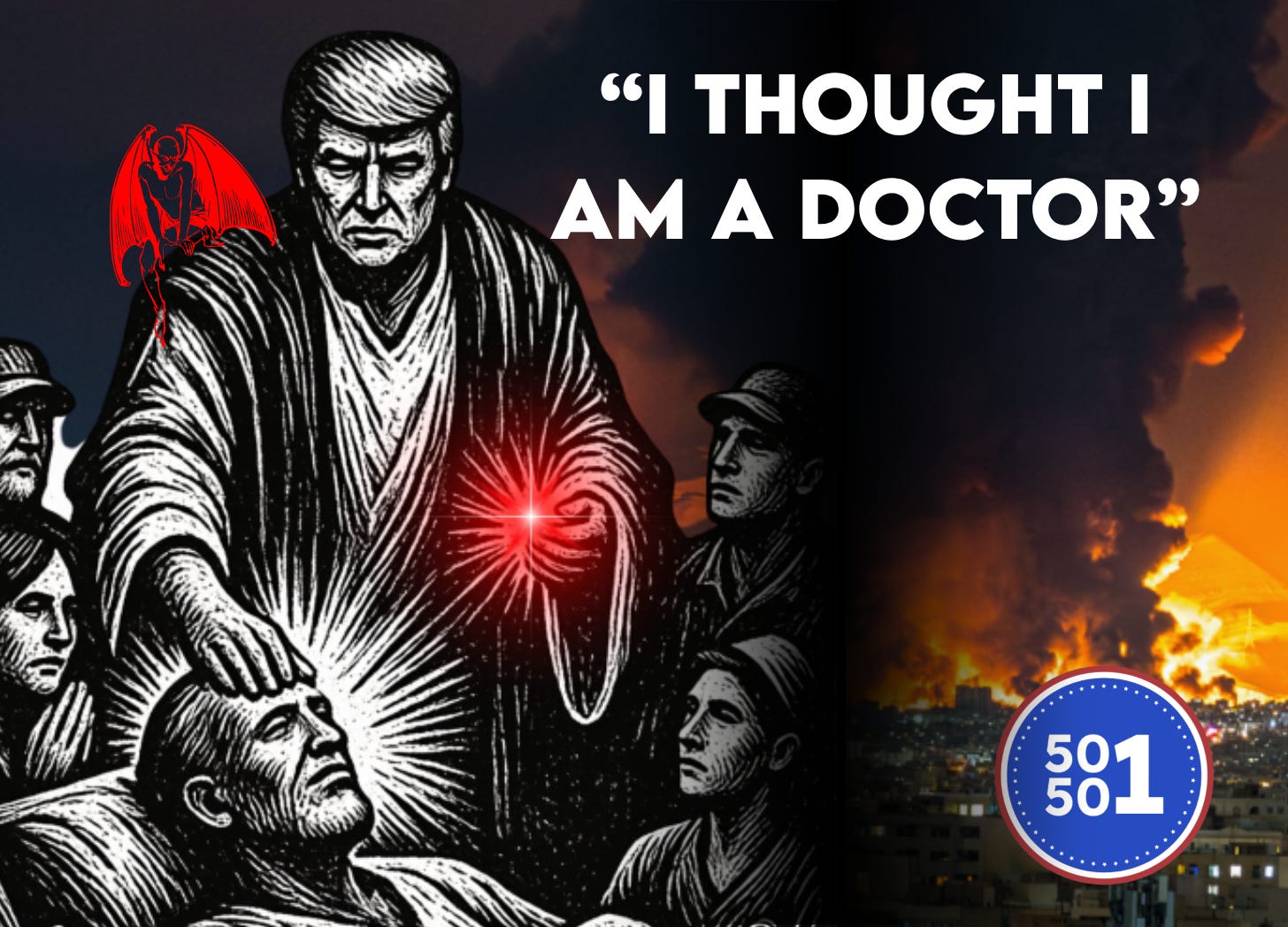
Early Monday morning, Trump posted an AI-generated image of himself in white and red robes, divine light emanating from his hand as he healed a bedridden man. Surrounding him were a nurse, a soldier, a woman with her hands clasped in prayer, the American flag, bald eagles, and the Lincoln Memorial. The image appeared on Truth Social shortly after he called Pope Leo XIV, the first U.S.-born pope in Catholic history, “WEAK on Crime, and terrible for Foreign Policy.”
By late Monday morning, the image had been deleted. When reporters asked about it, he told them he thought it was an image of himself as a doctor. A doctor, with ‘divine’ light pouring from his hands.
What the Sermon on the Mount Asks
The Sermon on the Mount is the most widely cited, most centrally placed ethical teaching in the entire Christian canon. In it, Jesus blesses the merciful, the peacemakers, the pure in heart, and the meek. He warns explicitly against lust, anger as a form of murder, oath-breaking, retaliation, and the love of public performance over private virtue.
He says, in Matthew 7:16, “You will know them by their fruits,” not by their affiliations or their self-descriptions.
The Old Testament commands that undergird the Gospel ethic are equally direct. Leviticus 19:34 instructs, “The stranger who resides with you shall be to you as one of your citizens; you shall love them as yourself.” The imago Dei teaching in Genesis 1:27 says, “So God created mankind in his own image, in the image of God he created them,” establishing that this dignity is universal and unconditional. Romans 2:11 states, “God does not show favoritism.” James 2:1 through 4 asks directly, “Have you not discriminated among yourselves and become judges with evil thoughts?” in its warning against honoring the powerful while dismissing the poor.
These teachings are central to mainstream Christian moral tradition and have been for centuries.
1973 and the Neighbor They Wouldn’t Rent To
In 1973, the Justice Department sued Trump, his father, and Trump Management for housing discrimination. The investigation found that Black applicants were being denied apartments or steered to inferior buildings while white applicants were offered units. The case settled in 1975 without an admission of guilt, but the documented findings established what the government believed had happened to people seeking housing.
Mark 12:31 records Jesus naming “Love your neighbor as yourself” as one of the two commands on which all of the Law and the Prophets depend. That command does not exempt housing policy.
The stranger Leviticus 19:34 instructs us to love was specifically the person who came from somewhere else, who did not share your background, who was dependent on whether you would treat them with fairness. Racial redlining was not a cultural quirk of the era that good Christians tolerated. It was a direct violation of what the tradition had taught for millennia about the equal dignity of every person made in God’s image.
2005 and the Theology of Entitlement
The Access Hollywood tape didn’t surface until 2016, but the conversation it captured took place in 2005. In it, Trump bragged to a television host about kissing women without consent and said that because he was a star, he could “grab them by the pussy” and face no consequences.
The deflection of “locker room talk” has been so thoroughly normalized that the actual content gets obscured. This is our president describing, with evident satisfaction, his own conduct toward women who had not consented.
Matthew 5:27 through 28 records Jesus saying, “You have heard that it was said, ‘You shall not commit adultery.’ But I tell you that anyone who looks at a woman lustfully has already committed adultery with her in his heart.” The moral responsibility extends inward, to the disposition of the heart that treats another person as an object for one’s own gratification. First Thessalonians 4:3 through 5 calls believers to “avoid sexual immorality” and to control their bodies “in a way that is holy and honorable, not in passionate lust like the pagans, who do not know God.” The violation is whether you see other people as full human beings or as instruments for your own pleasure and power.
2015 and the Two Attacks on the Stranger
In June 2015, Trump launched his presidential campaign by describing Mexican immigrants as people who brought drugs and crime across the border, and said, “They’re rapists. And some, I assume, are good people.” The framing here was deliberate.
Six months later, he issued a formal statement calling for a total and complete shutdown of Muslims entering the United States.
Taken together, these two statements targeted two different groups by two different methods, but the problem is nearly identical in both cases. Leviticus 19:34 doesn’t instruct God’s people to vet the stranger carefully before extending love. It says, “You shall love them as yourself.” Mark 12:31 uses the same language for the neighbor. Galatians 3:28 goes further still, declaring, “There is neither Jew nor Gentile, neither slave nor free, nor is there male and female, for you are all one in Christ Jesus.” The categories we use to divide humanity from humanity are dissolved in the Gospel’s vision of who counts as a person worthy of full moral regard.
Blanketing an entire nation’s immigrants as presumptive criminals, or declaring that an entire religious tradition should be barred entry, isn’t compatible with this teaching. The motivation is described as security or sovereignty, the teaching doesn’t include those exceptions.
2017 Through 2018 and the Hierarchy of Human Worth
After white supremacists marched with Nazi slogans through Charlottesville, Virginia in August 2017, and a counter-protester was killed when a car drove into the crowd, Trump told the country there were “very fine people on both sides.”
Christian leaders across denominations condemned the statement. Acts 10:34 records Peter saying, “I now realize how true it is that God does not show favoritism.” Matthew 5:9 calls peacemakers “the children of God.” The equivocation Trump offered that day was not a failure of political judgment. It was a moral statement about whose lives carry weight.
In January 2018, AP reported that Trump questioned why the United States would accept immigrants from Haiti and African nations, describing those countries with a slur, and expressed a preference for immigrants from Norway. Norway is predominantly white. Haiti and the African continent are predominantly not. James 2:1 through 4 asks, “Have you not discriminated among yourselves and become judges with evil thoughts?” in its condemnation of a community that honors the well-positioned while dismissing those who come without status. The condemnation of that kind of hierarchy isn’t subtle or contested, it’s among the clearest ethical teachings in the New Testament.
January 6 and the Theology of the Mob
At the rally on January 6, 2021, Trump told supporters they would need to “fight like hell” because if they did not, they would not have a country anymore. What followed was an assault on the United States Capitol while Congress was certifying the results of a democratic election.
Romans 13:1 through 2 instructs, “Let everyone be subject to the governing authorities, for there is no authority except that which God has established. Whoever rebels against the authority is rebelling against what God has instituted, and those who do so will bring judgment on themselves.” The passage is not about blind obedience to unjust rulers, but entirely about disposition toward ordered civic life that Christian teaching has historically demanded. Inciting a crowd to physically prevent the certification of a democratic election isn’t an act of civil disobedience in any recognizable Christian tradition. It’s the use of mob force to take the system of peaceful governance.
Matthew 5:9 says, “Blessed are the peacemakers, for they will be called children of God,” Peacemaking in the Jewish prophetic tradition, which Jesus was drawing on directly, meant the active work of creating conditions under which justice and order could coexist. Its opposite was the political use of grievance, fear, and righteous fury to produce dysfunction. What the crowd was sent to do on January 6 was not peacemaking.

April 2026 and the Image That Got Deleted
Pope Leo said he had “no fear” of Trump and would continue speaking out against war. During Palm Sunday Mass, he told worshippers that Jesus “does not listen to the prayers of those who wage war, but rejects them.” That is the pope who was attacked as weak and terrible for foreign policy. Then came the image of Trump with light coming from his hands.
Jesuit priest Fr. James Martin, S.J., quoted by America Magazine, called Trump’s attack on Pope Leo “unhinged, uncharitable and un-Christian.” Archbishop Paul Coakley, president of the U.S. Conference of Catholic Bishops, said he was “disheartened” by the president’s disparaging words about the Holy Father. Even some conservative Christian voices that have often supported Trump criticized the image as blasphemous or spiritually dangerous.
Exodus 20:3 commands, “You shall have no other gods before me.” Proverbs 16:18 warns, “Pride goes before destruction, a haughty spirit before a fall.” James 4:6 states, “God opposes the proud but shows favor to the humble.” These sit at the center of what Christianity has always taught about the limits of human self-regard, about the disposition that a believer is called to bring before God and before other people.
What Evangelical Support Reveals
Data from the 2024 election showed approximately eight in ten white evangelical Christian voters backed Trump. PRRI research found that white evangelical Protestants were the major religious group most likely to hold Christian nationalist beliefs.
This essentially means that for a significant portion of American Christianity, the word “Christian” has been redefined over decades to mean something primarily cultural and political. Anti-abortion judges, opposition to LGBTQ rights, immigration enforcement, the sense that a certain kind of America, white, Protestant, hierarchical, is the rightful inheritance of true believers. Within that framework, the behaviors documented above are not contradictions to be explained away. They’re irrelevant because the faith being practiced is not just about the Sermon on the Mount but about belonging, identity, and power for the right team.
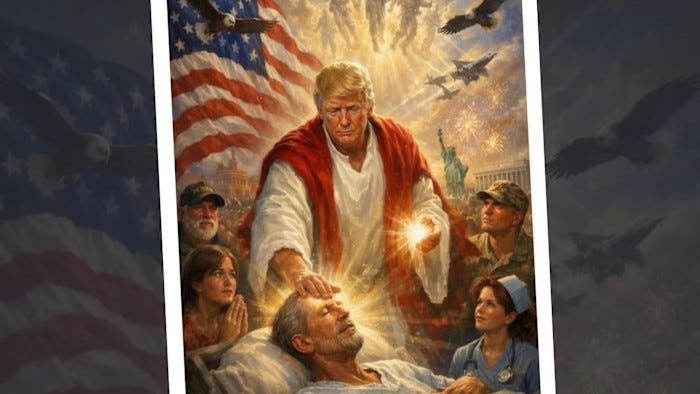
The image of Trump as a healer with divine light in his hands, deleted by late Monday morning with the explanation that he thought it was a doctor is the conclusion of fifty years of public life in which religious language has been deployed to sanctify whatever served the moment, whether that was denying housing to Black families, bragging about sexual entitlement, stoking fear of immigrants, equivocating about white supremacy, inciting a crowd toward the Capitol, or attacking a pope for preaching peace during a war.
Jesus reserved some of his sharpest language in the Gospels for precisely this kind of religiosity, calling it whitewashed and hollow. The Pharisees he condemned were not atheists… They were people who had mastered the appearance of righteousness while using religion to protect their own status and power.
The people who are genuinely harmed by the confusion between this conduct and Christian witness are not primarily the critics writing about it. They’re believers whose faith is made to look like a loyalty-oath to a political movement, the young people leaving churches that seem more interested in power than in the Beatitudes, and the communities around the world watching American Christianity be used to justify war, exclusion, and contempt.
And so we return to where we started. A man who has spent fifty years using religion as a stage prop was asked on Monday morning why he posted an image of himself with divine light coming from his hands, healing the sick while eagles circled overhead and the nation looked on in shock.
His answer was that he thought it was a doctor.
That answer, offered without embarrassment or apparent awareness of what it revealed, is the most honest thing he has said about his relationship to Christianity in fifty years. He has always seen the imagery of faith the way a doctor sees a white coat, as a symbol of authority, a signal of trustworthiness, a costume that makes people more willing to believe what you tell them. He has never appeared to notice the difference between wearing the image and embodying what it means.
The Gospel asks for the thing underneath the robe. By their fruits you will know them. Not by their affiliations, not by their photo ops, or by the images they post and delete when the reaction turns.
The fruits have been on display for fifty years.
At what point did the contradiction between Trump’s public conduct and Christian teaching become impossible for you to ignore? And what do you think it will take for the broader conversation to move beyond defending or dismissing it, toward actually reckoning with what it has done to faith in this country?
If this gave words to something you have been trying to explain, share it with someone who is still treating the image as a one-time mistake rather than what fifty years of public conduct actually suggests it is.
Independent journalism depends on readers who care and value it. If you want to support our newsletter, subscribing is the most direct way to support our publication.
An aside: I'm consistently impressed with the tone and depth of this daily newsletter. That the author(s?) can whip up a well-researched report--this one could practically pass as a sermon--on yesterday's absurdities, day after day, is quite the journalistic feat. Kudos to whomever you are!
I considered his weak explanation and call BS. Doctors do not wear broad sleeved robes. Even if the figure in the image were a doctor it would be depicting the doctor as divine- the robes, light emitting from hand, etc.
The images surrounding him are clearly evocative of a Christian nationalist version of the messiah. Hitler was depicted similarly as a Wagnerian knight.
I would believe he was wearing a Ku Klux Klan robe- the saviors of the white Christian nationalists and their "culture." But a doctor? No.