


📌 NOTE FOR NEW READERS: The 50501 Movement organizes peaceful action across all 50 states to defend democracy. This publication is nearly 100k readers strong and growing. If this resonates with you, hit subscribe.
Many of us are tired. It’s a predictable consequence of more than a year of sustained civic engagement in a country where the ground has feeling unstable. This post is about why the exhaustion is happening, why it doesn’t disqualify you from what’s to come, and why the research says collective action may actually be what refuels you.
You might feel tired. Researchers call it activist burnout, the emotional and physical fatigue that comes from sustained engagement with problems that feel bigger than any one person can solve. Psychologist Paul Gorski’s research at George Mason University found that it often starts with something admirable, a deep personal sense of responsibility for the outcome. The people most likely to burn out are the ones who care the most. That’s going to be people reading this, involved with this movement.
If you’ve been paying attention since February 2025, you have lived through more than a year of sustained civic emergency.
Executive orders, courts defied, wars launched without congressional authorization. And through all of it, you’re still here reading.
You make posts, called, marched, forwarded articles to people who were not ready to hear it, and then did it again and again. That’s more than many generations are asked to sustain.
So if you are reading this and feeling worn thin, here is what needs to be said, you’re not failing the movement. You’re experiencing the completely predictable cost of giving a damn for this long.
The cure for movement fatigue is the movement itself.
There is a concept in social psychology called collective effervescence.
Sociologist Émile Durkheim coined the term more than a century ago to describe what happens when large groups of people gather with shared purpose: People who arrived tired leave feeling recharged because they remembered they’re not carrying this weight alone.
A 2022 meta-analysis published in Frontiers in Psychology examined decades of research on collective gatherings, from religious pilgrimages to political demonstrations. The findings were consistent across studies and cultures that participation in collective gatherings was associated with increased wellbeing, greater feelings of personal and collective efficacy, stronger sense of purpose, and a measurable boost in what researchers call “vital energy.”
Demonstrations specifically showed some of the strongest effects.
Participants in protest gatherings reported stronger group identity, heightened collective self-esteem, and increased belief that their actions could make a difference.
And these weren’t just emotional highs that faded by the next morning… Longitudinal studies showed the effects persisted.
Research says that showing up to a collective action gives you energy back.
Social psychologist Serge Moscovici, who built on Durkheim’s framework decades later, stated that individuals in isolation lack vital energy, and that people replenish themselves when they come together in shared feeling, thought, and action.
Recent empirical evidence has backed him up saying social isolation is now linked to poorer health outcomes and lower wellbeing across multiple large-scale studies.
A lot of the civic engagement we have done has happened alone. Alone on a phone, alone at a screen, alone reading the news at 6 AM and feeling the weight of it settle into the day. We have been resisting in isolation, and then wondering why we feel depleted. This is why you need to use No Kings to plug into your local groups in your community and find community group-chats so that you can uplift and motivate your community, even just with your presence.
Saturday, over 3,000 events are planned across all 50 states, Washington D.C., and a dozen countries. That is up from 2,700 events in October and 2,100 in June. Nearly 7 million people showed up last time.
We have been taught that if we’re not fired up, we’re not doing it right. That exhaustion means we need to pull back, retreat, protect what’s left.
And sometimes that is true. But research suggests the kind of fatigue that comes from isolation is made worse by more isolation. The solution is community reconnection.
Showing up tired is not a lesser version of showing up. It might be the more important version because underneath the fatigue, the thing that makes you subscribe to this newsletter and read it and restack or share it to a friend is still there. The part that chooses to keep fighting for our country.
March 28. Over 3,000 events. Find yours at nokings.org.
This current era we are living through will one day have a name in history. What do you think the name of this era will be called?
Gorski, P.C. (2019) | “Fighting racism, battling burnout: causes of activist burnout in US racial justice activists,” Ethnic and Racial Studies; summarized in Psychology Today
Pizarro et al. (2022) | “Emotional processes, collective behavior, and social movements: A meta-analytic review of collective effervescence outcomes during collective gatherings and demonstrations,” Frontiers in Psychology
NoKings.org | No Kings event finder
Communities are buildling | What 50501 Communities Are Building for March 28
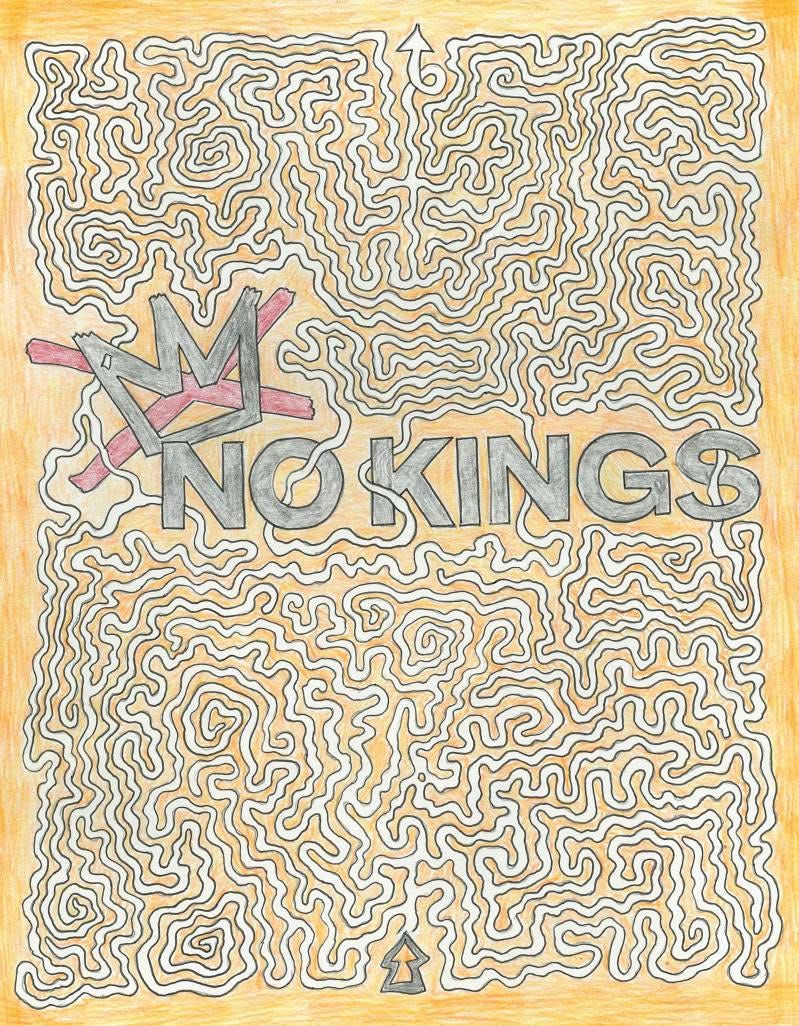
Feel free to print, fill out the maze, and/or share! Credit to Analogmazes on IG!
Excellent article.
I've made two free 'Faux-King Fascists' pdf posters for NO KINGS protests in US and UK using some free images. Please share the files with anyone who would like them.
substack.com/home/post/… to download.
Wonderful article!!