


📌 NOTE FOR NEW READERS:
The 50501 Movement organizes peaceful action across all 50 states to defend democracy. Our publication is thousands of subscribers strong and growing. If this resonates with you, hit subscribe! This post is guidance, not legal advice. Laws may vary by city and state.
TL;DR
Protest organizing is for anyone confident enough to start. You write one clear demand, choose one simple action you can repeat, recruit a small team so you don’t burn out, grow it over time, and build safety and clarity into the plan so your community supports you and show up again. If we get thousands of people nationwide doing this consistently, imagine the difference we could make.
Something to know about organizers
There is a myth that organizers are fearless extroverts with megaphones, the kind of people who never doubt themselves and always know what to say.
In reality, most organizers start as someone who keeps noticing the same thing happening in their community: people are worried, concerned, and overwhelmed.
Organizing is what replaces worry with structure and hope.
And if you’re reading this thinking, “someone should do something here,” … you don’t need to be perfect to start, you need to be clear enough to get support, prepared enough to be safe, and consistent enough so that your community will know how to help.
Step 1: Write one sentence
Before you make a flyer or post anything, write something like this:
“We are gathering at [place] on [date/time] to [visible action] to demand [specific outcome].”
This sentence protects you from trying to hold an event “about everything,” and it makes your message repeatable, which helps because we’ve all been overwhelmed from this administration.
If you’re stuck on the “outcome,” ask: what do we want to be different the day after this action?
A meeting scheduled? A public statement? A vote? A commitment? A demand delivered? A volunteer list built? This will help you to have a clear vision.
Step 2: Choose a simple action
New organizers often assume bigger and more complicated means more effective. But what builds community power is repeatability.
Your first action should be something you can run cleanly and run again: a rally in a public space, a vigil, a courthouse/city hall visibility action, a coordinated office visit, or a teach-in that ends with signups.
If you want the organizing logic behind this, Beautiful Trouble explains the difference between strategy (your plan) and tactics (your actions), and why movements win when tactics support strategy instead of feelings.
Step 3: Build your “Core 3” (because burnout will absolutely catch up to you if you don’t have help)
The fastest way to fail is to become the entire organization. The fastest way to succeed is to build a team with clear roles.
You can run a solid first action with three people:
Coordinator (time & decisions)
Logistics lead (site, supplies, accessibility, plan)
People and safety lead (volunteers, marshals, de-escalation)
If you don’t have these three, that’s the first task because movements aren’t held together by hype, they’re held together by people and structure.
Here’s a recruiting message you can use that works, it’s specific:
“I’m organizing one peaceful action. I need 2–3 steady people to help with logistics and volunteer coordination. You don’t need experience, just reliability.”
Step 4: Assign roles
Most people want to help. They just don’t know what “help” means.
So don’t ask “can you help?” Ask things like:
“Can you run the signup QR?”
“Can you be the water person?”
“Can you take photos and send them after?”
“Can you greet newcomers and direct them?”
This is how you build people up: you give people a clear role they can finish, you thank them because it is important and valuable work, and you invite them to do it again.
Step 5: Safety planning
A safety plan is how you tell your community: we thought about you.
At minimum, answer these out loud in your planning:
Where do people gather and regroup?
Who are marshals and how are they identified?
What happens if someone tries to provoke conflict?
Where is water/first aid?
How do people leave safely?
If you want a plug-and-play resource, Streetwise & Steady is a practical workbook for protest marshals and peacekeepers, with de-escalation and coordination tools that keep actions calm without turning marshals into “enforcers.”
Step 6: Know permits without spiraling
Yes, you have protest rights.
And yes, local governments can enforce “time, place, and manner” rules especially if you’re blocking traffic, using amplified sound, or occupying certain spaces.
Maximize participation, minimize risk. That usually means choosing a format where compliance is simple and nobody feels like they’re walking into an unsafe environment.
A necessary upgrade: legal observers
If you want your action safer and better documented, request trained legal observers. The National Lawyers Guild Legal Observer program trains volunteers to monitor, observe, and document interactions at protests.
Your starter plan
If you want to become an organizer this week, do this:
Write your one-sentence action statement.
Recruit your Core 3.
Choose one simple action you can repeat.
Assign volunteer roles (concrete tasks).
Make a basic safety plan.
Run it. Document it. Follow up within 48 hours.
Sources
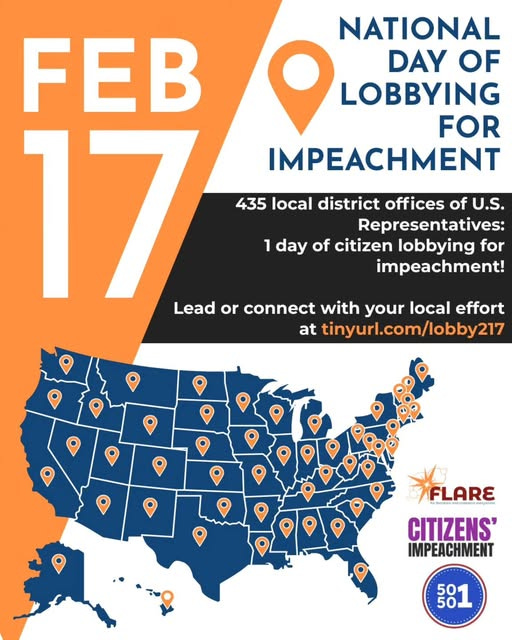
Coming Up: February 17th, National Day of Lobbying for the impeachment, conviction, and removal of Donald Trump and his regime.
We’re joining and supporting FLARE and Citizens Impeachment in organizing in all 435 congressional districts to show up at local Representatives’ offices and demand impeachment, conviction, and removal of Donald Trump and his administration. Reps will be in-district, and FLARE USA & Citizens’ Impeachment & 50501 will be providing a lobbying toolkit and follow-up guidance. (More to come!)
Sign up to organize here: tinyurl.com/lobby217.
Have more tips for new organizers starting out that we didn’t cover? Let us know in the comments:
Great idea on a lobby day for impeachment! We need a steady drumbeat for impeachment as the regime doubles down on brutality in the streets and their numbers continue to tank.
My husband and I are continuing the work to Paperclip the Nation. www.thepaperclipresistance.com
This has become a nationwide and international movement in great part to 50501 and Indivisible's supportive campaign to wear a paperclip. We receive messages from around the world that groups are spreading the message for everyone to wear a paperclip as a sign of resistance to tyranny and more importantly a powerful symbol of unity and solidarity. Wearing the humble paperclip let's everyone know where you stand, who you are and who you can trust. Symbols act as a universal shorthand that transcends barriers, speeds our comprehension and fosters a shared understanding. Wear a Paperclip!!