


📌 NOTE FOR NEW READERS: The 50501 Movement organizes peaceful action across all 50 states to defend democracy. This publication is nearly 100k readers strong and growing. If this resonates with you, hit subscribe.
SUMMARY
DHS funding lapsed at midnight Friday (12:01 a.m. ET Saturday), triggering a partial shutdown after Congress failed to reach agreement on immigration enforcement reforms. Democrats are demanding changes following fatal shootings of multiple U.S. citizens by federal officers in Minneapolis last month. About 90% of DHS employees are expected to continue working during the lapse, with pay delayed until funding is restored, while reporting suggests ICE and CBP may be less immediately disrupted because they can draw on prior funding. This is a test of if Congress can still use appropriations authority to impose oversight on federal enforcement agencies.
At 12:01 a.m. ET Saturday, February 15, the Department of Homeland Security’s funding formally lapsed. Many employees were required to keep working as pay was delayed. According to agency planning documents, about 90% of the department’s employees will continue working during the lapse.
This shutdown is testing if Congress can still use appropriations to shape executive enforcement power.
How Congress Controls Agencies Through Appropriations
Article I, Section 9 of the U.S. Constitution states that “No Money shall be drawn from the Treasury, but in Consequence of Appropriations made by Law.” This gives Congress the “power of the purse” one of its most effective tools to constrain executive agencies.
Congress failed to pass a full-year funding bill for DHS by the Friday midnight deadline. Earlier this month, lawmakers funded the rest of the federal government through September, but extended DHS funding for only two weeks to allow time for negotiations.
The sticking point: Democratic demands for immigration enforcement reforms following fatal shootings involving federal officers in Minneapolis.
Democrats have demanded a package of changes, including:
Requiring immigration officers to wear body cameras
Prohibiting agents from wearing masks to conceal identities
Requiring agents to display visible identification numbers
Mandating judicial warrants for arrests on private property
Tightening use-of-force policies
Republicans have resisted most reforms. On Thursday, Democrats blocked Republican attempts to pass either full-year funding without reforms or a two-week extension. Congress left town Thursday for recess until February 23 without resolving the impasse.
What This Shutdown Is Telling Us
Under the Antideficiency Act, federal agencies cannot spend funds without appropriation. But certain functions continue:
Excepted functions: Activities necessary for safety of life or property (TSA screening, Coast Guard operations)
Funded functions: Programs with existing multi-year appropriations
TSA agents keep screening passengers.
Coast Guard operations continue.
FEMA responds to emergencies.
But many employees work with pay delayed until Congress passes new funding.
The exception:
Immigration and Customs Enforcement and Customs and Border Protection may be less immediately disrupted. Both agencies can draw on substantial funding from last year’s major appropriations bill, enabling them to continue enforcement operations during the lapse.
The Tension: Congress is using appropriations to pressure enforcement reforms, but the enforcement agencies themselves have resources to sustain operations during the impasse.
Historical Precedent: Budget Fights As Leverage
2018-2019 Government Shutdown (35 days): A major shutdown centered on border wall appropriations saw DHS employees, including TSA agents, working without pay for five weeks. The shutdown ended when the government reopened under a temporary funding measure while negotiations continued, demonstrating that public pressure over essential services eventually forces resolution.
What’s different now:
The 2026 shutdown is specifically about enforcement oversight and use-of-force standards. Democrats are using appropriations to legislatively impose constraints on how enforcement operates including identification requirements and warrant standards.
As Senate Minority Leader Chuck Schumer stated: “Our caucus is passionate about this. If you sat in on our caucus meetings, you’d see how strongly people feel.”
This represents Congress using its most fundamental constitutional power to reassert oversight authority over agencies that have expanded enforcement discretion.
What This Tells Us, Structurally
The impasse reveals three structural dynamics:
1. Separate funding streams can insulate agencies.
When enforcement agencies receive substantial appropriations independent of annual DHS funding, they can sustain operations during shutdowns affecting the rest of the department.
2. The filibuster requirement means neither side can force resolution.
Funding bills require 60 votes in the Senate. Republicans control Congress, but Democrats can block funding indefinitely unless Republicans negotiate reforms.
3. Political pressure determines outcomes.
Shutdowns disrupt essential services, creating pressure on both sides. Historically, this pressure has forced resolution within weeks.
What Happens Next
Timeline:
Congress is not scheduled to return until February 23, one day before President Trump is scheduled to deliver the State of the Union address. Leadership could call members back sooner if negotiations progress.
What to watch for:
Potential movement on body cameras: Some Republicans have indicated openness to body camera requirements, which could become a compromise point.
White House positioning: President Trump said Thursday that some of the Democrats’ demands are “very, very hard to approve,” though negotiations continue.
Executive workarounds: Watch whether DHS reallocates funds to sustain operations more broadly testing how far agencies can work around appropriations constraints.
The structural question:
Shutdowns historically resolve once political pressure outweighs negotiating leverage. Whether Congress can extract oversight reforms in exchange for funding, or whether well-funded enforcement agencies can outlast legislative pressure, will determine if appropriations remain an effective accountability tool.
What You Can Do
Congressional offices track constituent contact on active legislation.
If you want to influence how your representatives vote on DHS funding, here are the most effective steps:
1. Identify where your senators stand
Find your senators here.
Check whether they’ve made public statements on the shutdown or enforcement reforms. Local news coverage often reports their positions before national outlets.
2. Call their district offices
DC offices receive thousands of calls daily. District offices (in your state) have more capacity to log constituent positions. A 30-second call stating your position gets recorded in daily tallies that staffers brief to the senator.
Example script:
“I’m calling about the DHS shutdown. I support ‘reforms/full funding without conditions’. I want to know how Senator ‘name’ plans to vote when they return February 23rd.”
3. Attend town halls or local events
When Congress is in recess (like now), members often hold constituent meetings. Questions asked in public forums get more attention than private calls. Check your representative’s website for scheduled events.
4. Track the February 23rd vote
Congress.gov publishes bill text and vote records. When members return, watch for:
Whether leadership calls an early session
What compromise language emerges
How your representatives vote
Congressional offices know when constituents are paying attention to specific votes.
5. Understand what’s negotiable
Some reforms (body cameras, visible ID) appear to have bipartisan support. Others (mask bans, warrant requirements) face Republican resistance. Focusing constituent pressure on the reforms most likely to pass increases effectiveness.
These actions help because appropriations bills require 60 Senate votes. That means both parties need persuadable members to break the impasse. Your senators’ positions is important especially if they’re not in leadership.
Sources
Anneken Tappe, “The Department of Homeland Security has been ensnared by a partial government shutdown,” CNN, Feb. 12, 2026.
Deepa Shivaram, “5 things to know about the shutdown at the Department of Homeland Security,” NPR, Feb. 14, 2026.
Camilo Montoya-Galvez and Kathryn Watson, “DHS shutdown begins as funding expires without a deal in Congress,” CBS News, Feb. 14, 2026.
Sahil Kapur, Scott Wong, Julie Tsirkin, and Frank Thorp V, “Homeland Security Department shuts down as Democrats and Trump negotiate changes,” NBC News, Feb. 14, 2026.
Leigh Ann Caldwell, “Much of DHS runs out of money after ICE negotiations falter,” The Washington Post, Feb. 14, 2026.
“US Department of Homeland Security to go into shutdown due to funding lapse,” Al Jazeera, Feb. 13, 2026.
What actually ended the 2018-2019 shutdown? Did either side 'win'?

Share in our Subscriber chat your last or upcoming protest sign! Join our community :)
COMING UP:
February 17: National Day of Lobbying.
Show up in your representatives’ district offices and demand impeachment, conviction, and removal. In-district pressure matters more than phone calls to D.C. offices. Visit here for more: citizensimpeachment.com/feb17

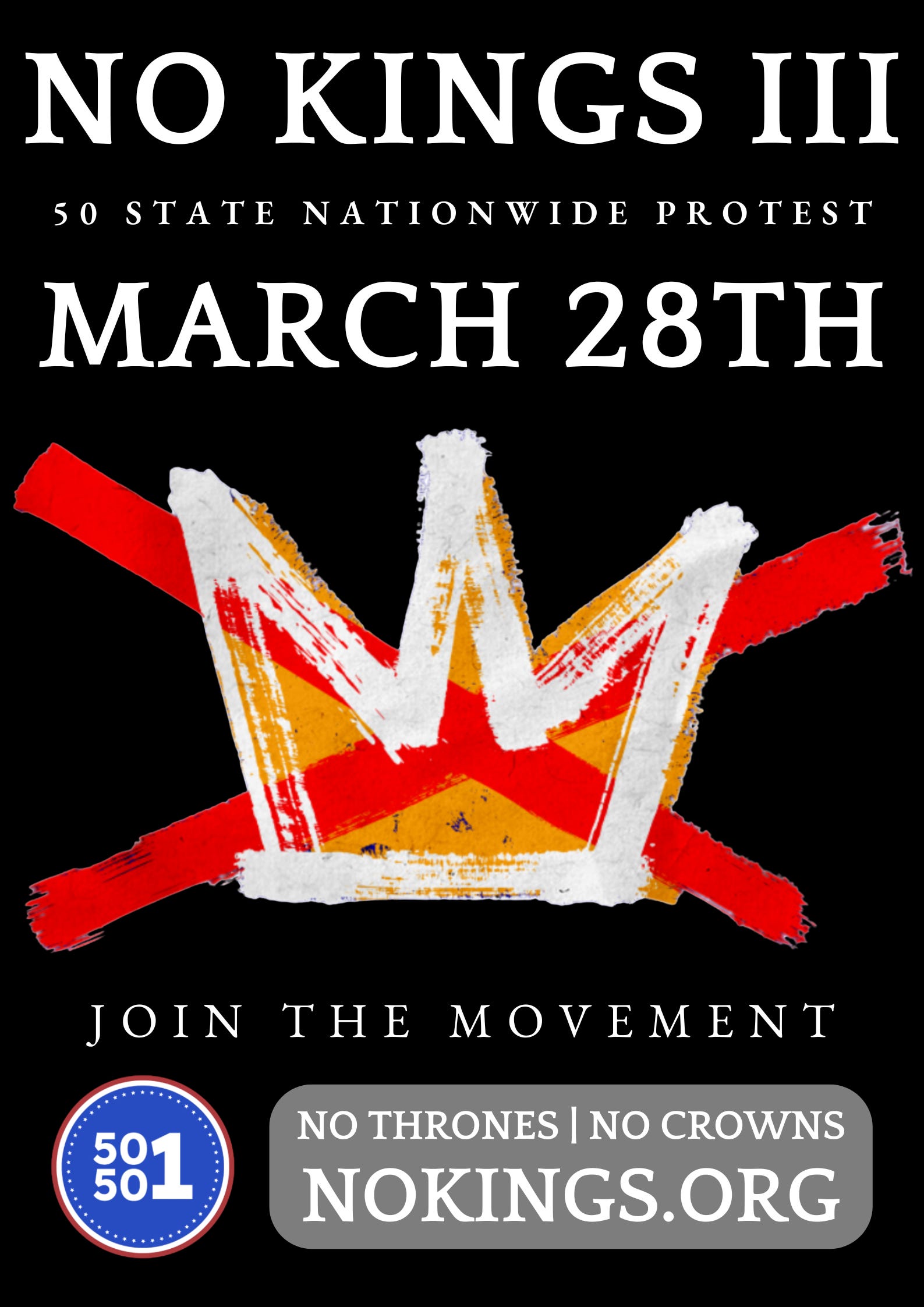
March 28: The next NO KINGS mass mobilization.
If you missed the announcement, read it here: ANNOUNCEMENT: The Next NO KINGS Mobilization. If you’re a beginner organizing locally, use this guide: How to Organize a Protest.
The question, did you understand how congressional appropriations control agencies, I answered I didn't know about. In fact, you had mentioned something like it in a former article, but now I fully do understand. Not your fault, what I know about politics would fit on a pinhead, with enough space for a parade to dance on it.
The key to defeating Trump? Mass non-cooperation | Mark Engler and Paul Engler
The following are excerpts from this article.
“The extraordinary level of grassroots solidarity and creative resistance in anti-ICE protests in Minnesota has given people a new appreciation for the power that mass non-cooperation can have in resisting the Trump administration’s drive toward authoritarianism. And it has created an awareness of why such action is clearly needed.”
Early in Trump’s second term, an array of mainstream critics expressed skepticism about the value of continued protests in the streets. They invested their faith in institutions such as Congress and the courts. But as these institutions – along with law firms, universities and the business community – have each caved in to the administration’s demands and proven themselves unwilling to catalyze an ardent defense of democracy, it has been left to the people themselves to do this essential work.
Mainstream political thinking in the US sees power as “monolithic,” resting in the hands of senators, generals, billionaires, presidents and CEOs. From that vantage point, the options for opposing a rogue administration seem desperately thin: wait for elections, file a lawsuit, hope for some unforeseen maneuver by elites. This worldview breeds despair. One prominent Democratic party consultant even advised that the best course for progressives is simply to “roll over and play dead”.
Those immersed in social movements look at the process of change in a different way than political insiders do. Instead of subscribing to the monolithic view of power, they hold a social view of power, which understands that those in positions of authority are dependent upon the cooperation and support of the governed.
Now, as then, the list of methods is best seen as an invitation to creativity, reminding organizers they have many tools in their collective toolbox – each with distinctive properties and powers. The potential of civil resistance is not just in holding large demonstrations. It is in drawing from a vast array of strikes, boycotts, noncooperation tactics and artistic protest. And it is in coming up with innovative forms of creative resistance that may never have been seen before.
https://www.theguardian.com/commentisfree/2026/feb/15/defeat-trump-mass-non-cooperation
Successful Social Movements
In this transcript Professor Chenoweth discusses the four elements necessary for a successful social movement. Below are excerpts from the transcript.
“The third thing that successful movements do is they innovate new tactics. This is very important because movements that tend to over-rely on a single technique like protests, like demonstrating every Friday, something that becomes very routinized, end up succumbing much more quickly first of all to protester fatigue, but the second thing is they often subject their participants to a higher risk of repression or communal violence from opponents. So movements that are capable of having the capacity to shift to methods of dispersion, like stay-at-homes or strikes or forms of economic noncooperation, tend to be much more effective because they have the capability of maneuver when the state begins to ramp up violence against them.”
The following takes the mass non-cooperation proposal a step further and would avoid the bloodshed we’ve already seen, and will see in the future with street demonstrations
The Peaceful Solution-Part 1
How much do you want to stop His Royal Heinous and the fascist takeover of the country?
Enough that you’re willing to make a small sacrifice? Like altering your spending habits for a month or two or three? That could be all it would take to get the attention of the oligarchs (formerly known as The Robber Barons in the first Gilded Age, also The Fat Cats, The Greedy Bastards).
A brief demonstration of We, the People’s, power of the purse could persuade them to quit supporting HRH and the politicians who enable him.
We quit spending, except on essentials, businesses lose money, stock market goes down, Greedy Bastards pay attention to our demands.
Greedy Bastards own most of the politicians of both major parties. GBs start losing money, tell politicians to change course and do what We, the People want.
We are running out of peaceful options. The legislature and Supreme Court are controlled by HRH. He controls the executive branch, including the Military, Justice Department, FBI, ICE, the IRS. He controls all levers of power.
We, the people, still have the power of the purse. No one can control our spending, or lack of spending. When all else fails we can go on a spending strike until the business community stops supporting HRH and the politicians who enable him.
Economic warfare is the only thing the oligarchs, the business community will understand and act on. Call it a Surreptitious General Strike (Quiet Quitting). Go to work, do as little as possible. Stop spending money except on essentials. Quit feeding the corporate beast that supports the HRH.
Stop participating. Nearly 70% of the U.S. economy is driven by consumer spending. All of us. Hobble the economy and the stock market. Mahatma Gandhi drove the British from India by peaceful civil disobedience and economic disruption. We can stop the fascist takeover in the same way.
We can keep rehashing past and present atrocities until our access to the internet is taken away by the regime, or we can DO something!
Now is the time for this Peaceful Solution.