


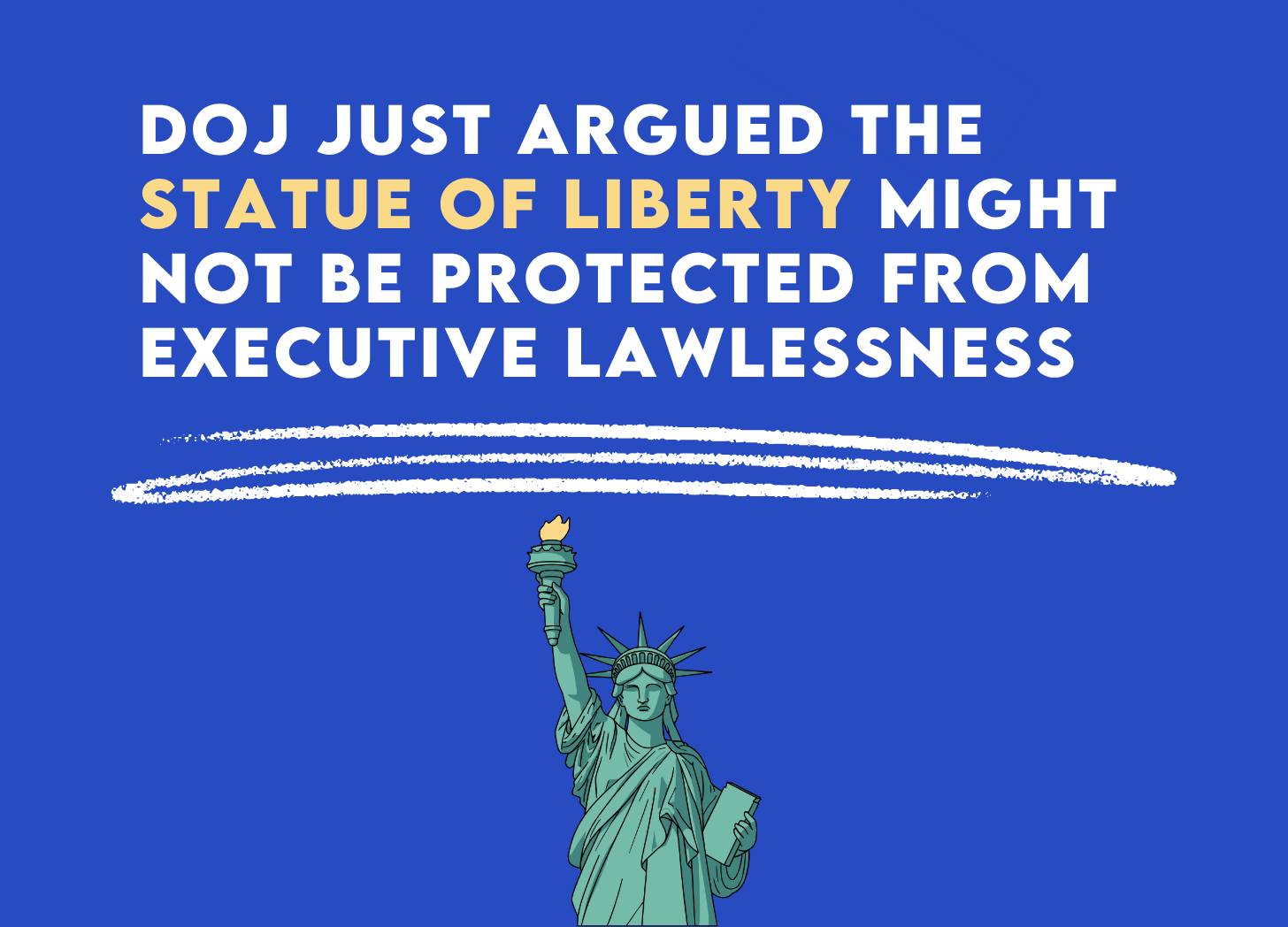
During arguments over Trump’s $400 million White House ballroom project, a federal appeals judge pressed the Department of Justice on how far its legal theory really goes.
The administration is arguing that courts can’t stop construction of the ballroom, even though the East Wing has already been demolished and the project is being challenged for moving forward without congressional approval.
DOJ attorney Yaakov Roth told the D.C. Circuit that the courts have “no role” in weighing the project and that it would have been improper to block it at any point.

According to the Associated Press, Judge Patricia Millett raised a hypothetical:
What if the government bulldozed the Statue of Liberty?
What if it bulldozed the White House itself?
Would descendants of immigrants who came through Ellis Island, or descendants of enslaved people who built the White House, have legal standing to challenge that destruction after the fact?
Roth agreed that, under the government’s theory, they would not.
The story is that the Department of Justice defended a legal theory so sweeping that, when a judge asked whether the government could bulldoze the Statue of Liberty and leave people without a court remedy after the fact, the government did not clearly say, “Of course the courts could stop that.”
The Statue of Liberty Hypothetical
Some people will try to dismiss this as just a hypothetical, but hypotheticals are how courts test legal arguments.
Judges ask extreme questions because extreme questions reveal whether a legal theory has limits.
This one revealed something very important: the DOJ’s position appears to have very few meaningful limits once the executive branch has already acted.
This Case Is About Power
The administration wants to continue building a 90,000-square-foot ballroom where the White House East Wing used to stand.

The National Trust for Historic Preservation sued after the East Wing was demolished, arguing that the administration moved forward without congressional authorization.
A lower court blocked above-ground construction while allowing underground bunker and security-related work to continue, which matters because the government keeps invoking national security as a reason courts should stay out.
Nobody is arguing that the White House should be left unsecured.
It’s really if “security” can be used as a blanket excuse to bypass Congress, demolish part of the White House complex, and then tell courts they are powerless to review what happened.
Reuters reported that Judge Millett asked the DOJ attorney whether “complete lawlessness by the government” could still be stopped by the courts under the administration’s theory. Roth answered, “On these theories, I think that’s right.”
That is the line that connects the ballroom to the Statue of Liberty.
If courts can’t stop “complete lawlessness” once the government has moved quickly enough, then the incentive for any future president is obvious: act first, make the harm irreversible, and argue later that no one has standing.
“Too Late” Can’t Be a Legal Strategy
If no one has standing, no court gets to decide whether the government broke the law. An unlawful act can become effectively untouchable because no one is allowed to challenge it.
That is why this argument is so dangerous…
If the government bulldozed the Statue of Liberty (or the White House), the injury would not just be aesthetic. It would be historical, cultural, national, and democratic. It would be a wound to the public’s shared inheritance. Yet DOJ’s theory, as tested by the court, suggested that even people with direct ancestral ties to Ellis Island might still be told they can’t sue after the fact.
The executive branch doesn’t own the White House.
It does not own the Statue of Liberty. It doesn’t own the country’s public history. These places belong to the American people, and the Constitution does not give one president a wrecking ball and a stopwatch.
The Department of Justice is supposed to defend the Constitution. In this case, it defended a theory of executive power that should make every American ask a very simple question: If the courts can’t stop the government from bulldozing the Statue of Liberty after the fact, what exactly is left of checks and balances?
Should courts be able to stop executive action when public landmarks or federal property are at risk, or should Congress be the only remedy after the damage has already begun?
Well I guess the French best come reclaim it - seeing as the Nation they gifted it to, isn’t interested in liberty’s mission anymore to “Give me your tired, your poor, / Your huddled masses yearning to breathe free".
Yeah, nah! America isn’t all about *that* nowadays.
1. DOJ Attorney Roth needs to be referred to the Bar Association re: Revoking his license to to practice law.
2. Both the Judicial and Legislative Branches of Government are meant to reign in the Executive Branch.
3.The Executive Branch is not a dictatorship.
The President and his cabinet (Looking at you Minion appointees) DO NOT HAVE ABSOLUTE POWER no matter what their DOJ says and/or thinks.
So, yes the Courts can stop it. So can the entire Legislative Branch. I would suggest removing Speaker Johnson first though.