


📌 NOTE FOR NEW READERS: This is an independent publication covering 50501, No Kings, and the broader pro-democracy and civic-action ecosystem. We cover the communities pushing back and the peaceful actions taking shape across the country. Read by thousands, subscribe to join our community. Thanks for reading!
Trainings, local relationship-building, targeted institutional pressure, and issue-based mobilizations that give a movement durability are taking place across the country this month. Some of the strongest organizing activities right now is May Day Strong’s national build-out, De-ICE Citizens Bank’s local action map, NDLON’s sustained community presence campaign, and a series of issue-specific national days of action in higher education, labor, climate, and LGBTQ+ rights.
We have the dates ready for you. Save this and add these to your calendar.
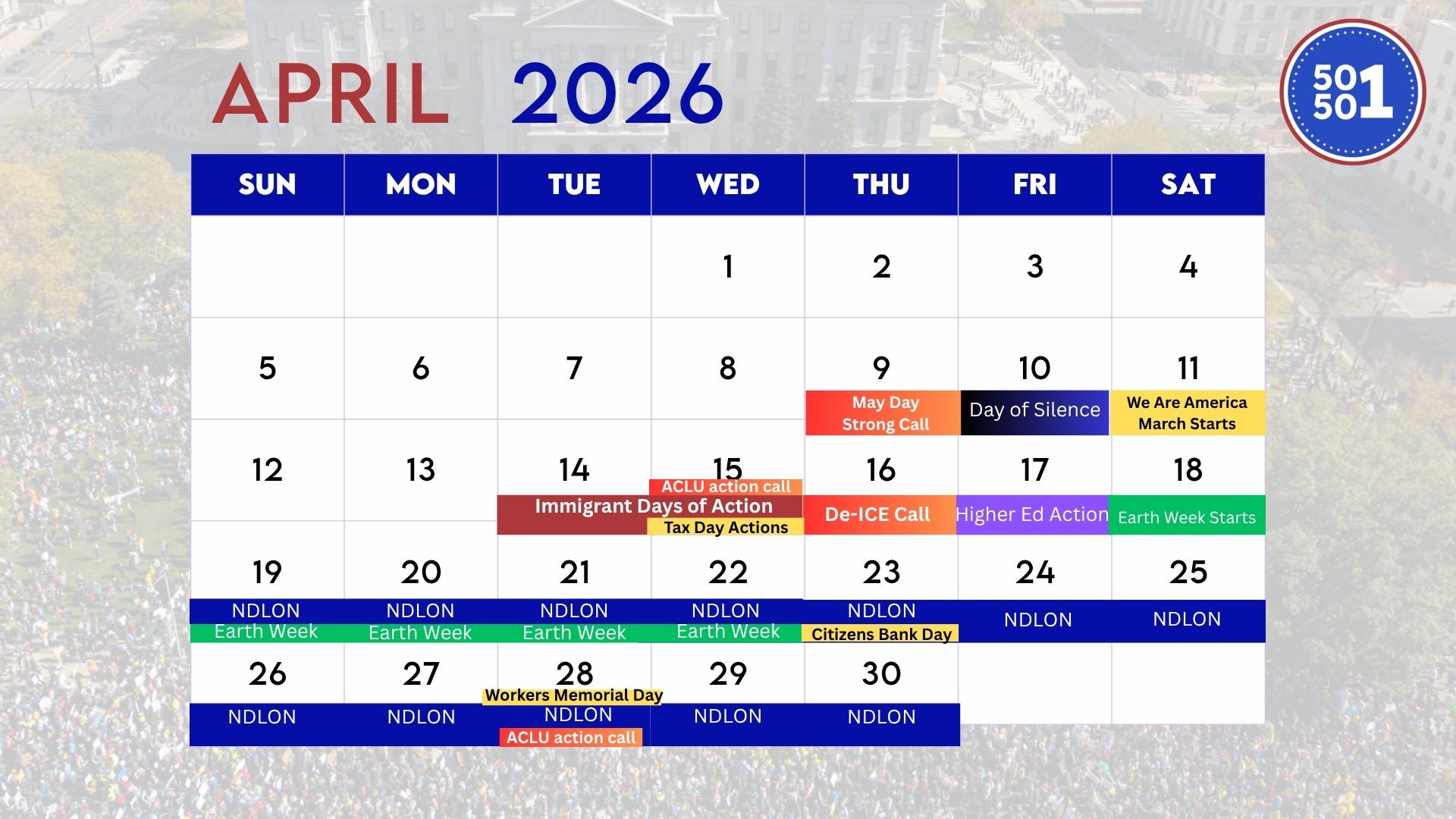
April 9 | May Day Strong National Organizing Call
May Day Strong is the primary coalition organizing May 1 under the banner “Workers Over Billionaires.” Its national call on April 9 at 7 PM ET is available for those who want to plug into May Day infrastructure and organizing before May 1. The coalition includes AFL-CIO, Indivisible, MoveOn, the Sunrise Movement, National Nurses United, UFCW Local 3000, and more than 200 other organizations. The call will cover confirmed participating cities, the “No Work, No School, No Shopping” framework, and how local groups can organize their own actions. Toolkits and a local event map are already live at maydaystrong.org.
April 10 | Day of Silence
Glisten (formerly GLSEN)’s Day of Silence marks its 30th year in 2026. Participants take a vow of silence to demonstrate the effect that anti-LGBTQ+ harassment and discrimination have on students’ ability to speak and be heard in school. For adults, participation options include workplace silence, social media amplification using the #dayofsilence hashtag, and fundraising through Glisten’s JustGiving platform. Toolkits, templates, and palm cards are available on the campaign site. The political context this year is direct. LGBTQ+ students are facing coordinated legislative attacks, visible solidarity from adults showing support has concrete value.
Through April 12 | “What’s Next” Local Organizing Meetings
Following March 28, No Kings and Indivisible is explicitly asking supporters to host or attend local organizing meetings through April 12. The plan is to convert March 28 turnout into durable local structure by identifying who showed up, building local contacts, establishing mutual aid and rapid-response capacity, and orienting people toward what comes next. If you hosted an event on March 28, this is the follow-through the movement is asking you to do.
April 11–25 | We Are America March
The We Are America March is a 160-mile march running from April 11 through April 25. Participation options include joining as a core marcher for the full distance, or joining for a single day or weekend segment. This is a multi-day action with incredible volunteers and messaging to connect community and defend democracy.
April 15 | ACLU: Organizing to Protect Democracy
The ACLU is hosting an April 15 organizing session framed as a practical skills and structure session for volunteers. For readers who are newer to organized civic engagement or looking for a structured national network with resources behind it, this is a more substantive entry point than many one-off protest listings.
April 16 | De-ICE Citizens Bank National Mobilization Call
The De-ICE Citizens Bank campaign is holding a national organizing call on April 16, 7–8 PM EDT for both existing participants and people looking to get involved ahead of Citizens Bank’s April 23 shareholder meeting. The campaign identifies Citizens Bank as a direct financial partner of CoreCivic and The GEO Group, two of the largest private operators of ICE detention facilities in the country. This is economic accountability enforced at a corporate governance moment.
April 17 | National Day of Action for Higher Education
The Coalition for Action in Higher Education is holding its third annual national day of action on April 17, organized around protests and teach-ins on campuses across the country. The 2024 action involved more than 100 campus events; 2025 involved more than 200. The coalition’s explicit goals are higher education that is freely accessible to the public and free of political interference, two conditions under active threat through federal funding freezes, administrative purges, and executive pressure on university leadership.
April 18–22 | Earth Week / Earth Day Actions
Earchday.org is running coordinated events from April 18 through Earth Day on April 22, with a public event finder and registration tools on its site. The current administration has moved aggressively to roll back environmental regulation, withdraw from international climate commitments, and open protected lands to extraction. Earth Week actions this year are taking place inside a broader democratic crisis.
April 20 | Indivisible Train-the-Trainer: Immigrants’ Rights
No Kings and Indivisible Train-the-Trainer session on April 20 at 8 PM EDT
The session is designed to equip participants to train others on core Know Your Rights topics on the right to remain silent, the right to refuse consent to searches, and the right to record ICE and other law enforcement officials. It’s being offered in partnership with the ACLU and Indivisible. This is not a rally or an awareness event. It’s skill transmission building capacity to protect neighbors. This event belongs in a category separate from protest mobilizations, and it matters more than its profile suggests.
April 23 | People’s Shareholder Meeting to De-ICE Citizens Bank
The De-ICE campaign is directing supporters to a Providence, Rhode Island action on April 23 timed to Citizens Bank’s annual shareholder meeting. Supporters who can’t travel to Providence can find coordinated local branch actions through the campaign’s event map. Shareholder meetings are among the few formal accountability moments in corporate governance. Demonstrating organized, public, visible opposition at that moment rather than in general, is the strategy behind this campaign.
April 28 | Workers Memorial Day
Workers Memorial Day, observed annually on April 28, is a day of remembrance and action organized by the AFL-CIO for workers killed or injured on the job. The AFL-CIO publishes toolkits and planning resources for local observances. In 2026, Workers Memorial Day arrives inside a moment when workplace safety protections are being actively dismantled at the federal level. It is a stronger late-April anchor than it typically receives credit for, and it connects labor organizing directly to the May Day moment that follows just four days later.
April 28 | ACLU People Power Action Call
The ACLU’s People Power network is hosting a national action call on April 28 at 8 PM ET / 5 PM PT. For readers who want a structured national entry point into ongoing civil liberties organizing, this is a well-resourced option.
Ongoing through April 30 | NDLON: Adopt a Day Labor Corner / Adopt a School
NDLON’s ongoing solidarity campaign asks people to establish a regular physical presence at hiring corners, Home Depots, car washes, delis, and day-labor centers where immigrant workers are most exposed to enforcement action. The campaign also supports schools serving immigrant students and families who may be vulnerable to raids, harassment, or intimidation. The explicit premise of the NDLON model is that sustained, visible community presence has a deterrent effect and that building it requires showing up repeatedly, not just once. Trainings, toolkits, and local event listings are available through their Mobilize profile.
April is being spent on local coordination, skills training, institutional targeting, and building capacity that determines how large and how effective May Day will be when it arrives.
We will be going deeper on several of these in the days ahead and how these actions can make a difference in our communities.
If you are joining in any of these actions, tell us in the comments. And if there are local actions in your area we have not listed let us know:
Sources
May Day Strong | maydaystrong.org
May Day Strong April 9 National Call | mobilize.us/mayday/event/929187/
Glisten Day of Silence | glisten.org/campaigns/dayofsilence/
No Kings “What’s Next” organizing | nokings.org
No Kings Trainings | nokings.org/trainings
We Are America March | actionnetwork.org/event_campaigns/we-are-america-march
ACLU Organizing to Protect Democracy, April 15 | act.aclu.org/a/april-action-call
De-ICE Citizens Bank | de-icecitizensbank.org
De-ICE April 16 National Call | mobilize.us/pittsburghwomenfordemocracy/event/924959/
Coalition for Action in Higher Education, 2026 | dayofactionforhighered.org/day-of-action-2026
Earth Day 2026 | earthday.org/earth-day-2026/
No Kings Train-the-Trainer: Immigrants’ Rights, April 20 mobilize.us/nokings/event/926205/
April 23 People’s Shareholder Meeting | mobilize.us/s/SWmzAi
Workers Memorial Day | AFL-CIO | aflcio.org/workers-memorial-day
ACLU People Power April 28 | act.aclu.org/a/april-action-call
NDLON Adopt a Day Labor Corner | ndlon.org/adopt-a-day-labor-corner/
Here is a small but worthy and very doable action most people can do.
You know how customer service phone people ask you,” is there anything else I can do?” Before they hang up?
I say yes. And ask them if they are registered to vote. If not, are they citizens? And if no and yes, I encourage them to register. Share the benefits etc.
Last night I was on recreation.gov. The young guy was a citizen from tx but who wasn’t a registered voter. So I encouraged him.
What if more of us did this? We can move outside our own social bubbles and I think have a big impact.
I also did this to encourage people to attend no Kings.
planning on the May Day planning session