


📌 NOTE FOR NEW READERS: This is an independent Substack covering 50501, No Kings, and the broader pro-democracy and civic-action ecosystem. Subscribe to never miss a post.

1. They’re not speed cameras
Flock’s plate readers don’t measure speed and can’t issue citations.
You can read about Speed Cameras and their laser technology to detect your speed by clicking here. Flock are not currently red-light cameras so nobody should be mailing you a $200 fine.
2. They read and track more than your plate
Flock tracks your plate, along with the make, model and color, plus the time and location of where you go.
Flock says that the plate readers don’t use facial recognition to identify drivers or passenger. Senator Ron Wyden’s office stated in its letter to the Flock company that agencies can search the database by more than just the plate number, they can search by make, model, and even bumper sticker(s).
3. There are more than 120,000 of them, in 49 states
Flock covers thousands of law-enforcement agencies, and Flock says that the cameras are in over 6,000 communities.
There are billions of vehicle scans stored each month. Alaska is the only state without them.
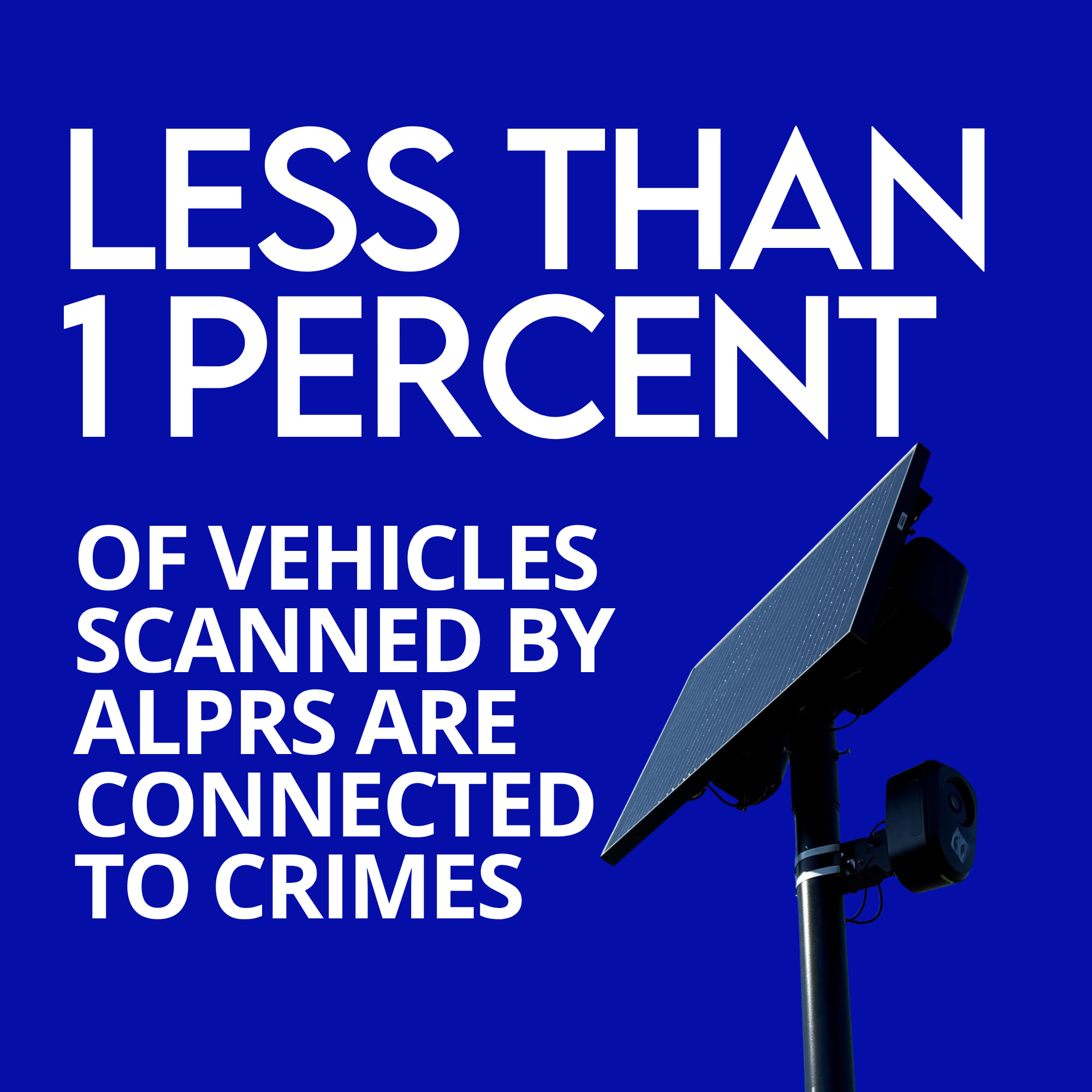
4. The ACLU says less than 1% of what they scan reaches a crime
ALPRs operate as population-scale collection systems rather than targeted surveillance tools. If fewer than 1% of scans are associated with crime or wrongdoing, more than 99% of the records involve vehicles with no identified connection to criminal activity.
5. Your city’s data can be searched by departments you’ve probably never even heard of
Flock’s National Lookup allows participating law-enforcement agencies to search data collected by participating agencies across jurisdictional lines.
Flock told Sen. Ron Wyden’s office in 2025 that 75% of its law-enforcement customers were enrolled in the National Lookup.
In 2026, CT Insider reviewed Flocks audit records from several Connecticut towns and found thousands of out-of-state searches tied to immigration enforcement, including searches labeled “ICE,” “ICE Assist,” and “immigration.”
6. The newly added 7 day rule doesn’t automatically apply to your city in all cases
CEO Garrett Langley, Flock’s CEO, announced on August 13 that the retention period drops from thirty days to seven but also wrote, “Existing customers will keep their current, democratically approved retention periods.”
So if your town has a current contract, then you keep whatever you have for now which could be 30 days or more until your city or town decides to change it.
7. Flock has an ICE hotlist
Agencies can subscribe their cameras to FBI hotlists organized by topic, and one of them is “Immigration Violator.”
EFF investigator Dave Maass published this article-(click here to read) after a records campaign that includes Stolen Vehicle, Missing Person, Gang or Suspected Terrorist... and Immigration Violator and according to the NCIC operator manual is populated exclusively by ICE.
8. Some Flock alerts trace to warrants ICE issued
The FBI’s Immigration Violator includes plates associated with administrative-warrants issued by ICE agents, not judges.
Created within the executive branch and don’t carry the same authority as a warrant signed by a judge. Participating Flock cameras can compare passing plates against the federal hotlist and alert your local law enforcement when there’s a match.
9. Flock searches have been used in connection with protests
The records have included searches connected to our major protests such as the February 2025 protests, the April Hands Off protests, and the June and October No Kings protests.
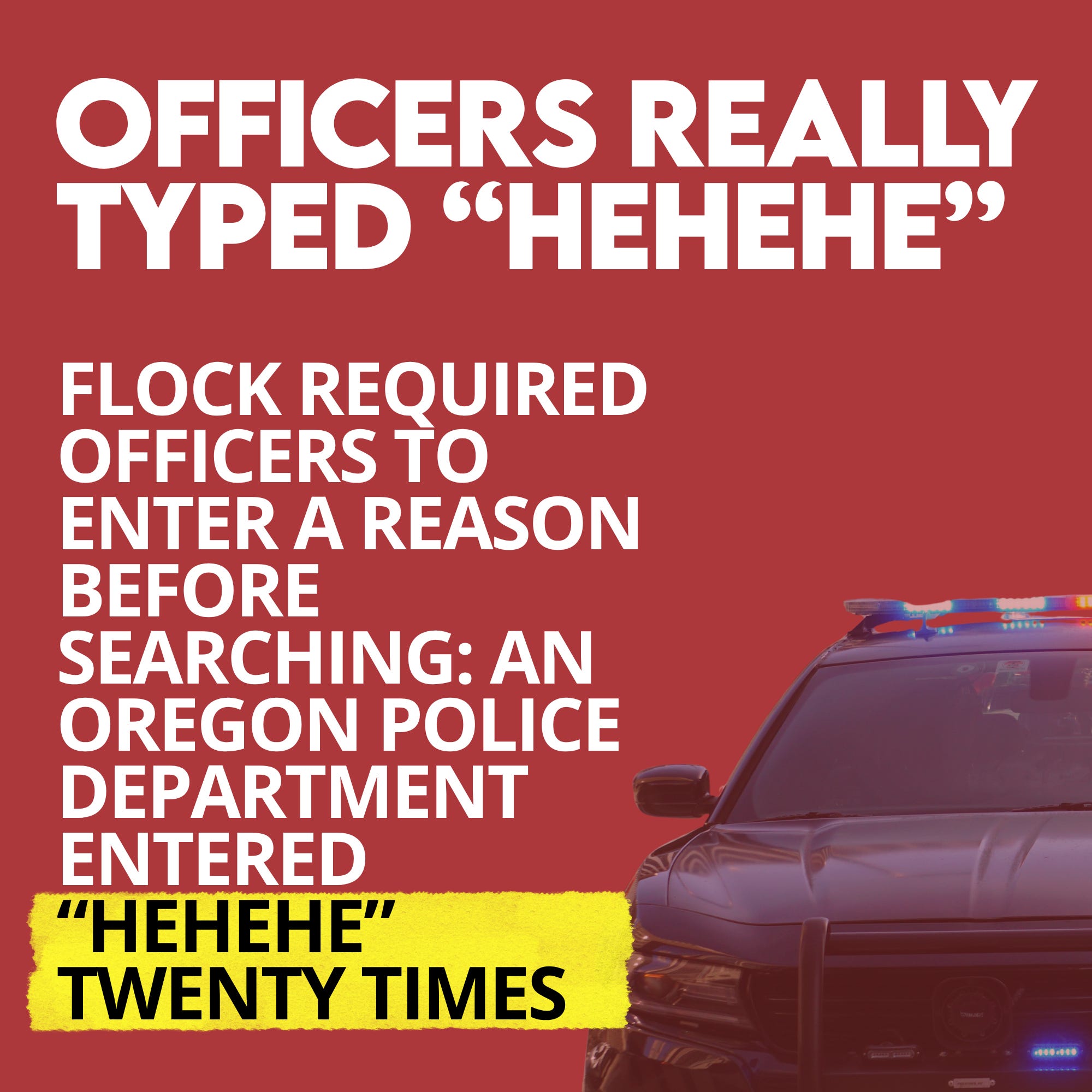
10. Officers have typed “hehehe” as their search reason
Flock required officers to enter a reason before searching
In September, officers at a Oregon police department entered “investigation” into a field 111 times and entered “hehehe” twenty times. The Register-Guard reported those were Medford PD searches of Eugene’s data.
Flock’s recently announced August 13, to require a case code instead of just text. MIT Technology Review pointed out last week that since Flock doesn’t verify case numbers against anything, officers can get around the new requirement roughly as easily as they got around the old one.
11. A police department in California found 71% of its felony alerts had the wrong plate
Roseville, California reviewed 1,427 Flock alerts for vehicles identified as stolen or connected to felony crimes, in 71% of the alerts, it misread license plates.
Flock said that Roseville’s results were because some cameras used old hardware and mounted higher and farther from traffic than recommended.
A bad alert can have serious consequences, one Roseville driver was falsely flagged at least six times because the system repeatedly read a 9 as an 8 on his plate. Police encountered the error often enough that a dispatch supervisor began to recognize his plate.
12. Cities can now block outside immigration searches
Flock’s new “offense filter” lets agencies restrict what other departments are allowed to search their Flock camera data for.
The Flock company says a city could continue allowing searches for stolen cars, missing people and violent crimes while still blocking immigration-enforcement searches.
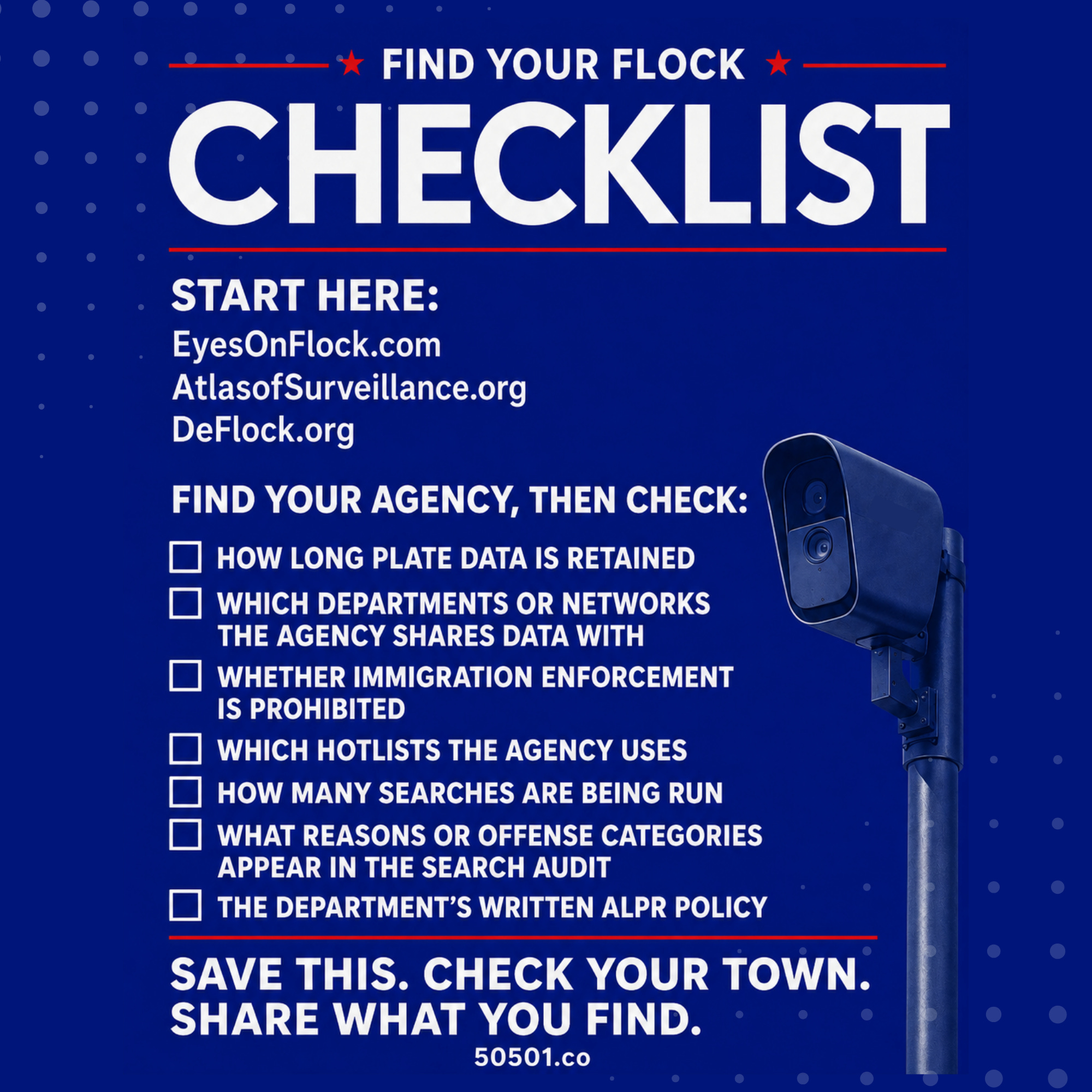
Find out if your local police department uses Flock
Search your city or agency in the Atlas of Surveillance, this will show you law-enforcement surveillance across the country. Next, check DeFlock, this is an open-source-crowdsourced map of ALPR Flock cameras.
Look for the department’s Flock Transparency Portal
Eyes on Flock indexes Flock transparency portals. Depending on if your local agency publicly publishes, the portals can show you the camera count, data-retention policies, sharing relationships/connections, search activity and permitted or prohibited use.
You can search your plate on “Have I Been Flocked”
Have I been Flocked is an independent database built from publicly obtained Flock logs and lets you search a plate to see if it appears in audit records.
If you want to view records that your department doesn’t publish publicly, you can file a public records request.
EFF published a specific template for requesting records about the NCIC Immigration Violator hotlist. You can send requests directly to your police department or use MuckRock to file and track requests. DeFlock also has a useful public-records guide with examples of ALPR requests
The ACLU’s Get the Flock Out Toolkit walks you through identifying ALPR, researching local programs and challenging or restricting them through the local government.
We need to get rid of those flock cameras.
Thank you for providing this information.
Thank you for this great information! Hovey Benjamin just did a great satirical piece on his IG page, "I Need Flock on My Block," https://www.instagram.com/p/Dbn6JtSBbGS/.